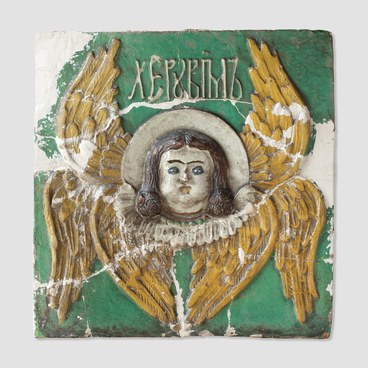
Legend has it that the worship of carved images in Christianity dates back to the miraculous sculpture of Christ made in Jerusalem by Nicodemus, a witness to the crucifixion. In Russia, carved images were often associated with pagan idols.
Repeated attempts by the authorities in the 18th century and the first half of the 19th century to ban the use of carved icons led to the reduction and eventual oblivion of the previously highly venerated reliefs. Many were destroyed, others were placed in storerooms, and only a few remained in churches. Some of the surviving monuments later ended up in museums.
The figure of Saint Menas was originally three-dimensional and was probably placed in a kiot. The legs were set straight and the arms, as they are today, were outstretched, with the entire figure forming a cross. During the renovation in the 19th century, the image was embedded in the board, the partially lost feet of the martyr were restored and turned to the side, the hand with a cross was carved anew.
The layer of paint on the sculpture was renewed several times. The original painting, hardly preserved, was painted with gold, silver, and colored lacquers. The details of the armor were decorated with a black pattern on gold, giving the garments an ornate appearance.
The martyr Menas of Phrygia (Kotyaion), or the Egyptian Wonderworker, was a warrior in the Roman army. He lived at the end of the 3rd century, at the time of the worst persecution of Christians. Because of the law which obliged all the inhabitants of the empire to make sacrifices and which threatened the death penalty for those who did not, the future saint left military service and retired to deserted places.
Some time later, Menas came to the celebration of the emperor’s birthday. In the theater, where the inhabitants of the city, led by the governor Pyrrhus, had gathered, Menas publicly confessed Christ. Not wanting to interrupt the celebrations, Pyrrhus ordered the saint to be imprisoned and the next day summoned Menas for interrogation.
For his refusal to sacrifice to idols, the emperor
ordered the executioners to stretch the former warrior on the ground and beat
him with oxen’s veins. Despite his suffering, Menas continued to confess Christ
and denounce paganism. His wounds were rubbed with woolen cloths and burned
with fire. The saint was beaten on the face and neck. Seeing Mena’s
steadfastness, the governor condemned him to death. Outside the city, he was
beheaded, and his body thrown into the fire. The Christians, however, managed
to rescue Menas’ remains and buried him.