Russian Empire civil official’s smallsword was not a military weapon, but an item of uniform.
Ceremonial weapons were worn by civil and court rank officials with parade uniform. It was not worn together with civil and everyday uniform or during the execution of duty. Retired officials also had the right to carry ceremonial weapon. Clerical and court officials, who did not hold state posts wore smallsword without sword knot — a cord or baldric on a cold arm’s hilt.
Smallsword was worn on a shoulder baldric sword belt. It was necessary to unbelt it during an act of icon worshiping, solemnization of marriage when entering the altar, and during balls and other festive events. Ceremonial smallswords were an indispensable part of the uniform worn by civil and court rank-officials until 1917.
In the 19th century, students of universities and other higher educational institutions also wore the smallswords, equipped without sword knot with uniforms. University Statute imposed carrying the weapon and wearing a uniform and cocked hat on holidays and Sundays. Although, not all students keep these rules. In the 1850s, it was cool to break the law and not to carry smallswords. In 1861, mandatory requirement to carry ceremony weapons for students was revoked. 24 years later, in 1885, a new decree was issued, according to which, carrying smallswords with a uniform once again become mandatory, but the uniform was no longer required. The type of uniform was left at the discretion of the student.
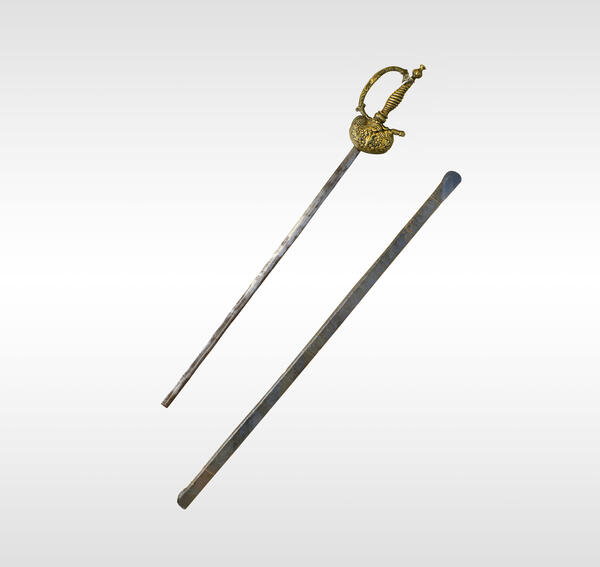
The exhibition presents a ceremonial steel sword of the Russian Empire official, model 1855. A straight blade is forged from steel. The hilt consists of a brass handle and handguard. The ball-shaped pommel is decorated with relief floral ornament. A shaped brass plate is fixed in the upper part; an ornamental thickening is in the lower part. The handguard consists of quillion, shell-guard, and knuckle-guard. A semicircular shell-guard lies where the blade passes into the hilt and is decorated with a relief image of the Russian Empire coat of arms — the double-headed eagle. The scabbard is made of leather.
Ceremonial weapons were worn by civil and court rank officials with parade uniform. It was not worn together with civil and everyday uniform or during the execution of duty. Retired officials also had the right to carry ceremonial weapon. Clerical and court officials, who did not hold state posts wore smallsword without sword knot — a cord or baldric on a cold arm’s hilt.
Smallsword was worn on a shoulder baldric sword belt. It was necessary to unbelt it during an act of icon worshiping, solemnization of marriage when entering the altar, and during balls and other festive events. Ceremonial smallswords were an indispensable part of the uniform worn by civil and court rank-officials until 1917.
In the 19th century, students of universities and other higher educational institutions also wore the smallswords, equipped without sword knot with uniforms. University Statute imposed carrying the weapon and wearing a uniform and cocked hat on holidays and Sundays. Although, not all students keep these rules. In the 1850s, it was cool to break the law and not to carry smallswords. In 1861, mandatory requirement to carry ceremony weapons for students was revoked. 24 years later, in 1885, a new decree was issued, according to which, carrying smallswords with a uniform once again become mandatory, but the uniform was no longer required. The type of uniform was left at the discretion of the student.
The exhibition presents a ceremonial steel sword of the Russian Empire official, model 1855. A straight blade is forged from steel. The hilt consists of a brass handle and handguard. The ball-shaped pommel is decorated with relief floral ornament. A shaped brass plate is fixed in the upper part; an ornamental thickening is in the lower part. The handguard consists of quillion, shell-guard, and knuckle-guard. A semicircular shell-guard lies where the blade passes into the hilt and is decorated with a relief image of the Russian Empire coat of arms — the double-headed eagle. The scabbard is made of leather.