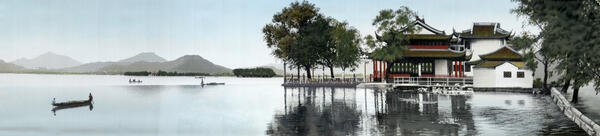
The panel is made in the technique of satin stich embroidery. The composition is framed in a passe-partout made of dark green cardboard and inserted into a frame under plexiglass.
In the foreground there is a lake, on the right side — the coast and part of the embankment. Among the tall green trees reflecting in the still water are several white buildings with traditional Chinese roofs. The largest house is brighter, with a red fence and veranda. Maybe there is a restaurant for vacationers. On the left on the lake are three fishing boats with figures of people. In the distance, against the background of a gray-blue sky, one can see the hills, wrapped in light fog.
In the culture of the Celestial Empire, embroidery is considered an important element — it is a part of human life. The technique of artistic embroidery on silk has its roots in ancient China, but since in the East people are very sensitive to the preservation of any traditions, we can see elements of ancient embroidery in the products of modern craftsmen.
In ancient times, embroidery was available only to wealthy people, it was applied to the clothes of the nobility, and framed the interiors of the imperial palaces. Even the wives of the rulers were engaged in needlework and devoted a lot of time and attention to this work. Many centuries passed, and embroidery became a part of the daily life of the Chinese, becoming an element of creativity — stories from legends and myths were added to it. During the Song Dynasty (960-1279), embroidery reached its peak.
The embroidery technique was constantly improving, the tools that the needlewomen used during their work were modified. It is worth noting that this is an extremely difficult craft that takes many days, because even a simple selection of materials can take more than one hour. It is necessary to choose the right shades and thickness of the threads to create realistic landscapes.
In China, this technique is inculcated from childhood, and all the subtleties of the master’s work are inherited. Perhaps the most popular and well-known Chinese embroidery technique in the world is the silk-on-silk method. This option really requires years of preparation. When creating silk paintings, more than a hundred different stitches and threads can be used, which are very close to each other, which creates a three-dimensional effect. The execution of double-sided paintings is considered the pinnacle of craftsmanship. The four embroidery schools located in different provinces are especially famous for this. Each has its own specific symbols, motives, uses different materials and paints.
The panel was received by the Amur Regional Museum of Local Lore in 1957 from the Amur Regional Committee of the CPSU and the Regional Executive Committee.
In the foreground there is a lake, on the right side — the coast and part of the embankment. Among the tall green trees reflecting in the still water are several white buildings with traditional Chinese roofs. The largest house is brighter, with a red fence and veranda. Maybe there is a restaurant for vacationers. On the left on the lake are three fishing boats with figures of people. In the distance, against the background of a gray-blue sky, one can see the hills, wrapped in light fog.
In the culture of the Celestial Empire, embroidery is considered an important element — it is a part of human life. The technique of artistic embroidery on silk has its roots in ancient China, but since in the East people are very sensitive to the preservation of any traditions, we can see elements of ancient embroidery in the products of modern craftsmen.
In ancient times, embroidery was available only to wealthy people, it was applied to the clothes of the nobility, and framed the interiors of the imperial palaces. Even the wives of the rulers were engaged in needlework and devoted a lot of time and attention to this work. Many centuries passed, and embroidery became a part of the daily life of the Chinese, becoming an element of creativity — stories from legends and myths were added to it. During the Song Dynasty (960-1279), embroidery reached its peak.
The embroidery technique was constantly improving, the tools that the needlewomen used during their work were modified. It is worth noting that this is an extremely difficult craft that takes many days, because even a simple selection of materials can take more than one hour. It is necessary to choose the right shades and thickness of the threads to create realistic landscapes.
In China, this technique is inculcated from childhood, and all the subtleties of the master’s work are inherited. Perhaps the most popular and well-known Chinese embroidery technique in the world is the silk-on-silk method. This option really requires years of preparation. When creating silk paintings, more than a hundred different stitches and threads can be used, which are very close to each other, which creates a three-dimensional effect. The execution of double-sided paintings is considered the pinnacle of craftsmanship. The four embroidery schools located in different provinces are especially famous for this. Each has its own specific symbols, motives, uses different materials and paints.
The panel was received by the Amur Regional Museum of Local Lore in 1957 from the Amur Regional Committee of the CPSU and the Regional Executive Committee.