Font
Color
Graphics
Изображение точки

To see AR mode in action:

1. Install ARTEFACT app for iOS or Android;

2. Find the exhibition «Art of the Orient»

3. Push the «Augmented reality» button and point your phone's camera at the exhibit;

Скрыть точки интересаПоказать точки интереса
Показать в высоком качестве

Round dish

Creation period
Late 19th - early 20th century
Place of сreation
China
Dimensions
2,4×29,2×29,2 cm
Technique
delft, painting, firing
0
Open in app
#1
Round dish
#2
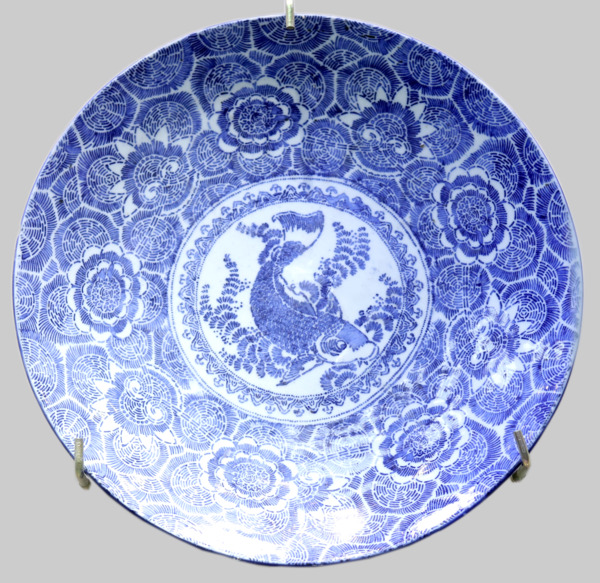
The decorative dish has a rounded and slightly concave shape on a low, circular stem. It is painted with floral design in an underglaze style in white and blue tones. In the center of the dish, a fish is depicted in a writhing position, its back, fins and tail are covered with scales, and the eye looks directly at the viewer, as if welcoming. The picture is clear and realistic, as if the fish will now wag her tail and sail away into the sea.

On the outer side of the bottom, in a circle, there are three contour lines, and along the edges there are drawings with a dense floral ornament. Since ancient times, the Chinese have loved to decorate their porcelain with cobalt. Items of such beauty were in high demand, which greatly influenced their acquisition by Europeans, who admired them and became collectors' items. It is known that for several years, blue and white porcelain has been the main export-worthy product from China.

The main center of porcelain production was the city of Jingdezhen, which is in the Jiangxi province. The products created there were very valuable due to their high quality. The great Chinese poet Li Bai wrote about porcelain in the 8th century:

#6
It is as pure as a clear sky.
As weightless as a sheet of paper.
As beautiful as mountain jade.
It rings like a mountain echo.
#4
White and blue paint, which was made from cobalt oxide, began to enter constant use starting from the 7th century. Initially, the paint was imported from Persia, but later it was found in China itself. Blue underglaze painting became widespread in the Ming era (1368–1644) and the era of the first emperors of the Qing dynasty (1644–1911). Its heyday was at the end of the reign of the Kangxi emperor (1644–1722), when the Chinese began to paint various objects with underglaze cobalt and overglaze iron paint.

The contrast of the deep blue of cobalt paint and the milky whiteness of porcelain has become an artistic technique of Chinese masters. This technique was called ‘imari’ and was borrowed from the Japanese. Such products were exported by the Dutch to Europe and Persia. Porcelain was very popular and, accordingly, had a considerable price. It is worth considering that the crock, i.e. the base on Chinese products was white and had restrained colors, but the composition outperformed Japanese masters.

The Amur Regional Museum of Local Lore bought the dish in 1988 from a resident of the city of Blagoveshchensk V.I. Shishkina.
#3
read morehide
00:00
00:00
1x

Round dish

Creation period
Late 19th - early 20th century
Place of сreation
China
Dimensions
2,4×29,2×29,2 cm
Technique
delft, painting, firing
0
Point your smartphone camera to open in the app
Share
VkontakteOdnoklassnikiTelegram
Share on my website
Copy linkCopied
Copy
Open in app
To see AR mode in action:
  1. Install ARTEFACT app for 
  2. iOS or Android;
  3. Find and download the «Paintings in Details» exhibition
  4. Push the «Augmented reality» button and point your phone's camera at the painting;
  5. Watch what happens on your phone screen whilst you flip through the pictures.
 
We use Cookies
Cookies on the Artefact Website. We use cookies to ensure that we give you the best experience on our website. If you continue without changing your settings, we'll assume that you are happy to receive all cookies on the Artefact website. However, if you would like to, you can change your cookie settings at any time.
Learn more about useHide
Content is available only in Russian

X

Нашли опечатку?...

%title%%type%