#5
Necklace, Appliqués
#6
#8
#9
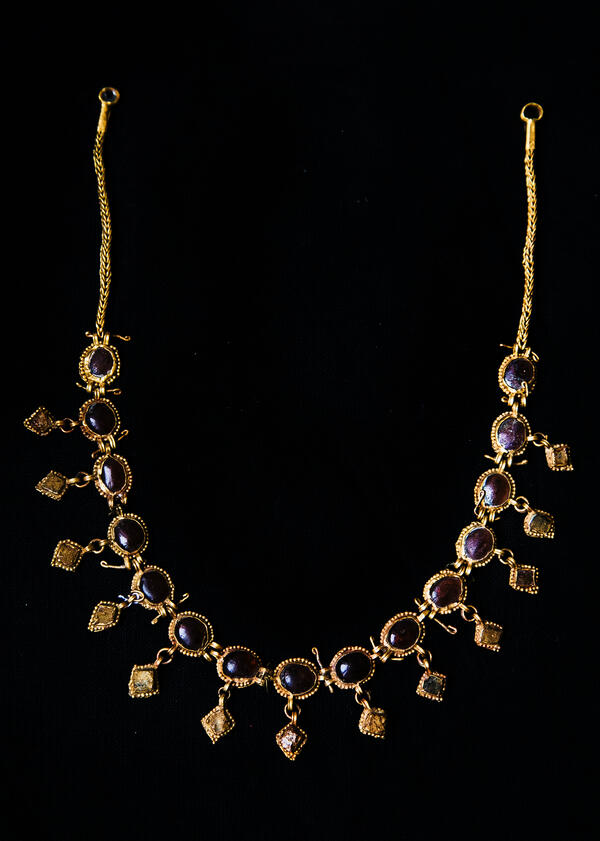
The necklace consisting of 15 identical oval medallions was found in the burial of a Sarmatian woman when excavating a burial mound near the StARitsa village of the ChernoYArsky District in the Astrakhan Region in 1961; the team was led by ValentIn ShIlov. In addition to it, a red-lacquered cup and a bronze vessel with the stamps of ancient craftsmen were found in the burial.
Each medallion in the necklace is adorned with convex inlays of garnet, amber and glass. The stone was covered with an oval gold leaf that served as a bottom base for a medallion. A narrow small gold plate-tray was soldered as a rib at the top near the edge of the base. The plate held the garnet in the socket. Each socket is framed with a gold notched wire soldered to the base of each medallion. Side lugs are soldered to the medallions: they were connected like links in a chain, and a gold wire pin was threaded through them. This is how the medallions were fastened.
The end elements are connected with a cord braided from thin gold wires. To put on the necklace, a string was passed through the eyes at the ends of the cord.
Each medallion, with the exception of the outer ones, has a rhomboid flat pendant with an amber insert framed by pseudo-filigree. To use this technique, a craftsman cast a metal item in a special mould that imitated an openwork soldered weaving.
Necklaces of this kind were made in many centers, including Panticapaeum, Olbia, Chersonesos, cities of the Eastern Black Sea region, and were also common in Rome and the Roman provinces. However, several inserts in the necklace were replaced with glass ones: these are traces of a repair by the Sarmatians. The fact is that the Sarmatians believed that if glass looks like a precious stone (similar in its colour and shape), then it also carries the sacred function of this stone. Thus, if required, they easily replaced precious stones with glass.
In 2005, the necklace with pendants and other valuable archaeological finds from the Astrakhan Museum Reserve collection were exhibited at the Astrakhan Steppe Treasures show at the National Museum of the Palazzo Venezia in Rome.
Each medallion in the necklace is adorned with convex inlays of garnet, amber and glass. The stone was covered with an oval gold leaf that served as a bottom base for a medallion. A narrow small gold plate-tray was soldered as a rib at the top near the edge of the base. The plate held the garnet in the socket. Each socket is framed with a gold notched wire soldered to the base of each medallion. Side lugs are soldered to the medallions: they were connected like links in a chain, and a gold wire pin was threaded through them. This is how the medallions were fastened.
The end elements are connected with a cord braided from thin gold wires. To put on the necklace, a string was passed through the eyes at the ends of the cord.
Each medallion, with the exception of the outer ones, has a rhomboid flat pendant with an amber insert framed by pseudo-filigree. To use this technique, a craftsman cast a metal item in a special mould that imitated an openwork soldered weaving.
Necklaces of this kind were made in many centers, including Panticapaeum, Olbia, Chersonesos, cities of the Eastern Black Sea region, and were also common in Rome and the Roman provinces. However, several inserts in the necklace were replaced with glass ones: these are traces of a repair by the Sarmatians. The fact is that the Sarmatians believed that if glass looks like a precious stone (similar in its colour and shape), then it also carries the sacred function of this stone. Thus, if required, they easily replaced precious stones with glass.
In 2005, the necklace with pendants and other valuable archaeological finds from the Astrakhan Museum Reserve collection were exhibited at the Astrakhan Steppe Treasures show at the National Museum of the Palazzo Venezia in Rome.
#10
Date: II century AD
Technique: forging, filigree, soldering
Dimensions: 0,2×0,2×32 cm, diameter — 0,9cm
Collection: State budgetary institution of culture of the Astrakhan region ‘Astrakhan Museum-Reserve’
Copyright: State budgetary institution of culture of the Astrakhan region ‘Astrakhan Museum-Reserve’
Goskatalog Number: 17112903
Technique: forging, filigree, soldering
Dimensions: 0,2×0,2×32 cm, diameter — 0,9cm
Collection: State budgetary institution of culture of the Astrakhan region ‘Astrakhan Museum-Reserve’
Copyright: State budgetary institution of culture of the Astrakhan region ‘Astrakhan Museum-Reserve’
Goskatalog Number: 17112903
#7
Appliqués
#11
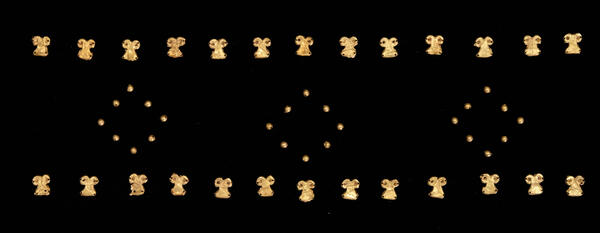
#12
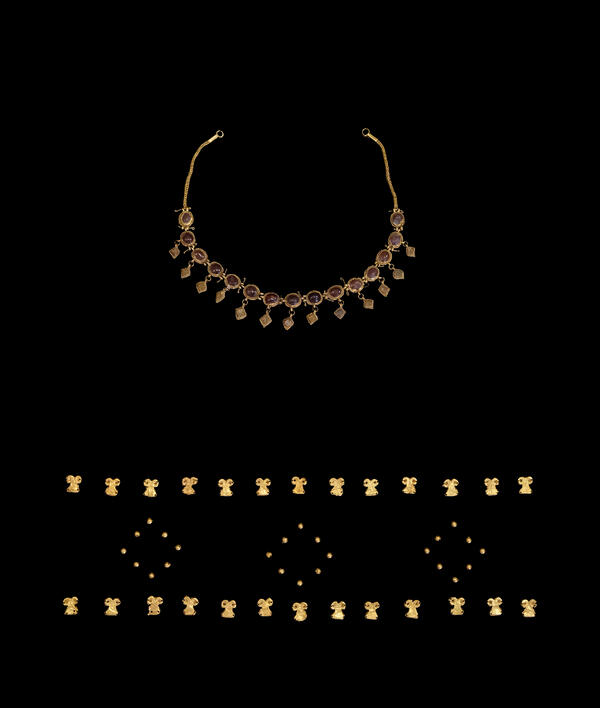
The appliqués from the collection of the Astrakhan Museum Reserve were found in the course of archaeological excavations near the Komsomolsky village of Krasnoyarsky District in the Astrakhan Region in 1987–1988.
The buried items gave to the researchers an idea that the woman was a family or clan priestess high-ranked in the society during her lifetime. Such sewn-on appliqués were used as decor details for clothes, horse blankets or worship textile items. In the present case, two types of appliqués have survived: hemispherical and zoomorphic, in the shape of ram heads with horns. The hem of the priestess’s dress and the front sides of the sleeves from wrists to elbows were decorated with the appliqués. Experts were even able to restore the pattern: the decorative frieze (strip) is bordered with stripes of zoomorphic appliqués at the top and bottom. The zoomorphic patterns alternate with hemispherical ones sewn as rhombuses.
According to scientists, the appliqués were crafted around the 1st or 2nd centuries AD. In those times, ancient craftsmen often decorated their art pieces with images of animals playing important roles in the religious and worship believes of the Sarmatians. The ram was one of the most popular symbols. It was often depicted on ceremonial dishes, decorations of horse harnesses, weapons, and jewelry. The ancient Iranian peoples believed that the ram personified “heavenly grace”, that’s why a Sarmatian had it on hand everywhere: in his or her everyday life and battles, in earthly and afterlife. Of course, the ‘ram worship’ did not arise out of nowhere. Rams were one of the most valuable animals supporting nomads’ lives: due to meat, milk and wool. A number of objects even imitated ram’s wool to gain special magic as the Sarmatians thought. The ram skin and wool were valued as a symbol of prosperity, abundant harvest and fertility. They were used in the worship ceremonies. Also, the rams were sacrificed.
In 2005, the appliqués and other archaeological finds from the Astrakhan Museum Reserve were exhibited at the Astrakhan Steppe Treasures show in Rome.
The buried items gave to the researchers an idea that the woman was a family or clan priestess high-ranked in the society during her lifetime. Such sewn-on appliqués were used as decor details for clothes, horse blankets or worship textile items. In the present case, two types of appliqués have survived: hemispherical and zoomorphic, in the shape of ram heads with horns. The hem of the priestess’s dress and the front sides of the sleeves from wrists to elbows were decorated with the appliqués. Experts were even able to restore the pattern: the decorative frieze (strip) is bordered with stripes of zoomorphic appliqués at the top and bottom. The zoomorphic patterns alternate with hemispherical ones sewn as rhombuses.
According to scientists, the appliqués were crafted around the 1st or 2nd centuries AD. In those times, ancient craftsmen often decorated their art pieces with images of animals playing important roles in the religious and worship believes of the Sarmatians. The ram was one of the most popular symbols. It was often depicted on ceremonial dishes, decorations of horse harnesses, weapons, and jewelry. The ancient Iranian peoples believed that the ram personified “heavenly grace”, that’s why a Sarmatian had it on hand everywhere: in his or her everyday life and battles, in earthly and afterlife. Of course, the ‘ram worship’ did not arise out of nowhere. Rams were one of the most valuable animals supporting nomads’ lives: due to meat, milk and wool. A number of objects even imitated ram’s wool to gain special magic as the Sarmatians thought. The ram skin and wool were valued as a symbol of prosperity, abundant harvest and fertility. They were used in the worship ceremonies. Also, the rams were sacrificed.
In 2005, the appliqués and other archaeological finds from the Astrakhan Museum Reserve were exhibited at the Astrakhan Steppe Treasures show in Rome.
#13
Date: I–II centuries AD
Technique: pressure forming
Dimensions: 0,1×0,9×1 cm
Collection: State budgetary institution of culture of the Astrakhan region ‘Astrakhan Museum-Reserve’
Copyright: State budgetary institution of culture of the Astrakhan region ‘Astrakhan Museum-Reserve’
Goskatalog Number: 17112908
Technique: pressure forming
Dimensions: 0,1×0,9×1 cm
Collection: State budgetary institution of culture of the Astrakhan region ‘Astrakhan Museum-Reserve’
Copyright: State budgetary institution of culture of the Astrakhan region ‘Astrakhan Museum-Reserve’
Goskatalog Number: 17112908
read morehide
00:00
00:00
1x
0
 Point your smartphone camera to open in the app
Open in app
Share