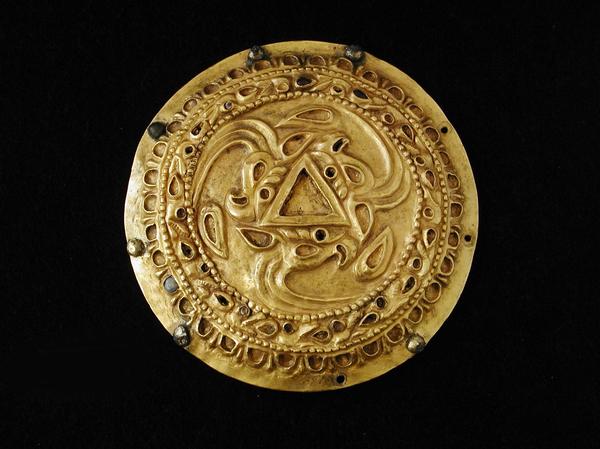
Phalerae are items for decorating horse harnesses and distributing harness belts.Our exhibit is a curved disk; there are triangular depressions surrounded by the heads of griffins in the middle, and stripes of pearl ornament around. The decor was crafted in a special way: first, an ancient craftsman pressed the ornament from the inside of the phalera, and then refined the pattern with an embossing die, chisel and punch (a tool for making dotted patterns).
The phalera is crafted in the Scythian-Sarmatian animal style: it is decorated with images of animals (in our case, they are fantastic griffins with the body of a lion and the head of an eagle), as well as with large inserts of precious stones or glass. The stones are placed in holders that are special sockets that were usually made apart and then soldered onto the base.
Researchers compare the Scythian-Sarmatian animal style with a certain language where the animal images serves to communicate ideas. Each animal had its own symbolical sacred meaning and ‘functions’. For example, the purpose of a rageful wild cat image was to be a powerful amulet for its owner. The griffin was both a predatory and winged creature, and, according to a legend, it connected all three zones of the universe (upper, middle, and lower worlds). Its image was associated with the idea of militancy and invincibility, the victory of a military state over the neighboring tribes.
The griffin images have not changed over the centuries. The classic one, a winged lion with the head of a cat or an eagle, became known around the beginning of the 1st millennium BC in the monuments of Ancient Iran and Greece. In the same era, griffin images appeared among the nomads of the Eurasian steppes. Often they decorated jewelry that ancient craftsmen produced for the Scythians and Sarmatians. The Scythian-Sarmatian version of a griffin, according to some researchers, is the head of a bird of prey with an animal’s ear.
The phalera was found in the course of archaeological activities at the ‘royal burial mound’ in 1984 by the team led by G.А. FEdorov-DavYdov, V.V. DvornichEnko and V.V. PlAkhova near the KOsika village of the EnotAevsky District of the Astrakhan Region.
In 2005, the phalera and other valuable finds were exhibited at the Astrakhan Steppe Treasures show at the National Museum of the Palazzo Venezia in Rome.
The phalera is crafted in the Scythian-Sarmatian animal style: it is decorated with images of animals (in our case, they are fantastic griffins with the body of a lion and the head of an eagle), as well as with large inserts of precious stones or glass. The stones are placed in holders that are special sockets that were usually made apart and then soldered onto the base.
Researchers compare the Scythian-Sarmatian animal style with a certain language where the animal images serves to communicate ideas. Each animal had its own symbolical sacred meaning and ‘functions’. For example, the purpose of a rageful wild cat image was to be a powerful amulet for its owner. The griffin was both a predatory and winged creature, and, according to a legend, it connected all three zones of the universe (upper, middle, and lower worlds). Its image was associated with the idea of militancy and invincibility, the victory of a military state over the neighboring tribes.
The griffin images have not changed over the centuries. The classic one, a winged lion with the head of a cat or an eagle, became known around the beginning of the 1st millennium BC in the monuments of Ancient Iran and Greece. In the same era, griffin images appeared among the nomads of the Eurasian steppes. Often they decorated jewelry that ancient craftsmen produced for the Scythians and Sarmatians. The Scythian-Sarmatian version of a griffin, according to some researchers, is the head of a bird of prey with an animal’s ear.
The phalera was found in the course of archaeological activities at the ‘royal burial mound’ in 1984 by the team led by G.А. FEdorov-DavYdov, V.V. DvornichEnko and V.V. PlAkhova near the KOsika village of the EnotAevsky District of the Astrakhan Region.
In 2005, the phalera and other valuable finds were exhibited at the Astrakhan Steppe Treasures show at the National Museum of the Palazzo Venezia in Rome.