The vessel from the Astrakhan Museum Reserve collection was found in the BEra burial mound near the KOsika village in the YenotAyevsky District. This burial was opened and destroyed in 1984, when a water culvert trench was laid there.
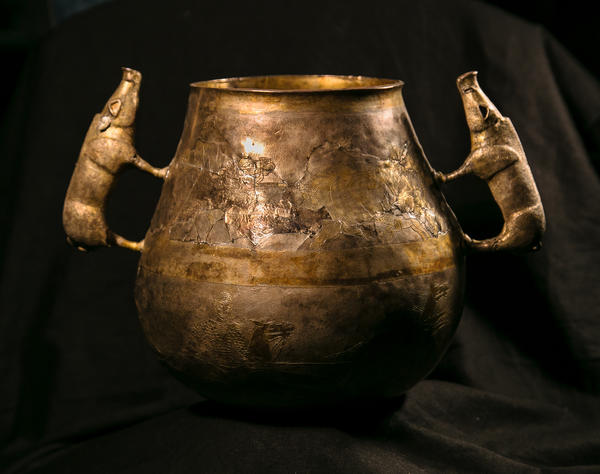
This is a goblet vessel; its body is spherical; the handles are boar-shaped. The edge of the collar and the outer part beneath are gold.
There are two friezes (stripes) of images below on the body on each side. They are separated by a gold-plated ribbon. This is a decor made with a special technique where thin plates of one metal, usually precious, were placed over another metal item. All the images are gilded.
The upper frieze represents hunting scenes with dogs; the rider strikes a huge boar with a spear. Some of the images have survived in their entirety, while only fragments of others have remained. The riders are armed with long spears; they are portrayed with long wavy hair and mustache, in belted jackets. A survived drawing shows a rider dressed in tight trousers tied with ribbons around lower legs. There are cuffs on the left hand of each rider, and bracelets on the right hand, which means that we are faced with people of high rank.
The lower frieze shows two combat scenes. One depicts a galloping warrior with a long spear. The spear is pointed at the defeated enemy. A galloping horseman in an armoured shirt with large scales and tight trousers tied with a cord at the lower legs. There is also a bracelet on the right hand, and cuff on the left hand. A bow and a sword handle are visible behind the back. The image is very detailed: the saddle is decorated with a tassel; you can see in detail the horse harness: belts, and reins.
As for the second scene, the entire image of only one horseman is survived. The horseman is doing archery. There is a sword holder protruding from behind his belt on his right side. Warriors have different social ranks: which can be judged by clothing and weapons. One is wearing an armoured shirt and has a spear, while the second has a plain shirt and no spear.
The figurines of boars, with which the ancient craftsman replaced the handles of the vessel, are hollow and cast. The animals have expressive repoussé muscles; the bristles are shown with wavy horizontal shading, and the withers are reticulated. The ears are cast separately and attached with rods. The eyes are marked with recessed triangles, one of which contains traces of red paint. The hooves are soldered and attached to the vessel with two rivets.
In 2005, the vessel was exhibited at the Astrakhan Steppe Treasures show at the National Museum of the Palazzo Venezia in Rome.
This is a goblet vessel; its body is spherical; the handles are boar-shaped. The edge of the collar and the outer part beneath are gold.
There are two friezes (stripes) of images below on the body on each side. They are separated by a gold-plated ribbon. This is a decor made with a special technique where thin plates of one metal, usually precious, were placed over another metal item. All the images are gilded.
The upper frieze represents hunting scenes with dogs; the rider strikes a huge boar with a spear. Some of the images have survived in their entirety, while only fragments of others have remained. The riders are armed with long spears; they are portrayed with long wavy hair and mustache, in belted jackets. A survived drawing shows a rider dressed in tight trousers tied with ribbons around lower legs. There are cuffs on the left hand of each rider, and bracelets on the right hand, which means that we are faced with people of high rank.
The lower frieze shows two combat scenes. One depicts a galloping warrior with a long spear. The spear is pointed at the defeated enemy. A galloping horseman in an armoured shirt with large scales and tight trousers tied with a cord at the lower legs. There is also a bracelet on the right hand, and cuff on the left hand. A bow and a sword handle are visible behind the back. The image is very detailed: the saddle is decorated with a tassel; you can see in detail the horse harness: belts, and reins.
As for the second scene, the entire image of only one horseman is survived. The horseman is doing archery. There is a sword holder protruding from behind his belt on his right side. Warriors have different social ranks: which can be judged by clothing and weapons. One is wearing an armoured shirt and has a spear, while the second has a plain shirt and no spear.
The figurines of boars, with which the ancient craftsman replaced the handles of the vessel, are hollow and cast. The animals have expressive repoussé muscles; the bristles are shown with wavy horizontal shading, and the withers are reticulated. The ears are cast separately and attached with rods. The eyes are marked with recessed triangles, one of which contains traces of red paint. The hooves are soldered and attached to the vessel with two rivets.
In 2005, the vessel was exhibited at the Astrakhan Steppe Treasures show at the National Museum of the Palazzo Venezia in Rome.