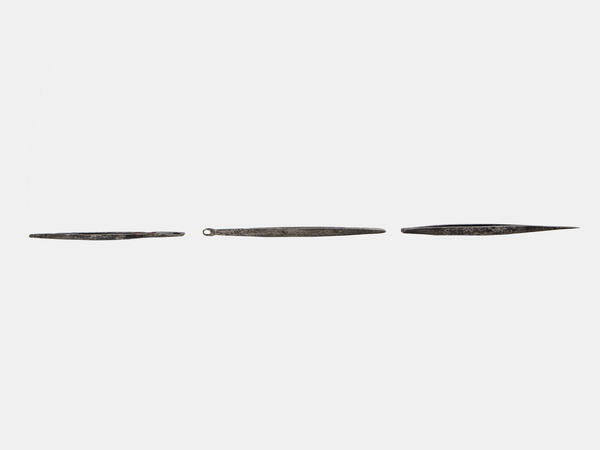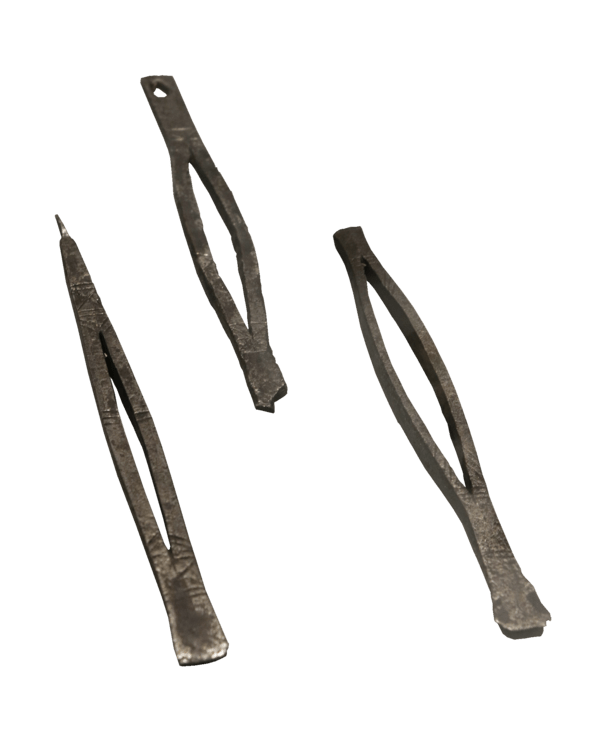
These are screwdrivers for servicing handguns. They are suitable for trigger and wheel mechanisms of gun locks — hand cannons, carbines, and pistols. The tool appeared at the end of the 16th — in the 17th centuries along with the new flint locks that used screws to connect the parts. In previous matchlock mechanisms, the fastenings had no hardware, so screwdrivers were not needed.
The screwdrivers had pointed ends on one side and a hole on the other — it was used for attaching the instrument to the belt. Before pockets, tools were hung on the belt, along with cloth or leather bags for small items and money. The surfaces of the screwdrivers are decorated with notches, which are arranged in simple geometric patterns. Such ornaments helped to distinguish one’s instrument from someone else’s, emphasized its value and made it an additional adornment.
Most of such screwdrivers were found in Tula on the territory of the siege yards, the residential area of the Kremlin. This suggests that the tools were items of personal equipment of the Russian military class of the 17th century: they were used by the military themselves, and not just by gunsmiths. To enhance the rotational effect, a knife could be inserted into the slot of the screwdriver, which served as a lever.
The shape of the screwdrivers was the result of working with oval flints: the tool was used to ignite. A flint is the simplest way to make fire, the prototype of a modern lighter. In the old days, people believed that fire that was obtained by striking a flint had a cleansing power and brought prosperity and health to the house. In Russian fairy tales, people used flint to cast spells, summon spirits, and treated it as an intermediary between the real and other worlds.
Russian peasants used steel, flint, and tinder as the main means of making fire until the late 1920s. Matches, invented by the German chemist Kammerer in 1833, were not widely used in villages, although they were sold in large quantities in shops, stores and fairs. The Old Believers did not use matches at all, considering them a “demonic invention”.