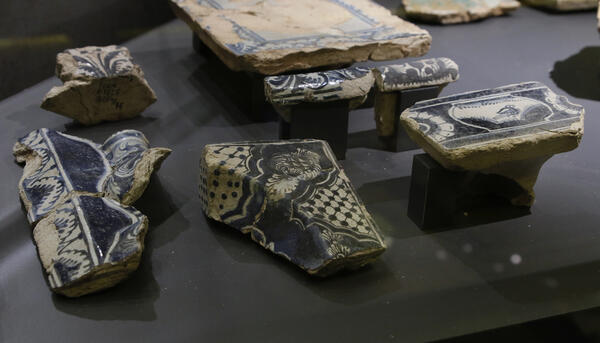
Tiles are one of the types of architectural ceramics, designed for cladding walls, stoves and fireplaces. In Russia they were called “cut bricks”: they appeared in the late 15th — early 16th century, during the period of active development of brick construction.
The first tiles were simple and made of red clay. They could be decorated with floral patterns or representational imagery, battle scenes being the most common subject. The stoves made of red tiles have not survived. Finds of red tiles in Tula are rare and have happened only on the territory of the Tula Kremlin. This is partly due to the short period of time when terracotta tiles were in fashion.
Starting from the middle of the 17th century, red tiles were replaced by glazed ones. The skill of painting tiles reached its peak when Tsar Peter I returned from his trips to Europe and ordered to build stoves in the Dutch style. To do this, he sent his artists abroad to study tile making.
For the new capital, St. Petersburg, new stove ceramics — smooth blue and white tiles — began to be produced. The front side was first covered with white enamel, then painted with cobalt, after which the tile was fired. During the second firing, the painting was fused into the enamel. Painters began to play the leading role in the manufacture of tiles — previously wood carvers who made molds for clay were more important.
Many European motifs appeared on tiles, especially the images of buildings and sailing ships. Tiered tiled stoves were also decorated with painted columns and placed on shaped oak legs.
By the middle of the 18th century, a new type of multi-colored tiles illustrating stories had developed in Moscow. The classic wall tiles featured genre scenes in a frame of scrolls or garlands. Various types of geometric and floral patterns were also widely used: palm leaves, flower heads, and various kinds of fruit and leaves. At the same time, laconic tiles were also popular — those were plain white tiles with a wide band of pattern along the perimeter.