#7
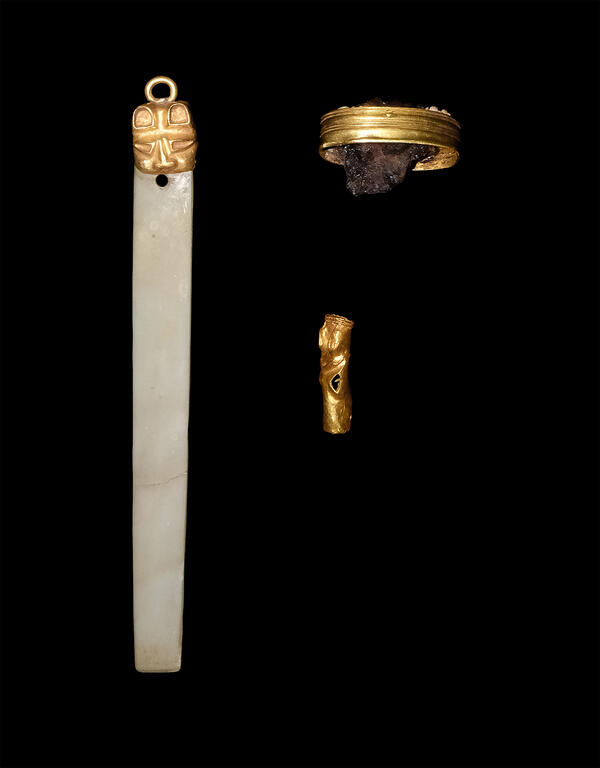
Rectangular sharpening stone, Sword crossguard coupler, Zoomorphic Head
#8
#11
#12
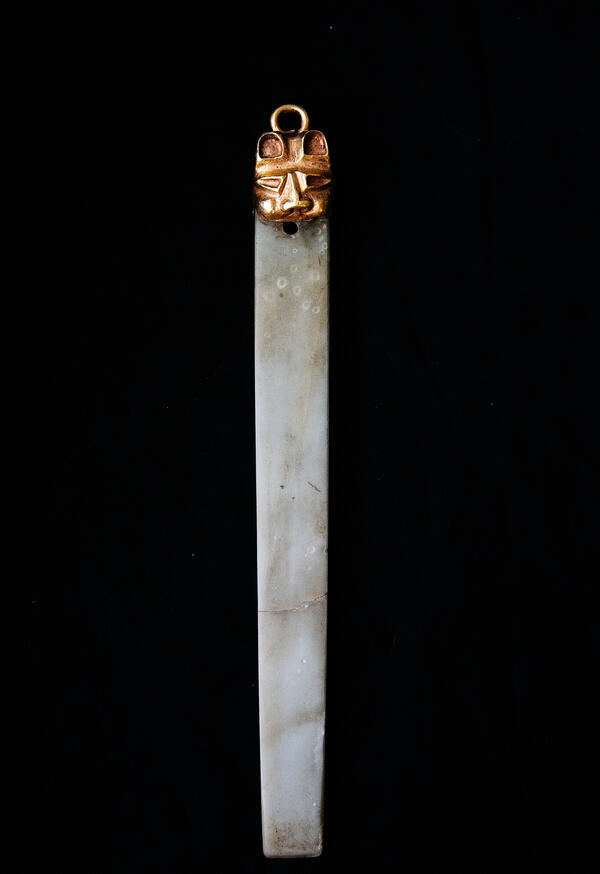
Rectangular sharpening stone made of gray-white stone with a removable lion head
A sharpening stone is a whetstone in the form of a bar. Since ancient times, they have been used to sharpen the blades of knives, scythes and other cutting objects. The rectangular sharpening stone from the Astrakhan Museum Reserve collection was found in the BEra burial mound near the KOsika village in the YenotAyevsky District. This burial was opened and destroyed in 1984, when a water culvert trench was laid there.
The sharpening stone is made of gray-white nephrite and decorated with a removable lion head. Zoomorphic images were very popular in the Scythian-Sarmatian culture: at that time it was believed that each of them personifies certain qualities and patronizes people. The images of rams, horses, birds and feline predators were especially popular in the art of the nomads of the Scythian-Sarmatian era.
Usually, ancient craftsmen depicted animals of various types. In our case, it is not clear what species of cats the animal belongs to. Scientists call such images with similar details as ‘Sarmatian panthers’: rounded outlines with a blunt muzzle, as if cut off at a right angle, a prominent, wide, large nose pressed between convex cheeks, round eyes and semi-oval ears. A sharpening stone of this kind most likely served as a worship item. It can be seen that the cat is depicted as non-aggressive; the toothy mouth is not even shown.
Nephrite (originated from ancient Greek word for kidney; its obsolete name was kidney stone) is a mineral featured with fibrous structure. One of its most valuable properties is its extremely high impact strength. Nephrite is difficult to split; since ancient times, it was valued for its hardness and durability. It personified wisdom and eternity, Heaven and Earth. Nephrite jewelry had deep meanings and was considered talismans. Besides nephrite, jewelry and worship items were decorated with inserts of precious and semi-precious stones, as well as of coloured glass and glass paste.
In 2005, the sharpening stone and other valuable ancient items from the Astrakhan Museum Reserve collection were exhibited at the Astrakhan Steppe Treasures show at the National Museum of the Palazzo Venezia in Rome.
A sharpening stone is a whetstone in the form of a bar. Since ancient times, they have been used to sharpen the blades of knives, scythes and other cutting objects. The rectangular sharpening stone from the Astrakhan Museum Reserve collection was found in the BEra burial mound near the KOsika village in the YenotAyevsky District. This burial was opened and destroyed in 1984, when a water culvert trench was laid there.
The sharpening stone is made of gray-white nephrite and decorated with a removable lion head. Zoomorphic images were very popular in the Scythian-Sarmatian culture: at that time it was believed that each of them personifies certain qualities and patronizes people. The images of rams, horses, birds and feline predators were especially popular in the art of the nomads of the Scythian-Sarmatian era.
Usually, ancient craftsmen depicted animals of various types. In our case, it is not clear what species of cats the animal belongs to. Scientists call such images with similar details as ‘Sarmatian panthers’: rounded outlines with a blunt muzzle, as if cut off at a right angle, a prominent, wide, large nose pressed between convex cheeks, round eyes and semi-oval ears. A sharpening stone of this kind most likely served as a worship item. It can be seen that the cat is depicted as non-aggressive; the toothy mouth is not even shown.
Nephrite (originated from ancient Greek word for kidney; its obsolete name was kidney stone) is a mineral featured with fibrous structure. One of its most valuable properties is its extremely high impact strength. Nephrite is difficult to split; since ancient times, it was valued for its hardness and durability. It personified wisdom and eternity, Heaven and Earth. Nephrite jewelry had deep meanings and was considered talismans. Besides nephrite, jewelry and worship items were decorated with inserts of precious and semi-precious stones, as well as of coloured glass and glass paste.
In 2005, the sharpening stone and other valuable ancient items from the Astrakhan Museum Reserve collection were exhibited at the Astrakhan Steppe Treasures show at the National Museum of the Palazzo Venezia in Rome.
#13
Date
1st century BC
Technique
grinding, casting, soldering, repoussé work
Place
Dimensions
2,2×20,2 cm
Collection
Precious metals
Copyright
State budgetary institution of culture of the Astrakhan region ‘Astrakhan Museum-Reserve’
Restorers
Goskatalog Number
17112915, 17112931
1st century BC
Technique
grinding, casting, soldering, repoussé work
Place
Dimensions
2,2×20,2 cm
Collection
Precious metals
Copyright
State budgetary institution of culture of the Astrakhan region ‘Astrakhan Museum-Reserve’
Restorers
Goskatalog Number
17112915, 17112931
#9
Sword crossguard coupler
#14
#15
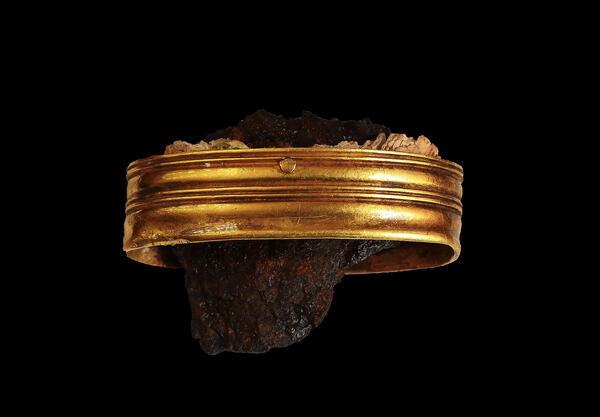
The sword crossguard was found in the BEra burial mound near the KOsika village in the YenotAyevsky District. This burial was opened and destroyed in 1984, when a water culvert trench was laid there.
In 2015, scientists were able to find out when this artifact had been approximately crafted. M.Yu. Traister and B.A. Raev found a Greek dotted inscription in the crossguard lower part that adjoined the blade. It was not visible when the dagger was sheathed.
The inscription was made with a punch — a special tool; in ancient times, convex-concave images and ornaments were embossed on yielding materials: metal, leather, and clay.
In 2015, scientists were able to find out when this artifact had been approximately crafted. M.Yu. Traister and B.A. Raev found a Greek dotted inscription in the crossguard lower part that adjoined the blade. It was not visible when the dagger was sheathed.
The inscription was made with a punch — a special tool; in ancient times, convex-concave images and ornaments were embossed on yielding materials: metal, leather, and clay.
‘238 (year) (Work? Corporation) by goldsmiths led by Bion, besides him, (also) by Bakhiy. The (weight) of good gold as measured by eclogist Guy is 8 drachmas, two obols, half an obol’.
The text consists of three parts: it contains the date, the craftsmen and the gold weight confirmed by an eclogist — an official who was involved in tax assessment and tax collection.
As for the date, the year is 238. It can refer to either the Seleucid era (from the fall of 312 BC) or the Pontic era (from 297 BC). Thus, according to the Seleucid era, the date falls to 74 BC, and according to the Pontic era, to 59 BC. It is difficult to decide in favor of one of the eras: the dagger was most likely crafted in Asia Minor or beyond its eastern borders, and both dates coincide with the dating of the burial.
The crossguard is made in the shape of a straight gold holder rolled into an ellipsoid. It is decorated with five grooves: they encircle the object with two ribbons. A blade used to be coming from the crossguard holder; the crossbar has preserved traces of the wooden sheathing; traces of a bone sheathing are visible on the shaft of the handle. The sword from KOsika burial might not have a pommel or decorative top. However, it belongs to rare examples of ceremonial weapons. The buried person, most likely, was granted it either as a gift for service, or as booty during the campaign of the Bosporan king Pharnaces to Asia Minor in 49–47 BC.
In 2005, the sword crossguard and other items were exhibited at the Astrakhan Steppe Treasures show at the National Museum of the Palazzo Venezia in Rome.
As for the date, the year is 238. It can refer to either the Seleucid era (from the fall of 312 BC) or the Pontic era (from 297 BC). Thus, according to the Seleucid era, the date falls to 74 BC, and according to the Pontic era, to 59 BC. It is difficult to decide in favor of one of the eras: the dagger was most likely crafted in Asia Minor or beyond its eastern borders, and both dates coincide with the dating of the burial.
The crossguard is made in the shape of a straight gold holder rolled into an ellipsoid. It is decorated with five grooves: they encircle the object with two ribbons. A blade used to be coming from the crossguard holder; the crossbar has preserved traces of the wooden sheathing; traces of a bone sheathing are visible on the shaft of the handle. The sword from KOsika burial might not have a pommel or decorative top. However, it belongs to rare examples of ceremonial weapons. The buried person, most likely, was granted it either as a gift for service, or as booty during the campaign of the Bosporan king Pharnaces to Asia Minor in 49–47 BC.
In 2005, the sword crossguard and other items were exhibited at the Astrakhan Steppe Treasures show at the National Museum of the Palazzo Venezia in Rome.
#16
Date
1st century BC
Technique
forging, soldering
Place
Dimensions
2,7×5,2 cm
Collection
State budgetary institution of culture of the Astrakhan region ‘Astrakhan Museum-Reserve’
Copyright
State budgetary institution of culture of the Astrakhan region ‘Astrakhan Museum-Reserve’
Restorers
Goskatalog Number
17112921
1st century BC
Technique
forging, soldering
Place
Dimensions
2,7×5,2 cm
Collection
State budgetary institution of culture of the Astrakhan region ‘Astrakhan Museum-Reserve’
Copyright
State budgetary institution of culture of the Astrakhan region ‘Astrakhan Museum-Reserve’
Restorers
Goskatalog Number
17112921
#10
Zoomorphic Head
#17
#18
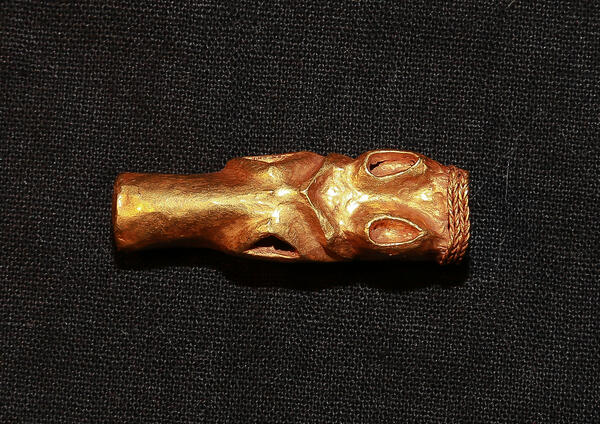
The zoomorphic head made of a gold plate is a styled horse head and a tip of an unknown object. Most likely, it was fixed on a wooden or bone base.
There are four holes punched along the object edges for nails. There is a round hole in the place of the mouth; the eye sockets are marked with triangular depressions with holes in the middle; the ears are drop-shaped holders. Holders are special recesses to fix stones or coloured glass.
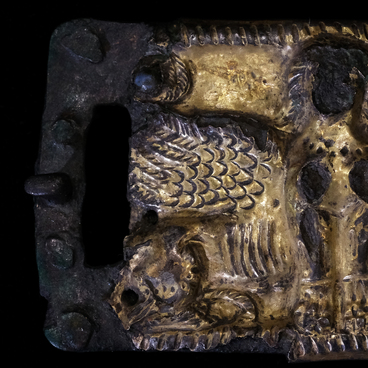
The zoomorphic head was found in the course of archaeological activities at the ‘royal burial mound’ in 1984 near the KOsika village of the YenotAyevsky District of the Astrakhan Region. Here, during the excavation activities, a burial mound of a Sarmatian leader was discovered. The bones of the skeleton were attributed to a man about 35 years old. The leader’s clothes were made of leather and decorated with gold sewn-on appliqués shaped as a styled ram’s head, a ram’s skin with a knot in the middle, and with square-shaped appliqués.
Besides the appliqués and a tip, a rich set of things was found in the burial mound. It correlates with an important milestone in the history of the Sarmatians: the aristocracy began to isolate itself from the rest of the society, and some Sarmatian tribal associations experienced the beginnings of statehood. A heavy gold pectoral was also found in the burial mound. Similar values were kept in the treasuries of the Sarmatian leaders. The pectoral was decorated with repoussé scenes of torments. They depict fantastic griffins and lions sinking their teeth into a deer, ram and bull. A large gold double-sided bracelet with enamels, like the pectoral, was most likely made for the Sarmatian by Greek craftsmen. Also, several gold buckles, a richly decorated belt that was a symbol of nobility and wealth in ancient times, two spears, iron arrows, a bow, a dagger, a sword with a golden cross and a bone handle, and other valuable items were found in the grave.
In 2005, the zoomorphic head and other archelogical finds were exhibited at the Astrakhan Steppe Treasures show at the National Museum of the Palazzo Venezia in Rome.
There are four holes punched along the object edges for nails. There is a round hole in the place of the mouth; the eye sockets are marked with triangular depressions with holes in the middle; the ears are drop-shaped holders. Holders are special recesses to fix stones or coloured glass.
The zoomorphic head was found in the course of archaeological activities at the ‘royal burial mound’ in 1984 near the KOsika village of the YenotAyevsky District of the Astrakhan Region. Here, during the excavation activities, a burial mound of a Sarmatian leader was discovered. The bones of the skeleton were attributed to a man about 35 years old. The leader’s clothes were made of leather and decorated with gold sewn-on appliqués shaped as a styled ram’s head, a ram’s skin with a knot in the middle, and with square-shaped appliqués.
Besides the appliqués and a tip, a rich set of things was found in the burial mound. It correlates with an important milestone in the history of the Sarmatians: the aristocracy began to isolate itself from the rest of the society, and some Sarmatian tribal associations experienced the beginnings of statehood. A heavy gold pectoral was also found in the burial mound. Similar values were kept in the treasuries of the Sarmatian leaders. The pectoral was decorated with repoussé scenes of torments. They depict fantastic griffins and lions sinking their teeth into a deer, ram and bull. A large gold double-sided bracelet with enamels, like the pectoral, was most likely made for the Sarmatian by Greek craftsmen. Also, several gold buckles, a richly decorated belt that was a symbol of nobility and wealth in ancient times, two spears, iron arrows, a bow, a dagger, a sword with a golden cross and a bone handle, and other valuable items were found in the grave.
In 2005, the zoomorphic head and other archelogical finds were exhibited at the Astrakhan Steppe Treasures show at the National Museum of the Palazzo Venezia in Rome.
#19
Date
1st Century A.D.
Technique
forging, soldering
Place
Dimensions
1,4×4,5 cm
Collection
State budgetary institution of culture of the Astrakhan region “Astrakhan Museum-Reserve”
Copyright
State budgetary institution of culture of the Astrakhan region “Astrakhan Museum-Reserve”
Restorers
Goskatalog Number
17112909
1st Century A.D.
Technique
forging, soldering
Place
Dimensions
1,4×4,5 cm
Collection
State budgetary institution of culture of the Astrakhan region “Astrakhan Museum-Reserve”
Copyright
State budgetary institution of culture of the Astrakhan region “Astrakhan Museum-Reserve”
Restorers
Goskatalog Number
17112909
read morehide
00:00
00:00
1x
Sharpening, Coupler, Zoomorphic Head
Collection
Exhibition
0
 Point your smartphone camera to open in the app
Open in app
Share