#1
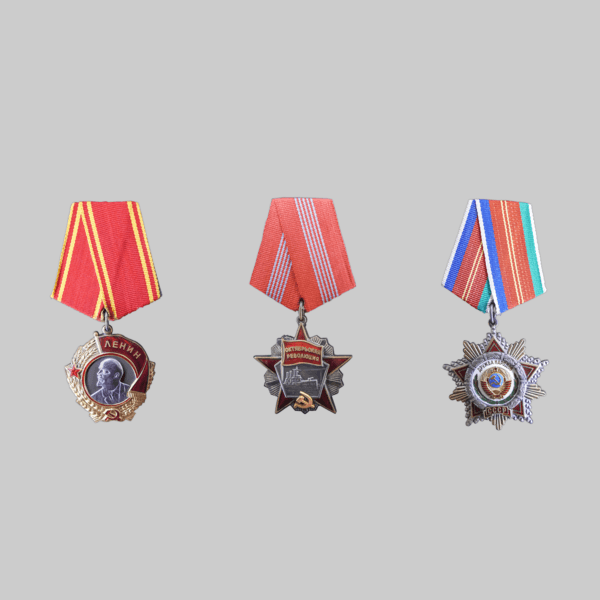
The Order of Lenin of 1934, The Order of the October Revolution of 1970, The Order of Friendship of Peoples of 1972
#2
#5
#6
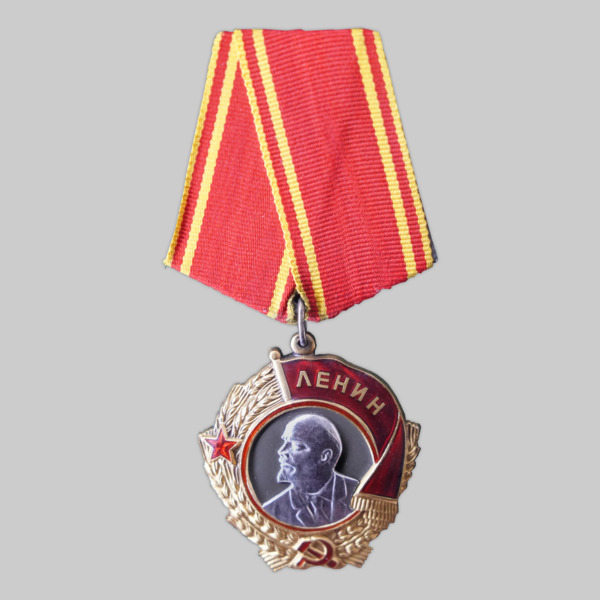
On January 3, 1934, the Presidium of the Central Commission of the CPSU (Communist Party of the Soviet Union) awarded the Tatar Republic the Order of Lenin ‘for major successes in the development of agriculture’. The medal is kept in the collection of the Museum of the History of Tatar Statehood and the Republic of Tatarstan.
The Order of Lenin is the highest state award in the Soviet Union. It was awarded to individual citizens, collectives, institutions, enterprises, public organizations and regions of the country for labour and military achievements. The Order was founded in 1930 and newspaper ‘Komsomolskaia Pravda’ became the first laureate for ‘active assistance in strengthening the pace of socialist construction and in connection with the fifth anniversary of its foundation’.
Orders were produced at the printing factory ‘Gosznak’ in Moscow. From 1934 to 1936, the awards were made from 750 gold. The medal was a round medallion portrait with a bas-relief in the centre. The project was made by the artist Ivan Dubasov. As a basis, he took a photograph of Vladimir Lenin which was taken in the summer of 1920 at the Second Congress of the Comintern in Moscow. In the photograph the photographer captured the leader of the proletariat from the left side.
In the upper part of the medallion there is a red flag with the inscription ‘Lenin’, below – a hammer and sickle – symbols of Soviet power and the world communist movement. They signified the unity of workers and peasants and were also located on the state flag of the Soviet Union. The composition was framed by a rim of golden heads of wheat.
In 1934, not only Tatarstan was awarded, but also the leaders and active workers of a number of machine and tractor stations (MTS). Among them are Karim Bairamov (Isanbaevskaia MTS), Sergei Kozhevnikov (MTS of Pestrechinsky district), Sergey Smolov (Mamadyshskaia MTS), Mahmut Bagautdinov (Arskaia MTS).
One of the laureates of the order, Karim Bairamov, was the head of the political department of the Isanbaevskaia MTS. He became a member of the party in 1926. Prior to that, he led the community of local peasants and made a significant contribution to the development of collective farms. During the Great Patriotic War, Bairamov went to the front and upon his return he became a scientific worker and was engaged in teaching work in higher educational institutions of Kazan.
The Order of Lenin is the highest state award in the Soviet Union. It was awarded to individual citizens, collectives, institutions, enterprises, public organizations and regions of the country for labour and military achievements. The Order was founded in 1930 and newspaper ‘Komsomolskaia Pravda’ became the first laureate for ‘active assistance in strengthening the pace of socialist construction and in connection with the fifth anniversary of its foundation’.
Orders were produced at the printing factory ‘Gosznak’ in Moscow. From 1934 to 1936, the awards were made from 750 gold. The medal was a round medallion portrait with a bas-relief in the centre. The project was made by the artist Ivan Dubasov. As a basis, he took a photograph of Vladimir Lenin which was taken in the summer of 1920 at the Second Congress of the Comintern in Moscow. In the photograph the photographer captured the leader of the proletariat from the left side.
In the upper part of the medallion there is a red flag with the inscription ‘Lenin’, below – a hammer and sickle – symbols of Soviet power and the world communist movement. They signified the unity of workers and peasants and were also located on the state flag of the Soviet Union. The composition was framed by a rim of golden heads of wheat.
In 1934, not only Tatarstan was awarded, but also the leaders and active workers of a number of machine and tractor stations (MTS). Among them are Karim Bairamov (Isanbaevskaia MTS), Sergei Kozhevnikov (MTS of Pestrechinsky district), Sergey Smolov (Mamadyshskaia MTS), Mahmut Bagautdinov (Arskaia MTS).
One of the laureates of the order, Karim Bairamov, was the head of the political department of the Isanbaevskaia MTS. He became a member of the party in 1926. Prior to that, he led the community of local peasants and made a significant contribution to the development of collective farms. During the Great Patriotic War, Bairamov went to the front and upon his return he became a scientific worker and was engaged in teaching work in higher educational institutions of Kazan.
#7
Date: 1934 year
Technique: gold
Dimensions: 3,85×3,8 cm
Collection: The Museum of the History of Tatar Statehood and the Republic of Tatarstan, Kazan, Republic of Tatarstan
Copyright: The Museum of the History of Tatar Statehood and the Republic of Tatarstan, Kazan, Republic of Tatarstan
Technique: gold
Dimensions: 3,85×3,8 cm
Collection: The Museum of the History of Tatar Statehood and the Republic of Tatarstan, Kazan, Republic of Tatarstan
Copyright: The Museum of the History of Tatar Statehood and the Republic of Tatarstan, Kazan, Republic of Tatarstan
#3
The Order of the October Revolution of 1970
#8
#9
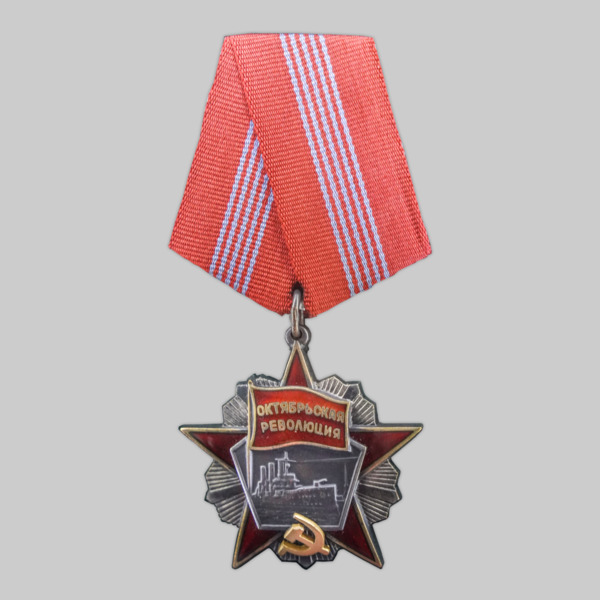
The Order of the October Revolution of 1970 is kept in the Museum of the History of Tatar Statehood and the Republic of Tatarstan.
The USSR government established the order in 1967 in honour of the 50th anniversary of the October Revolution. It was an award ‘for active revolutionary activity, contribution to the formation and strengthening of Soviet power, services in building socialism and communism, outstanding achievements in the development of the national economy, science and culture’. It could be received by both citizens of the USSR and foreigners, as well as Soviet enterprises, institutions, organizations and other collectives of workers, military units and formations, republics, territories, regions and cities. Order No. 1 was awarded to the city of Leningrad, and Order No. 2 to Moscow. In the table of ranks of the Soviet award system, the medal took second place after The Order of Lenin.
In June 1970, Tatarstan received the Order of the October Revolution to commemorate the 50th anniversary of the TASSR. The government gave the region an award for ‘outstanding successes achieved in the development of the national economy and socialist culture’. On behalf of the region, the ceremony was attended by the First Secretary of the Tatar Regional Party Committee Fikrat Tabeev and the Chairman of the Presidium of the Supreme Soviet of the TASSR Salikh Batyev. The award was presented by the Secretary of the CPSU Central Committee Andrei Kirilenko.
The order was made as a five-pointed star covered with gold and red enamel. There was an image of a flag with the inscription ‘October Revolution’ in the upper part. There was a silver pentagon with the image of the cruiser Aurora in its centre. There were overhead hammer and sickle — symbols of Soviet power and the world communist movement — in the lower part. They stood for the unity of workers and peasants and were located on the State Flag of the Soviet Union.
The order was connected to a pentagonal red ribbon by the eyelet and a ring. There were five narrow longitudinal blue stripes in the middle of the ribbon. The five-pointed star was a symbol of triumph of the ideas of communism at the five inhabited continents of the globe.
The last awarding took place in December 1991 — the order was received by Atmagambet Oinarbaev, Head of the Kazakh Mining and Geological Expedition of the ‘Building Materials’ group of companies.
The USSR government established the order in 1967 in honour of the 50th anniversary of the October Revolution. It was an award ‘for active revolutionary activity, contribution to the formation and strengthening of Soviet power, services in building socialism and communism, outstanding achievements in the development of the national economy, science and culture’. It could be received by both citizens of the USSR and foreigners, as well as Soviet enterprises, institutions, organizations and other collectives of workers, military units and formations, republics, territories, regions and cities. Order No. 1 was awarded to the city of Leningrad, and Order No. 2 to Moscow. In the table of ranks of the Soviet award system, the medal took second place after The Order of Lenin.
In June 1970, Tatarstan received the Order of the October Revolution to commemorate the 50th anniversary of the TASSR. The government gave the region an award for ‘outstanding successes achieved in the development of the national economy and socialist culture’. On behalf of the region, the ceremony was attended by the First Secretary of the Tatar Regional Party Committee Fikrat Tabeev and the Chairman of the Presidium of the Supreme Soviet of the TASSR Salikh Batyev. The award was presented by the Secretary of the CPSU Central Committee Andrei Kirilenko.
The order was made as a five-pointed star covered with gold and red enamel. There was an image of a flag with the inscription ‘October Revolution’ in the upper part. There was a silver pentagon with the image of the cruiser Aurora in its centre. There were overhead hammer and sickle — symbols of Soviet power and the world communist movement — in the lower part. They stood for the unity of workers and peasants and were located on the State Flag of the Soviet Union.
The order was connected to a pentagonal red ribbon by the eyelet and a ring. There were five narrow longitudinal blue stripes in the middle of the ribbon. The five-pointed star was a symbol of triumph of the ideas of communism at the five inhabited continents of the globe.
The last awarding took place in December 1991 — the order was received by Atmagambet Oinarbaev, Head of the Kazakh Mining and Geological Expedition of the ‘Building Materials’ group of companies.
#10
Date: 1970 year
Technique: chasing, enamel
Dimensions: 4,3×2,2 cm
Collection: The Museum of the History of Tatar Statehood and the Republic of Tatarstan, Kazan, Republic of Tatarstan
Copyright: The Museum of the History of Tatar Statehood and the Republic of Tatarstan, Kazan, Republic of Tatarstan
Technique: chasing, enamel
Dimensions: 4,3×2,2 cm
Collection: The Museum of the History of Tatar Statehood and the Republic of Tatarstan, Kazan, Republic of Tatarstan
Copyright: The Museum of the History of Tatar Statehood and the Republic of Tatarstan, Kazan, Republic of Tatarstan
#4
The Order of Friendship of Peoples of 1972
#11

#12
The Order of Friendship of Peoples of 1972 is kept in the Museum of the History of Tatar Statehood and the Republic of Tatarstan.
The Republic of Tatarstan was awarded with The Order of Friendship of Peoples in 1972. Thus, the Supreme Soviet of the USSR noted the great merits of the region in strengthening the friendship and cooperation of the Soviet peoples.
The Order of Friendship of Peoples was made of silver. It was made as a convex five-pointed star covered with gold and dark red enamel. There is an overhead gilded State Emblem of the USSR in the centre of the medallion. The number of ribbons on it varied according to the number of the Union Republics: 11 ribbons — in 1937–1946, 16 ribbons — in 1946–1956, and 15 ribbons since 1956.
Each element of the coat of arms had a meaning: the hammer and sickle symbolized the indestructible alliance of workers and peasants, red — revolution, creative beginning and struggle, and the sun — the noble goal of building communism. The wheat crown was a symbol of peaceful constructive work and the well-being of the region, and the five-pointed star was a symbol of triumph of the ideas of communism at the five inhabited continents of the globe.
The medallion was framed with golden heads of wheat and an overlaid circle depicting handshakes, a symbol of brotherhood and trust. In the lower part of the frame there was an overhead gilded ribbon covered with dark red enamel and inscription ‘USSR’. There is an inscription ‘Friendship of peoples’ between the State Emblem and the circle, against the background of white enamel in the upper part, and laurel branches covered with green enamel in the lower and middle part. The laurel branches stand for triumph, victory and glory.
The diameter of the Order is 4.7 centimetres. It was connected to a pentagonal block, covered with a 2.4 cm wide silk ribbon, by an eyelet and a ring. A longitudinal red stripe with two narrow longitudinal yellow stripes was placed in the middle of the ribbon. To the left of the red stripe was a blue one, and to the right was a green one, each of 4 centimetres wide.
The order was established on December 17, 1972 in honour of the 50th anniversary of the formation of the USSR. The sketch for the award was made by Soviet artist Aleksandr Zhuk.
The Republic of Tatarstan was awarded with The Order of Friendship of Peoples in 1972. Thus, the Supreme Soviet of the USSR noted the great merits of the region in strengthening the friendship and cooperation of the Soviet peoples.
The Order of Friendship of Peoples was made of silver. It was made as a convex five-pointed star covered with gold and dark red enamel. There is an overhead gilded State Emblem of the USSR in the centre of the medallion. The number of ribbons on it varied according to the number of the Union Republics: 11 ribbons — in 1937–1946, 16 ribbons — in 1946–1956, and 15 ribbons since 1956.
Each element of the coat of arms had a meaning: the hammer and sickle symbolized the indestructible alliance of workers and peasants, red — revolution, creative beginning and struggle, and the sun — the noble goal of building communism. The wheat crown was a symbol of peaceful constructive work and the well-being of the region, and the five-pointed star was a symbol of triumph of the ideas of communism at the five inhabited continents of the globe.
The medallion was framed with golden heads of wheat and an overlaid circle depicting handshakes, a symbol of brotherhood and trust. In the lower part of the frame there was an overhead gilded ribbon covered with dark red enamel and inscription ‘USSR’. There is an inscription ‘Friendship of peoples’ between the State Emblem and the circle, against the background of white enamel in the upper part, and laurel branches covered with green enamel in the lower and middle part. The laurel branches stand for triumph, victory and glory.
The diameter of the Order is 4.7 centimetres. It was connected to a pentagonal block, covered with a 2.4 cm wide silk ribbon, by an eyelet and a ring. A longitudinal red stripe with two narrow longitudinal yellow stripes was placed in the middle of the ribbon. To the left of the red stripe was a blue one, and to the right was a green one, each of 4 centimetres wide.
The order was established on December 17, 1972 in honour of the 50th anniversary of the formation of the USSR. The sketch for the award was made by Soviet artist Aleksandr Zhuk.
#13
Date: 1972 year
Technique: chasing, gilding, cold enamel
Dimensions: Diameter — 4,7 cm
Collection: The Museum of the History of Tatar Statehood and the Republic of Tatarstan, Kazan, Republic of Tatarstan
Copyright: The Museum of the History of Tatar Statehood and the Republic of Tatarstan, Kazan, Republic of Tatarstan
Technique: chasing, gilding, cold enamel
Dimensions: Diameter — 4,7 cm
Collection: The Museum of the History of Tatar Statehood and the Republic of Tatarstan, Kazan, Republic of Tatarstan
Copyright: The Museum of the History of Tatar Statehood and the Republic of Tatarstan, Kazan, Republic of Tatarstan
read morehide
00:00
00:00
1x
The Orders
0
 Point your smartphone camera to open in the app
Open in app
Share