

Before the invention and wide distribution of glass, a wide variety of materials were inserted into window openings: animal skins, bull or fish bubbles, canvas, as well as mica, a natural layered material that easily splits into thin plates. Mica was used in the windows of ships and buildings, in doors, carriages, furniture and lanterns. The use of mica has been known since the 11th century. In the 16th — 17th centuries, mica was the highest quality and relatively affordable material for window decoration. It surpassed the properties of glass, which at the time still opaque and heavy.
They mined mica in the Keretsky district in the north of the Kola Peninsula, as well as along the coast and islands of the White Sea. Since the 16th century, the White Sea was the centre of the mica industry. Mica was sold both domestically and abroad and was regulated by royal decrees. The royal monopoly extended to plates longer and wider than one arshin (Russian unit of length equal to 28 inches), and private individuals could not sell them. Abroad, mica was known as ‘muscovite’ and was in great demand.
The window was assembled from mica plates with a thickness of 0.1 to 0.8 mm, they were connected to each other with overlap and then fixed by double strips of metal. These strips were fastened together by small nails and prevented the penetration of cold air through the seams.
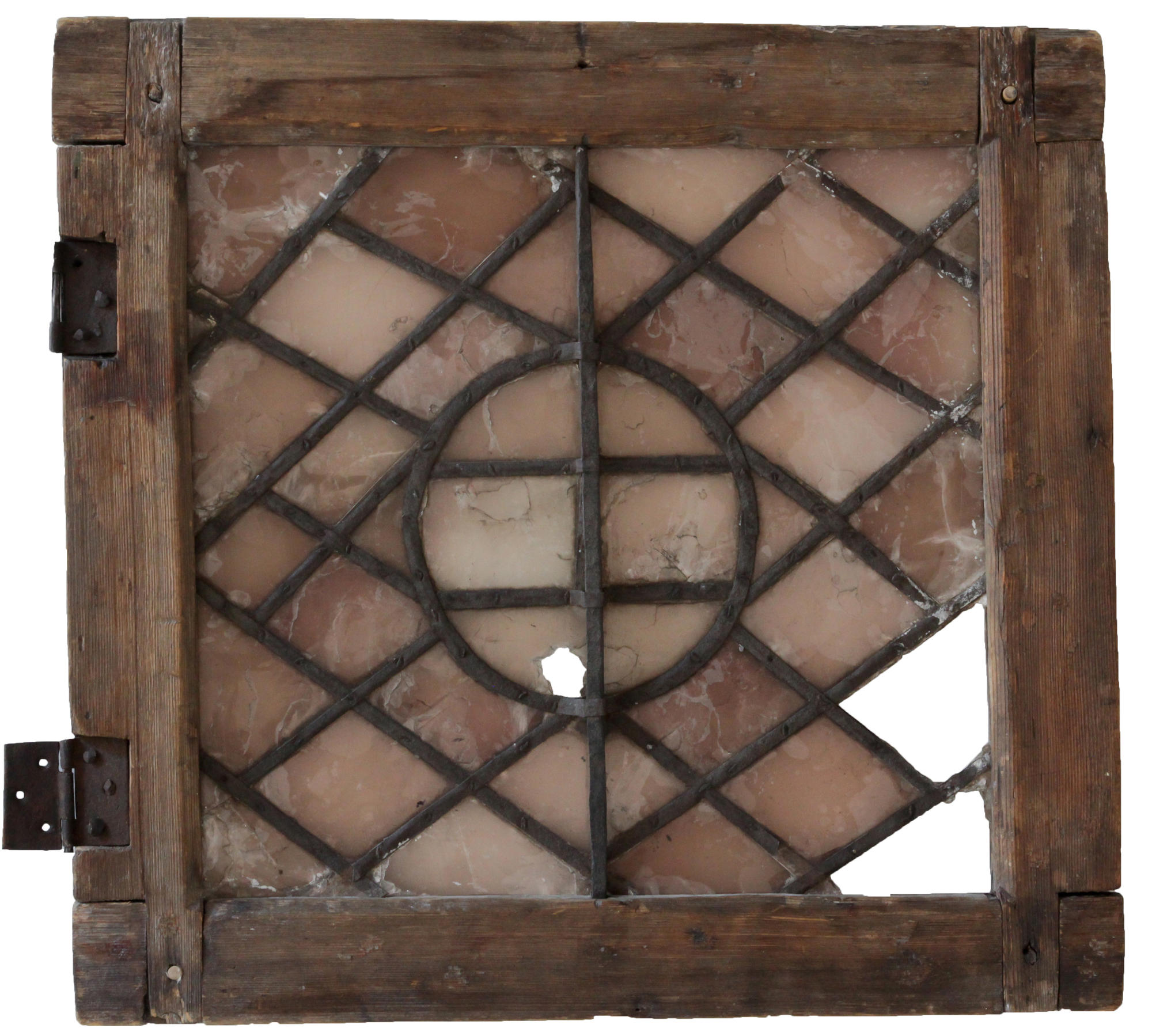
There were all kinds of different patterns of mica windows. The ‘squinting’ grid of diagonal stripes with diamond-shaped cells was the most widely used. Such windows were simple in execution, looked elegant and gave rigidity to the structure. Often in the centre of the ‘squinting’ grids, there could be of circles, ovals, octagons, flowers, which made the window frame even more elegant.
In the window opening, mica windows were mounted in a frame: nailed to it from the outside or inserted into the internal groove. The mica window was fixed tightly in the opening or hung on hinges.
This window entered the museum in 1920 from Kholmogory district. Prior to the founding of Arkhangelsk (1583-1584), the Kholmogory mountains were the trade and fishing centre of the Dvina lands. In the 17th century, mica was transported from Arkhangelsk to Moscow exclusively through Kholmogory.
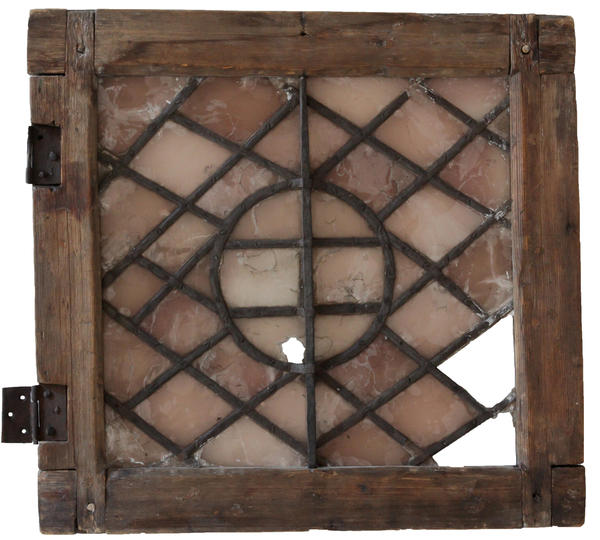
This is a mica, ‘squinting’ window, with hinges. A metal diagonal-rhombic grid with a circle in the centre is inserted into the wooden frame. Mica is inserted between the metal plates of the grid. The whole structure is attached with small studs. On the outside, the window is decorated with ‘burdocks’ — metal plates of a triangular shape, decorated along the edges with through-holes.