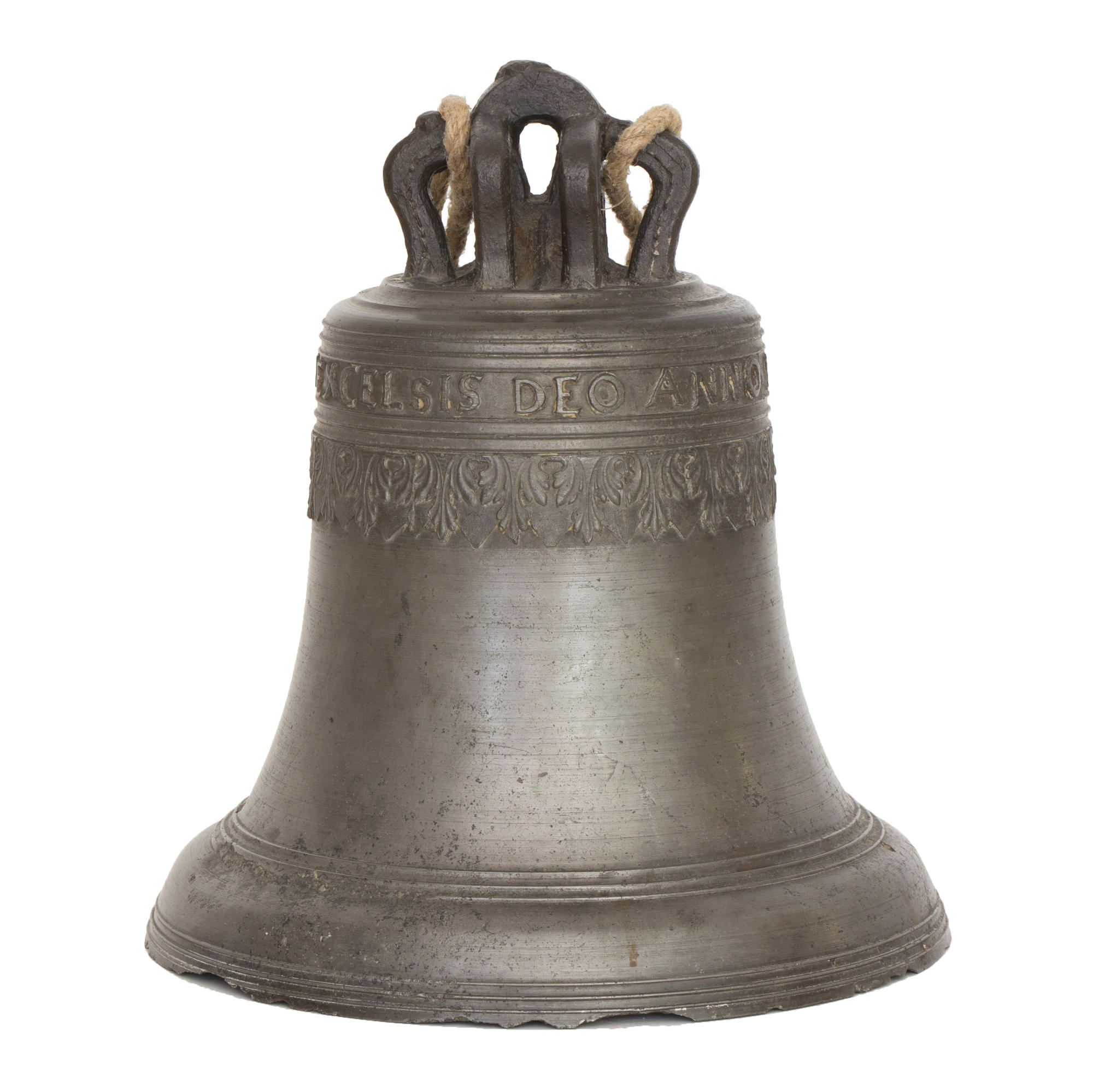


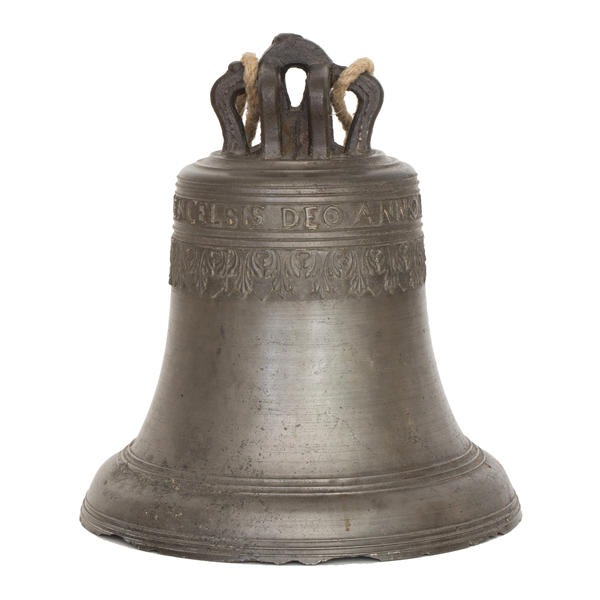
The bell was lifted from the bottom of the Severnaya Dvina River by the team of the Chernyshevsky excavation steamer. The representative of the Northern Technical Fleet, F. D. Grishin, gave it to the museum on August 6, 1941.
The bell has six eyelets for suspension. On the upper part of the body there is an encircled inscription: ‘GLORIA IN EXELSIS DEO ANNO 1619 MNN’ — ‘Glory to God in the highest. 1619’ ‘Gloria’ can also be translated as a liturgical hymn. Under the inscription there are two wide rings and a belt with floral ornaments. The body of the bell expands and thickens at the bottom (at the strike point), it is decorated with two rows of narrow rings. There is a droplet-shaped tongue inside the bell.
Bells and are an integral part of Russian culture. A part of the Orthodox worship, they rung ‘in the days of the triumphs and tribulations of the people.’ The bells announced the arrival of noble guests and the enemy, were a beacon for ships and lost travelers in the fog. They would sound the alarm about fires and called for gatherings. The bell was commonly treated as a talisman, and its ringing seen as a salvation from evil forces. Each church or temple complex, and sometimes chapels, had their belfries with a bunch of different-sized bells.
At numerous rural and village belfries, ringleaders, as a rule, were self-taught, and during the Easter week anyone could ring.
At numerous rural and village belfries, ringleaders, as a rule, were self-taught, and during the Easter week anyone could ring.
In the Russian North there were quite a few bells of Dutch production. From the 16th century, the bells of Amsterdam casting were sold to Russia by the rebellious Dutch Protestants. Calvinist reformers who fought against Catholicism firmly rejected objects of worship: sculptures, utensils, including bells. If the Dutch merchants who traded with Russia at first looked at the bells as iron scrap, they soon realized they could make a profit on them, since for the Russian Christians the bells were not only of a valuable material, but also spiritual value. The famous merchant and diplomat Jan Van de Walle brought them at the end of the 16th and the beginning of the 17th century in bulk. Dutch bells were decorated with ornamental belts, medallions depicting saints, and inscriptions. The inscriptions included the words of prayers, the date and place of manufacture, as well as the name of the master.