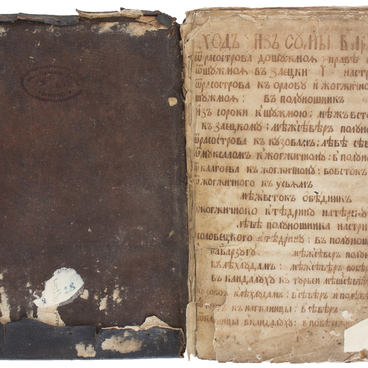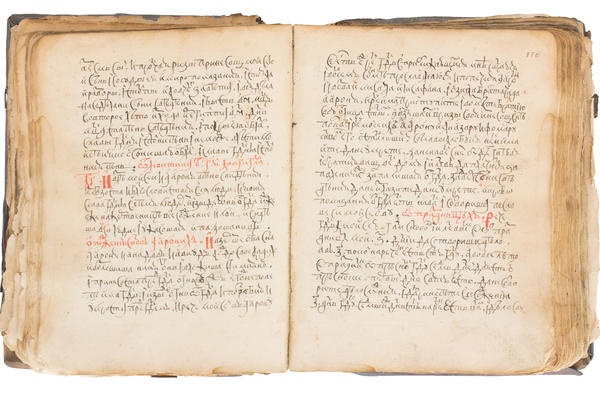
The manuscript ‘Chronograph’ dates back to the 17th century and was compiled by an unknown scribe. The book contains 252 pages of skoropis (cursive) writing. The headings and stylized floral ornaments are made in red. ‘Chronograph’ contains a retelling of biblical stories from Adam to the Flood, a retelling of the history of Russia from Rurik to the baptism of the Russian people, as well as extracts from the work ‘Alexandria’ (a description of the life of Alexander the Great, created in the 3rd century in Egypt). The book contains ‘owner’s records’ — signatures of those to whom it previously belonged, including several generations of the same family who owned it. The book was purchased by the museum at the Bukinist store in 1983.
Chronographs are monuments of Old Russian writing, collections of stories in which the world history from the creation was told. Chronographic texts have been known in Russia since the 14th century, but they began to be actively copied only from the 16th century. These were either translations from Greek or Old Russian retellings of the Holy Scripture, Greek chronicles and Russian chronicles. A significant part of them consisted of Old Testament stories that were retold in great detail. The Bible as a single collection of biblical books was unknown in medieval Russia until the end of the 15th century, and through chronographs, people got acquainted with the Old Testament.
The heyday of the chronographic genre was the 17th century. Given the rising interest of Russian people in history, chronographs began to include excerpts from Western European historical collections. Chronographs also contained information of a natural scientific nature, they recounted works of ancient literature, Christian Apocrypha, and excerpts from the lives of saints. The presentation of these stories was distinguished by the vivid narrative. People read chronographs for entertainment, so the stories were supposed to fascinate.
Unlike chronicles, for which historical truth and strict documentation of records were the most important things, stories in chronographs often had a moralizing connotation, and political events in them became a source for theological reasoning.