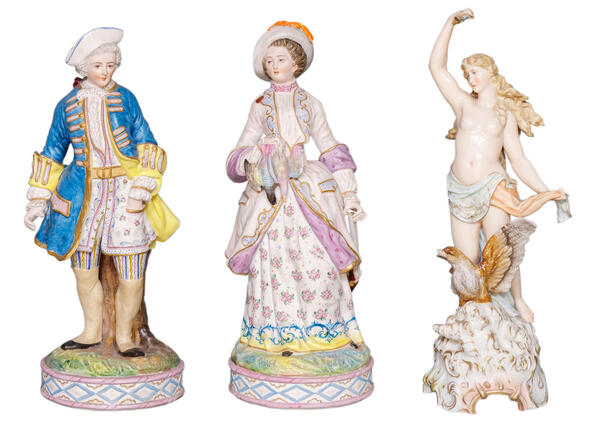
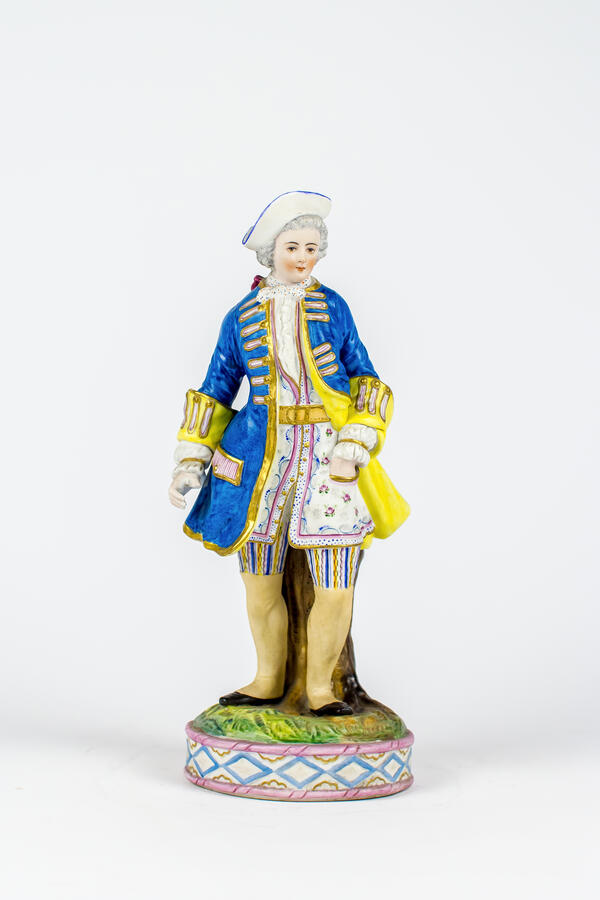
The statuette “A Hunter” was made at the private porcelain manufactory of Alexei Popov in the village of Gorbunovo, Dmitrov district, Moscow Governorate.
The statuette depicts a man in a wig and a white triangle. The hunter’s hair is pulled back in a ponytail and tied with a burgundy bow. The man is wearing a white vest with a floral pattern, breeches in a multicolored stripe and a blue camisole with yellow lapels and lining. The hunter had a rifle in his right hand, but it has not been preserved to the present day. All the smallest details of the statuette, down to the buttons on the golfs, are carefully worked out.
Until 1917, the figurine was stored in the house of one of the Tetyushi merchant families. After the nationalization of the merchant’s property, the workers and peasants' militia handed it over to the museum.
The Alexei Popov factory was one of the leading private porcelain enterprises in Russia in the first half of the 19th century.
Production at the Popov porcelain factory was based on the enterprise established by Carl Melli in the village of Gorbunovo in 1804. The factory made many different products: table and tea sets, vases, inkwells, inn utensils, porcelain figurines, plot compositions, animal sculptures and other elegant products. Initially, the factory produced sculptures based on the products of the Imperial Porcelain Factory, preferring romantic and gallant scenes, but later began to expand the range of products.
In terms of the standard of painting, the quality of the shard and the whiteness of the porcelain mass, the products of the Popov factory stood on a par with the famous Gardner porcelain, the products of the St. Petersburg Kornilov brothers' factory and the Imperial Porcelain Factory. The enterprise regularly presented its products at Russian art and industrial exhibitions and received honorary awards and medals. In 1833, Alexei Popov was awarded the Order of St. Stanislaus, 4th class, and in 1839 and 1841, his son Dmitry received the Order of St. Anne, 3rd class, and St. Vladimir, 4th class, for participation in industrial exhibitions.
The Popov factory used underglaze and overglaze porcelain painting, developed at the Imperial Porcelain Factory during the reign of Emperor Alexander I. The enterprise used an original palette of colors, which was rich in colors and in exquisite shades.
After the death of Alexei Popov, the factory was inherited by his children Dmitry and Tatiana, and afterwards by Dmitry’s sons. The last owner of the factory in 1875 was the merchant Fomichev. Gypsum molds for manifacturing figures and utensils were sold to the Ikonnikov factory, and paint recipes were sold to the Kornilov brothers' factory.
The statuette depicts a man in a wig and a white triangle. The hunter’s hair is pulled back in a ponytail and tied with a burgundy bow. The man is wearing a white vest with a floral pattern, breeches in a multicolored stripe and a blue camisole with yellow lapels and lining. The hunter had a rifle in his right hand, but it has not been preserved to the present day. All the smallest details of the statuette, down to the buttons on the golfs, are carefully worked out.
Until 1917, the figurine was stored in the house of one of the Tetyushi merchant families. After the nationalization of the merchant’s property, the workers and peasants' militia handed it over to the museum.
The Alexei Popov factory was one of the leading private porcelain enterprises in Russia in the first half of the 19th century.
Production at the Popov porcelain factory was based on the enterprise established by Carl Melli in the village of Gorbunovo in 1804. The factory made many different products: table and tea sets, vases, inkwells, inn utensils, porcelain figurines, plot compositions, animal sculptures and other elegant products. Initially, the factory produced sculptures based on the products of the Imperial Porcelain Factory, preferring romantic and gallant scenes, but later began to expand the range of products.
In terms of the standard of painting, the quality of the shard and the whiteness of the porcelain mass, the products of the Popov factory stood on a par with the famous Gardner porcelain, the products of the St. Petersburg Kornilov brothers' factory and the Imperial Porcelain Factory. The enterprise regularly presented its products at Russian art and industrial exhibitions and received honorary awards and medals. In 1833, Alexei Popov was awarded the Order of St. Stanislaus, 4th class, and in 1839 and 1841, his son Dmitry received the Order of St. Anne, 3rd class, and St. Vladimir, 4th class, for participation in industrial exhibitions.
The Popov factory used underglaze and overglaze porcelain painting, developed at the Imperial Porcelain Factory during the reign of Emperor Alexander I. The enterprise used an original palette of colors, which was rich in colors and in exquisite shades.
After the death of Alexei Popov, the factory was inherited by his children Dmitry and Tatiana, and afterwards by Dmitry’s sons. The last owner of the factory in 1875 was the merchant Fomichev. Gypsum molds for manifacturing figures and utensils were sold to the Ikonnikov factory, and paint recipes were sold to the Kornilov brothers' factory.