#1
Puzzle, Spectacles
#2
#8
#3
People have been fond of solving puzzles since ancient times, ingenious logical problems can be found on the walls of Egyptian pyramids, in ancient Greek manuscripts and other historical monuments. China and Mesopotamia could also contest the claim to be called pioneers in creating puzzles.
Puzzles saw their heyday in the 8th-9th centuries. The first ever collection of puzzles entitled ‘Tasks for the Development of a Young Mind’ came out in Europe at the time. Historians believe that it was authored by Irish educator Alcuin. At the turn of the 19th and 20th centuries, there was a new surge of fascination with logical problems and, in particular, push puzzles invented at the time. Another peak was the invention of the Rubik’s Cube in 1974. Puzzles known today can be divided into several types: oral, printed, mechanical type and those involving various items.
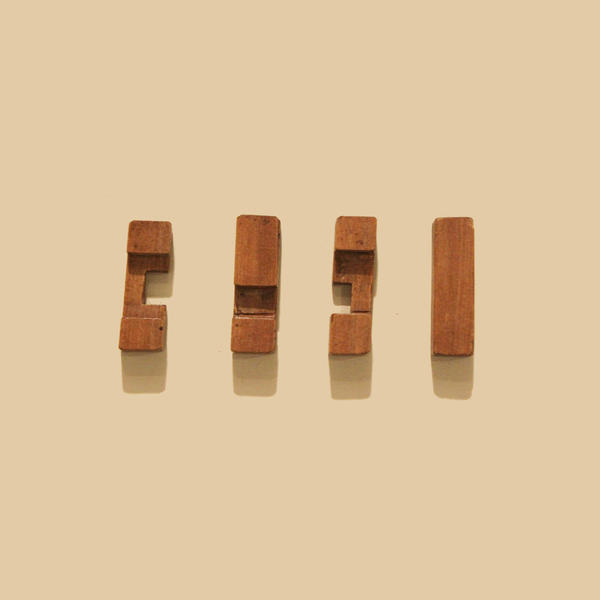
The puzzle presented in the museum’s collection is probably a ‘Chinese wood knot’, or a ‘burr’ brought by Chernyshevsky from his Siberian exile. In 1920, his son Mikhail Nikolaevich donated the puzzle to the museum; there are only four sticks of various shapes remaining from it, they are presented in the display case dedicated to his Vilyuisk period.
Chernyshevsky was transferred to Vilyuisk in 1871, after seven years of penal servitude. In letters to his relatives Nikolai Gavrilovich described the place of his exile as ‘a tiny town’, ‘something like a small oasis amidst a desert’, adding that ‘the air here is very healthy’ and ‘the river is abundant in fish; and excellent fish at that. "
When his wife Olga Sokratovna mentioned that she was trying to come to Vilyuisk, Chernyshevsky lowered the tone considerably telling her that ‘Vilyuisk is just called a town, but in reality it is not even a settlement, not even a village in the Russian sense of the word, it is something so deserted and small, that there is nothing like it anywhere in Russia’.
Chernyshevsky spent nearly 12 years in Vilyuisk prison built specially for important political and state offenders. He continued writing novels, novellas, short stories and treatises there, many of which he later burnt down or tore into small pieces letting them to be carried away by the river. Of all the manuscripts written during his Vilyuisk period there remained only a few fragments of his novel ‘The Reflections of Radiance’.
Puzzles saw their heyday in the 8th-9th centuries. The first ever collection of puzzles entitled ‘Tasks for the Development of a Young Mind’ came out in Europe at the time. Historians believe that it was authored by Irish educator Alcuin. At the turn of the 19th and 20th centuries, there was a new surge of fascination with logical problems and, in particular, push puzzles invented at the time. Another peak was the invention of the Rubik’s Cube in 1974. Puzzles known today can be divided into several types: oral, printed, mechanical type and those involving various items.
The puzzle presented in the museum’s collection is probably a ‘Chinese wood knot’, or a ‘burr’ brought by Chernyshevsky from his Siberian exile. In 1920, his son Mikhail Nikolaevich donated the puzzle to the museum; there are only four sticks of various shapes remaining from it, they are presented in the display case dedicated to his Vilyuisk period.
Chernyshevsky was transferred to Vilyuisk in 1871, after seven years of penal servitude. In letters to his relatives Nikolai Gavrilovich described the place of his exile as ‘a tiny town’, ‘something like a small oasis amidst a desert’, adding that ‘the air here is very healthy’ and ‘the river is abundant in fish; and excellent fish at that. "
When his wife Olga Sokratovna mentioned that she was trying to come to Vilyuisk, Chernyshevsky lowered the tone considerably telling her that ‘Vilyuisk is just called a town, but in reality it is not even a settlement, not even a village in the Russian sense of the word, it is something so deserted and small, that there is nothing like it anywhere in Russia’.
Chernyshevsky spent nearly 12 years in Vilyuisk prison built specially for important political and state offenders. He continued writing novels, novellas, short stories and treatises there, many of which he later burnt down or tore into small pieces letting them to be carried away by the river. Of all the manuscripts written during his Vilyuisk period there remained only a few fragments of his novel ‘The Reflections of Radiance’.
#4
Author: unknown
Date: 1870s
Technique: hand-made
Dimensions: the length of each stick is 45 mm
Collection: Artefacts
Copyright: Municipal institution of culture The Memorial Estate of N.G. Chernyshevsky
Goskatalog Number: 18310908
Date: 1870s
Technique: hand-made
Dimensions: the length of each stick is 45 mm
Collection: Artefacts
Copyright: Municipal institution of culture The Memorial Estate of N.G. Chernyshevsky
Goskatalog Number: 18310908
#5
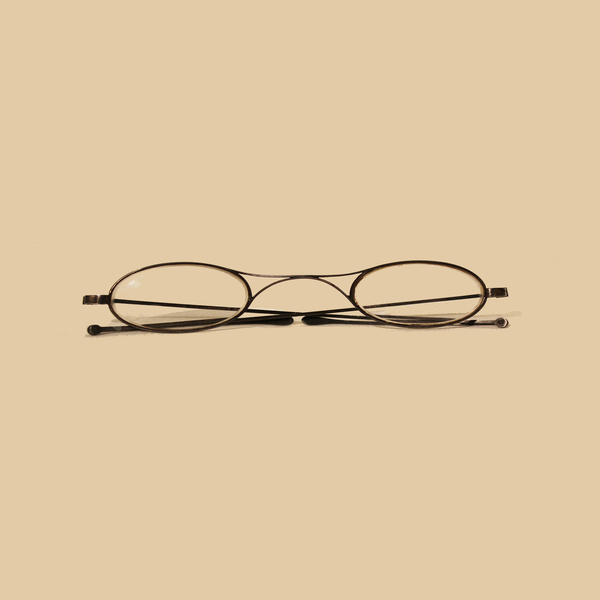
Nikolay Gavrilovich Chernyshevsky’s Spectacles of his Astrakhan Life Period, in Metal Frame and with Paper Case
#9
#6
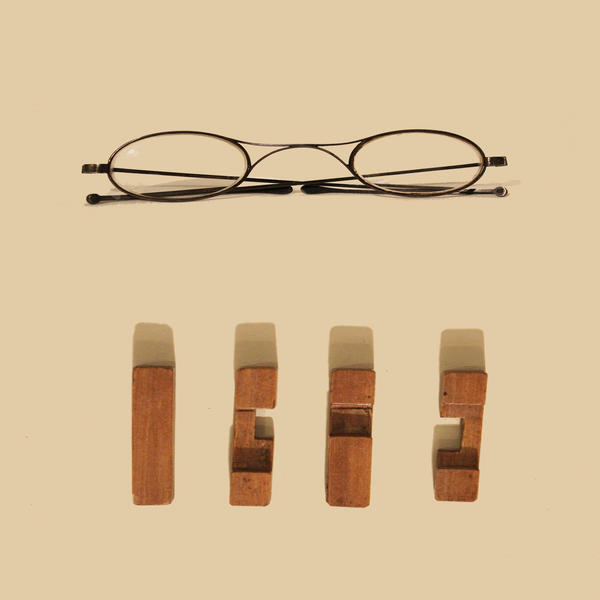
The pride of the exhibits of the Memorial Estate is held by N.G. Chernyshevsky’s spectacles of the period of 1880s. It is exactly these spectacles that can be seen in photographs by Stanislava Klimashevskaya taken in Astrakhan in 1883 and 1888.
N.G. Chernyshevsky’s appearance was influenced by his habits, tastes and ideological convictions. After his exile in Siberia, Chernyshevsky grew long hair and a beard: alongside with his modest suit, simple peak cap and cheap spectacles they made him look like an aged Russian workman.
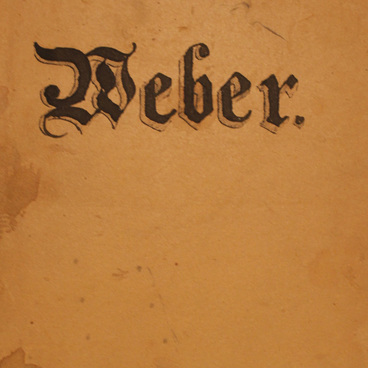
N.G. Chernyshevsky’s everyday unpretentiousness was caused by his oddness that grew even stronger after his Siberian tribulations. The writer did not care for expensive things and demonstrated utter disregard thereof. To some extent, that resulted from absence of steady income up until March 1885. At that time, Chernyshevsky started the largest work of the last years of his life: translation into Russian of the 15-volume General History by Georg Weber.
Also in Astrakhan Chernyshevsky wrote his Notes While Reading Nekrasov, personal memoirs of his acquaintance with N.A. Dobrolubov, autobiographic excerpts Grandmother’s Stories and Our Happiness. His contemporaries were amazed with Nikolay Chernyshevsky’s industriousness that he retained after the penal servitude and exile in Vilyuisk: at the age of 60, having weak health, he worked “at least 14 hours a day”. Olga Sokratrovna tried to keep strict watch of her husband’s daily routine and did not allow him to work by night.
In addition, Chernyshevsky retained his love of books. In Astrakhan, he joined a library and started using books of its collection. Moreover, when Chernyshevsky lived in his last apartment in Astrakhan, in the house of Stepan Karamyshev, he always had books from the landlord’s extensive library close at hand.
In this context, Chernyshevsky hardly needed his spectacles for reading: the writer was short sighted, and he could clearly see texts in books and magazines. Most probably, he needed spectacles for household needs and when communicating with people: in the Astrakhan exile, the Chernyshevskys family were visited by their close relatives, as well as by progressive journalists, publishers, newspaper editors, scientists.
N.G. Chernyshevsky’s appearance was influenced by his habits, tastes and ideological convictions. After his exile in Siberia, Chernyshevsky grew long hair and a beard: alongside with his modest suit, simple peak cap and cheap spectacles they made him look like an aged Russian workman.
N.G. Chernyshevsky’s everyday unpretentiousness was caused by his oddness that grew even stronger after his Siberian tribulations. The writer did not care for expensive things and demonstrated utter disregard thereof. To some extent, that resulted from absence of steady income up until March 1885. At that time, Chernyshevsky started the largest work of the last years of his life: translation into Russian of the 15-volume General History by Georg Weber.
Also in Astrakhan Chernyshevsky wrote his Notes While Reading Nekrasov, personal memoirs of his acquaintance with N.A. Dobrolubov, autobiographic excerpts Grandmother’s Stories and Our Happiness. His contemporaries were amazed with Nikolay Chernyshevsky’s industriousness that he retained after the penal servitude and exile in Vilyuisk: at the age of 60, having weak health, he worked “at least 14 hours a day”. Olga Sokratrovna tried to keep strict watch of her husband’s daily routine and did not allow him to work by night.
In addition, Chernyshevsky retained his love of books. In Astrakhan, he joined a library and started using books of its collection. Moreover, when Chernyshevsky lived in his last apartment in Astrakhan, in the house of Stepan Karamyshev, he always had books from the landlord’s extensive library close at hand.
In this context, Chernyshevsky hardly needed his spectacles for reading: the writer was short sighted, and he could clearly see texts in books and magazines. Most probably, he needed spectacles for household needs and when communicating with people: in the Astrakhan exile, the Chernyshevskys family were visited by their close relatives, as well as by progressive journalists, publishers, newspaper editors, scientists.
#7
Author: unknown
Date: 1880s
Technique: manual assembly
Dimensions: 110 cm long
Collection: Artefacts
Copyright: Municipal institution of culture The Memorial Estate of N.G. Chernyshevsky
Goskatalog Number: 1830938
Date: 1880s
Technique: manual assembly
Dimensions: 110 cm long
Collection: Artefacts
Copyright: Municipal institution of culture The Memorial Estate of N.G. Chernyshevsky
Goskatalog Number: 1830938
read morehide
00:00
00:00
1x
Puzzle, Spectacles
Exhibition
0
 Point your smartphone camera to open in the app
Open in app
Share