#1
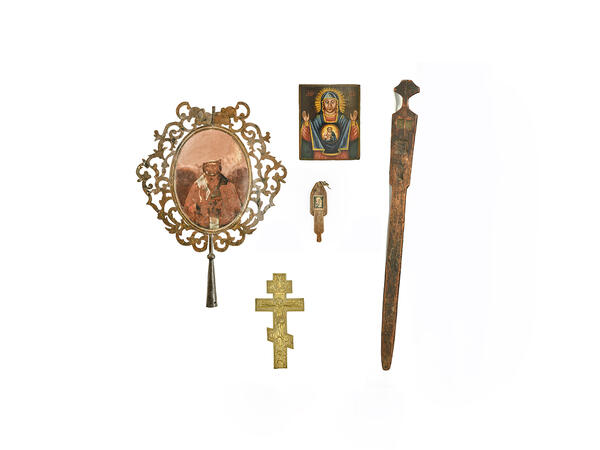
Icon, Iconostasis, Mother of God, Altar hand blessing cross, Gonfalon
#2
#22
Icon
#3
The Bishop’s House collection includes a small icon of the Mother of God of Rome. It was made in the second half of the 19th century. Such an icon was popular among Siberian indigenous peoples, especially with the Ostyak-Samoyeds — the name of the Selkups in bygone days.
The icon belongs to the Hodegetria type — the name is translated as “Our Lady of the Way” from Greek. Legend has it that Luke the Evangelist painted the first image of this type. The Virgin is depicted with the Christ Child in her left hand while pointing to him with her right hand. In his left hand, Jesus holds a scroll of the Holy Scripture, raising his right hand in the gesture of Christian blessing. In the museum’s icon, the Mother of God has slightly inclined her head toward Christ; while usually, she is depicted standing straight. The Hodegetria iconographic type includes many icons especially revered in Russia: the Kazan Icon of the Mother of God, the Tikhvin Icon of Mother of God, the Iviron Icon of the Mother of God, and Icon of the Three Hands. These icons have special celebration days in the Orthodox calendar.
It is believed, that the first icon of the Mother of God of Rome, or Mother of God of Lydda, was not made by human hands. It appeared in the city of Lydda on the modern Israel territory. According to Christian legend, the Apostles Peter and Paul founded a church in this area, where the Mother of God with Christ’s image had appeared on a stone pillar. A replica of this icon was made for Hermogenes Patriarch of Constantinople According to legend, during Byzantine iconoclasm times, Hermogenes let out the icon Mother of God of Lydda into the sea. The icon sailed as far as Rome and remained there until those in Constantinople began to worship the holly images again.
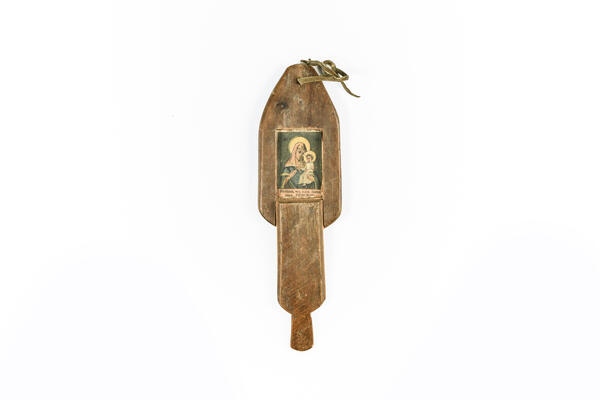
The icon of the Mother of God of Rome from the Tobolsk Museum was printed on paper and attached to a flat wooden base with a rounded lower edge and pointed upper part. A round hole was drilled in the cover for inserting a deerskin chamois lace. This lace was used to hang the icon. The icon was placed in the recess and closed with a hinged wooden cover. The wooden parts had to fit tight: such a case protected the icon from moisture and damage during long journeys.
The icon belongs to the Hodegetria type — the name is translated as “Our Lady of the Way” from Greek. Legend has it that Luke the Evangelist painted the first image of this type. The Virgin is depicted with the Christ Child in her left hand while pointing to him with her right hand. In his left hand, Jesus holds a scroll of the Holy Scripture, raising his right hand in the gesture of Christian blessing. In the museum’s icon, the Mother of God has slightly inclined her head toward Christ; while usually, she is depicted standing straight. The Hodegetria iconographic type includes many icons especially revered in Russia: the Kazan Icon of the Mother of God, the Tikhvin Icon of Mother of God, the Iviron Icon of the Mother of God, and Icon of the Three Hands. These icons have special celebration days in the Orthodox calendar.
It is believed, that the first icon of the Mother of God of Rome, or Mother of God of Lydda, was not made by human hands. It appeared in the city of Lydda on the modern Israel territory. According to Christian legend, the Apostles Peter and Paul founded a church in this area, where the Mother of God with Christ’s image had appeared on a stone pillar. A replica of this icon was made for Hermogenes Patriarch of Constantinople According to legend, during Byzantine iconoclasm times, Hermogenes let out the icon Mother of God of Lydda into the sea. The icon sailed as far as Rome and remained there until those in Constantinople began to worship the holly images again.
The icon of the Mother of God of Rome from the Tobolsk Museum was printed on paper and attached to a flat wooden base with a rounded lower edge and pointed upper part. A round hole was drilled in the cover for inserting a deerskin chamois lace. This lace was used to hang the icon. The icon was placed in the recess and closed with a hinged wooden cover. The wooden parts had to fit tight: such a case protected the icon from moisture and damage during long journeys.
#4
Полное наименование предмета: Ancient Samoyedic or Ostyak icon
Дата создания: mid-to-late 19th century
Дата создания: mid-to-late 19th century
Техника: carving
Владелец коллекции: Bishop’s House
Размеры: 23×11 cm
Номер в Госкаталоге: 4109830
Владелец коллекции: Bishop’s House
Размеры: 23×11 cm
Номер в Госкаталоге: 4109830
#6
Iconostasis
#23
Iconostasis
#8
A portable iconostasis was necessary for praying to God when there was no church, for example during a journey or away from home. Thus one could avoid carrying numerous icons, which took up space and increased the weight of the luggage. Moreover, the iconostasis provided believers with all the necessary icons. In military regiments, such items were usually called folding icons and consisted of several metal plates, which could be easily folded or unfolded if necessary.
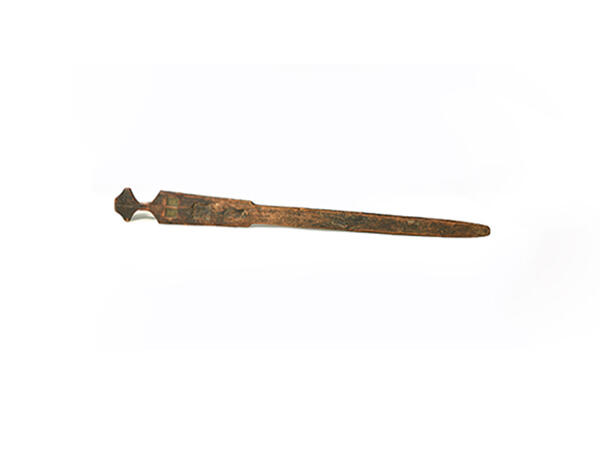
The portable iconostases of Siberian priests looked different. The Tobolsk Historical and Architectural Museum-Reserve houses one such exhibit. It looks like an oblong dagger, with a carved pommel and rounded point, which was probably used to hold the object upright during worship services. The item was carved from a single piece of wood and painted reddish brown.
The pommel is diamond-shaped, with a carved four-pointed cross. It is connected to the middle part by a thin link. The central part is made as a rectangular blade slightly flaring upwards. Four recesses are arranged in three rows. Miniature copper icons of Jesus Christ and Nicholas the Wonderworker have survived in the two upper rows. The edges are decorated with floral patterns. The other three recesses have an irregular shape, and the icons in them have been lost.
In Siberia, Orthodox priests had to travel time and again through the eparchy. They went to indigenous peoples and preached to convert them to the Christian faith. In addition, the clergymen studied local languages, treated the sick, encouraged commerce, and educated the nomads.
It was often difficult to find an Orthodox church nearby during these trips. The indigenous peoples had no churches and there could be many kilometers from towns and villages. Therefore, worships were often performed on the way. Sometimes people had to pray in the open air, though more often the priests set up a special camp church, a light structure made of available materials.
The portable iconostases of Siberian priests looked different. The Tobolsk Historical and Architectural Museum-Reserve houses one such exhibit. It looks like an oblong dagger, with a carved pommel and rounded point, which was probably used to hold the object upright during worship services. The item was carved from a single piece of wood and painted reddish brown.
The pommel is diamond-shaped, with a carved four-pointed cross. It is connected to the middle part by a thin link. The central part is made as a rectangular blade slightly flaring upwards. Four recesses are arranged in three rows. Miniature copper icons of Jesus Christ and Nicholas the Wonderworker have survived in the two upper rows. The edges are decorated with floral patterns. The other three recesses have an irregular shape, and the icons in them have been lost.
In Siberia, Orthodox priests had to travel time and again through the eparchy. They went to indigenous peoples and preached to convert them to the Christian faith. In addition, the clergymen studied local languages, treated the sick, encouraged commerce, and educated the nomads.
It was often difficult to find an Orthodox church nearby during these trips. The indigenous peoples had no churches and there could be many kilometers from towns and villages. Therefore, worships were often performed on the way. Sometimes people had to pray in the open air, though more often the priests set up a special camp church, a light structure made of available materials.
#9
Полное наименование предмета: Portable iconostasis
Дата создания: the mid- to late 19th century
Техника: carving
Место создания: Bishop’s House
Размеры: 96×8,5×2 cm
Номер в Госкаталоге: 4109797
Дата создания: the mid- to late 19th century
Техника: carving
Место создания: Bishop’s House
Размеры: 96×8,5×2 cm
Номер в Госкаталоге: 4109797
#10
Mother of God
#24
Mother of God
#12
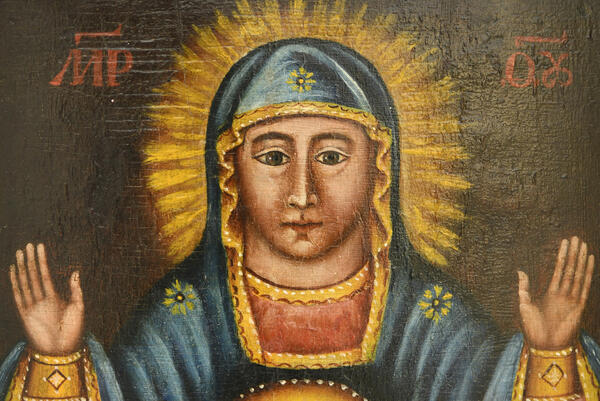
It is customary to depict the Mother of God with her hands raised and palms open on icons of the ‘Sign’ type. This gesture symbolizes prayer for all Christians, including sinners, and intercession before Christ. Emmanuel — Christ as a teenage boy — is depicted on the chest of the Virgin in a round medallion. Such an image was supposed to remind parishioners of the dual nature of Jesus: he was not only God but also a man — he grew up and came of age like an ordinary child.
The icon from the collection of the Bishop’s House is painted in uncharacteristically bright colors — blue, red, green instead of the usual muted and dark tones of Russian icon painting. The Virgin wears a red tunic with a gold border at the collar. Her head and shoulders are covered with a maphorium — a blue veil with golden trim and three stars that are located on the forehead and shoulders of the Mother of God: they symbolize her purity before, during, and after the birth of Jesus. The maphorium was most often depicted in red; the blue color of this item is rare in Russian icons.
Emmanuel is depicted in a circle, the border of which is marked with white dots. Christ wears a pink chiton and a blue himation (cloak). In one hand, he has a scroll. He seems to hold his other hand in the gesture of blessing. His whole figure is surrounded by light, and there is a radiant halo around the head of the Mother of God.
Most of the small details of the icon have a special religious meaning. For example, golden brocade cuffs symbolize the allegiance to Christ and the church. The red and gold colors in the attire of the Mother of God serve as a symbol of her divine power over believers.
The face and figure of the Mother of God are painted in an unusual way: her neck looks massive, her face is wide, the facial features are heavy, and the inward slant of the eyes makes her look like the women of Siberian nomadic peoples. Christ, the Mother of God, and saints were often depicted in such a way if the icon was intended for different ethnic groups. Women were painted with a Mongoloid eye shape, and men often acquired long hanging mustaches like those that the Tatars had. At the same time, their robes remained the same, similar to the Greek ones.
The icon from the collection of the Bishop’s House is painted in uncharacteristically bright colors — blue, red, green instead of the usual muted and dark tones of Russian icon painting. The Virgin wears a red tunic with a gold border at the collar. Her head and shoulders are covered with a maphorium — a blue veil with golden trim and three stars that are located on the forehead and shoulders of the Mother of God: they symbolize her purity before, during, and after the birth of Jesus. The maphorium was most often depicted in red; the blue color of this item is rare in Russian icons.
Emmanuel is depicted in a circle, the border of which is marked with white dots. Christ wears a pink chiton and a blue himation (cloak). In one hand, he has a scroll. He seems to hold his other hand in the gesture of blessing. His whole figure is surrounded by light, and there is a radiant halo around the head of the Mother of God.
Most of the small details of the icon have a special religious meaning. For example, golden brocade cuffs symbolize the allegiance to Christ and the church. The red and gold colors in the attire of the Mother of God serve as a symbol of her divine power over believers.
The face and figure of the Mother of God are painted in an unusual way: her neck looks massive, her face is wide, the facial features are heavy, and the inward slant of the eyes makes her look like the women of Siberian nomadic peoples. Christ, the Mother of God, and saints were often depicted in such a way if the icon was intended for different ethnic groups. Women were painted with a Mongoloid eye shape, and men often acquired long hanging mustaches like those that the Tatars had. At the same time, their robes remained the same, similar to the Greek ones.
#13
Полное наименование предмета: “The Mother of God of the Sign” Icon
Дата создания: the 19th century
Техника: gesso, oil
Владелец коллекции: Bishop’s House
Размеры: 29×23 cm
Дата создания: the 19th century
Техника: gesso, oil
Владелец коллекции: Bishop’s House
Размеры: 29×23 cm
#14
Altar hand blessing cross
#25
Altar hand blessing cross
#15
The altar hand blessing cross is a mandatory attribute of every Orthodox Church. It is placed in the altar, on a small rectangular table, which is called the communion table. The Gospel, the antimins (a quadrangular large piece of linen cloth containing relics), and the ciborium for the Communion prosphora and wine are placed on the table. In Orthodox Christian tradition, the communion table is considered the place where Christ is invisibly present during service. The altar hand blessing cross is used by priests to bless the congregation, consecrate water, and is used in Cross Procession. Parishioners also kiss it after prayer.
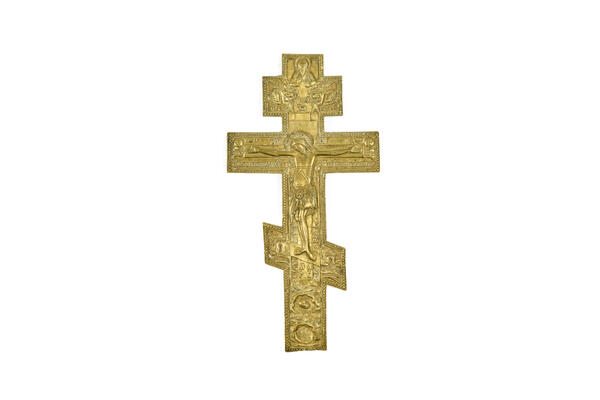
The altar hand blessing cross from the collection of the Tobolsk Museum is made of copper. In Siberia, this metal was one of the most popular materials for church items, folding icons, and pectoral crosses. People extracted copper in large quantities; it was easy to process and relatively cheap.
The cross has eight points: in addition to the main crossbar, there are two more at the top and bottom. Around the perimeter, it is fringed with a thin rim. Almost the entire surface is decorated with a relief pattern. At the top of the cross, there is a figure of Sabaoth, or God the Father. Underneath, one can see angels flying with scarves in their hands, and between them, there is a dove, which represents the Holy Spirit.
In the central part of the cross, there is a relief figure of the crucified Jesus. His head is crowned with a patterned halo and a cross inside of it. Near the Savior’s palms, there is a picture of the moon and the sun, and at his feet is a human skull or Adam’s head. Legend has it that the first man on earth was buried on Calvary. Christ’s blood was shed on Adam’s remains during crucifixion and thus it symbolically cleansed the entire human race of its sins.
On the lower slanting crossbar, the master depicted a view of Jerusalem. The outline of the Calvary cross and the text of the canon to the Life-Giving Cross are embossed on the back of the piece,
The altar hand blessing cross from the collection of the Tobolsk Museum is made of copper. In Siberia, this metal was one of the most popular materials for church items, folding icons, and pectoral crosses. People extracted copper in large quantities; it was easy to process and relatively cheap.
The cross has eight points: in addition to the main crossbar, there are two more at the top and bottom. Around the perimeter, it is fringed with a thin rim. Almost the entire surface is decorated with a relief pattern. At the top of the cross, there is a figure of Sabaoth, or God the Father. Underneath, one can see angels flying with scarves in their hands, and between them, there is a dove, which represents the Holy Spirit.
In the central part of the cross, there is a relief figure of the crucified Jesus. His head is crowned with a patterned halo and a cross inside of it. Near the Savior’s palms, there is a picture of the moon and the sun, and at his feet is a human skull or Adam’s head. Legend has it that the first man on earth was buried on Calvary. Christ’s blood was shed on Adam’s remains during crucifixion and thus it symbolically cleansed the entire human race of its sins.
On the lower slanting crossbar, the master depicted a view of Jerusalem. The outline of the Calvary cross and the text of the canon to the Life-Giving Cross are embossed on the back of the piece,
#27
The cross is the guardian of the universe, the cross is the beauty of the church, the cross is the power of kings, the cross is the statement to the faithful, the cross is the glory of angels, the cross is anathema to demons.
#16
Полное наименование предмета: Altar hand blessing cross
Дата создания: the 19th century
Техника: casting
Владелец коллекции: Bishop’s House
Размеры: 40×20 cm
Техника: casting
Владелец коллекции: Bishop’s House
Размеры: 40×20 cm
#18
Gonfalon
#26
Gonfalon
#20
A gonfalon is the oldest kind of banner. In olden times, when Russian soldiers went on a military campaign they took banners with the images of Christ, the Mother of God, the Trinity, or the most revered saints. They believed that the heavenly host would protect them in battle and help to win. Soldiers treated gonfalons with special care and made sure that the enemy would not capture or shoot arrows and damage the sacred images.
In Imperial Russia, each regiment had its own heavenly patron and a banner with his image. Historian Pavel Savvaitov so described the military gonfalons of 16th — 17th centuries:
In Imperial Russia, each regiment had its own heavenly patron and a banner with his image. Historian Pavel Savvaitov so described the military gonfalons of 16th — 17th centuries:
#28
The cloth was made in the form of a quadrangle of taffeta, damask, kindik, red bunting, dowlas; often the bottom corner of it, not adjacent to the flagstaff, was cut off, and the rest was a slope, instead of which the two or three tails were sometimes made in the form of wedges.
#29
Church gonfalons looked a little different from military ones. The cloth was attached to a crossbar on the shaft with cords. Such banners were intended for solemn processions on holidays. They were carried in front of the procession by special servants, gonfalon-bearers.
The most popular material for church banners was fabric of different kinds. The fabric was decorated with sacred images, that were painted, embroidered, or created in the appliqué technique. They were decorated with gold and silver threads, cords, tassels and fringe.
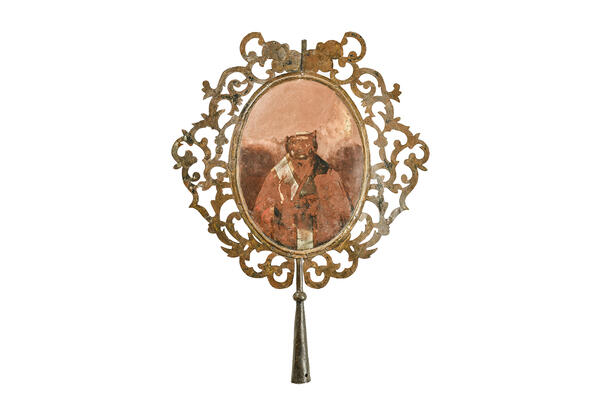
There were also metal gonfalons. They were more durable than fabric ones and did not fade with time. The exhibit from the Bishop’s House collection belongs to this type. The upper part of the gonfalon is framed by an openwork metal ornament; it still bears traces of the gilding. In the center, there is a painted image of Saint Nicholas the Wonderworker — the patron saint of farmers, children, soldiers and travelers, one of the most revered saints in Russia. The saint wears a bishop’s liturgical vestment: a broad long sakkos of red cloth and an omophorion — a long white band, which was worn around the neck and descended on the chest. The right hand of Nicholas the Wonderworker is raised, his fingers are folded in the gesture of blessing. The image has not been preserved in its entirety: some of the paint has faded and crumbled over time.
The most popular material for church banners was fabric of different kinds. The fabric was decorated with sacred images, that were painted, embroidered, or created in the appliqué technique. They were decorated with gold and silver threads, cords, tassels and fringe.
There were also metal gonfalons. They were more durable than fabric ones and did not fade with time. The exhibit from the Bishop’s House collection belongs to this type. The upper part of the gonfalon is framed by an openwork metal ornament; it still bears traces of the gilding. In the center, there is a painted image of Saint Nicholas the Wonderworker — the patron saint of farmers, children, soldiers and travelers, one of the most revered saints in Russia. The saint wears a bishop’s liturgical vestment: a broad long sakkos of red cloth and an omophorion — a long white band, which was worn around the neck and descended on the chest. The right hand of Nicholas the Wonderworker is raised, his fingers are folded in the gesture of blessing. The image has not been preserved in its entirety: some of the paint has faded and crumbled over time.
#21
Полное наименование предмета: Metal oval gonfalon in an openwork frame
Дата создания: the early 20th century
Дата создания: the early 20th century
Техника: forging, painting
Место создания: Mulymya village, Kondinsky District, Khanty-Mansi Autonomous Okrug
Владелец коллекции: Bishop’s House
Место создания: Mulymya village, Kondinsky District, Khanty-Mansi Autonomous Okrug
Владелец коллекции: Bishop’s House
Размеры: 79×56,5 cm
Номер в Госкаталоге: 3547467
Номер в Госкаталоге: 3547467
#30
Ministry of Culture of the Russian Federation
read morehide
00:00
00:00
1x
Icon, Iconostas, Mother of God, Cross, Gonfalon
Collection
1
 Point your smartphone camera to open in the app
Open in app
Share