The scabbard sheath was found in 1994 in the PrivOlzhsky District of the Astrakhan Region. Archaeologists discovered there a burial destroyed by time and by treasure hunters who tried to ransack the grave. The burial contained the skeleton of a teenage boy.
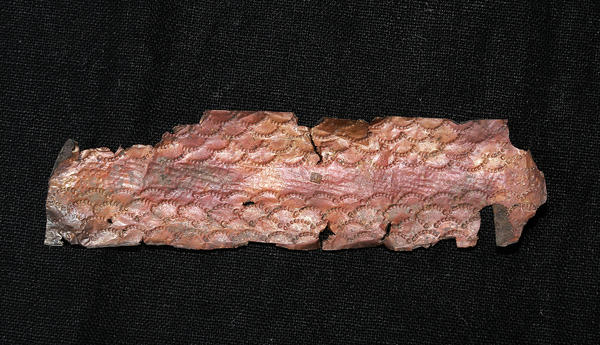
A lot of items were found with the buried boy. It was a short sword 33 cm long. Its scabbard was decorated with a gold foil sheath covered with a geometric ornament in the form of scales. Researchers believe that the scabbard sheath was crafted around the 5th–10th centuries AD. The ornament is a result of repoussé work. To this end, an ancient craftsman used an embossing die. The tool was positioned upright and hammered to leave traces on the metal. The scaly pattern on our exhibit is formed by rows of semicircular arches.
A similar style of ornamentation is well known among the nomadic people Huns who broke into the Eastern Europe in the 4th century AD from Asia. This invasion had historical consequences for Europe and marked the beginning of the Great Migration. Like any other nomadic army the Huns were replenished with conquered peoples during their campaigns, including the Sarmatians who inhabited the steppe of Eurasia at that time. However, the Huns practically did not leave any traces of their stay in the Astrakhan region, even though, apparently, it was the region where their army crossed the Volga River.
The Huns adorned saddles and scabbards with scaly decorated gold foils. A similar pattern spread widely across Europe, the Caucasus and other regions. Some researchers believed that the ornament beloved by the Huns could have oriental roots and probably imitate bird feathers. However, there is also an opinion that the ancient craftsmen tried to depict the skin of a snake in a similar way.
Another popular decors among the Huns are plaques depicting male faces to decorate horse harnesses. Such faces are rather Mongoloid, although sometimes they have a rather thick beard that is unusual for Mongoloid men.
A lot of items were found with the buried boy. It was a short sword 33 cm long. Its scabbard was decorated with a gold foil sheath covered with a geometric ornament in the form of scales. Researchers believe that the scabbard sheath was crafted around the 5th–10th centuries AD. The ornament is a result of repoussé work. To this end, an ancient craftsman used an embossing die. The tool was positioned upright and hammered to leave traces on the metal. The scaly pattern on our exhibit is formed by rows of semicircular arches.
A similar style of ornamentation is well known among the nomadic people Huns who broke into the Eastern Europe in the 4th century AD from Asia. This invasion had historical consequences for Europe and marked the beginning of the Great Migration. Like any other nomadic army the Huns were replenished with conquered peoples during their campaigns, including the Sarmatians who inhabited the steppe of Eurasia at that time. However, the Huns practically did not leave any traces of their stay in the Astrakhan region, even though, apparently, it was the region where their army crossed the Volga River.
The Huns adorned saddles and scabbards with scaly decorated gold foils. A similar pattern spread widely across Europe, the Caucasus and other regions. Some researchers believed that the ornament beloved by the Huns could have oriental roots and probably imitate bird feathers. However, there is also an opinion that the ancient craftsmen tried to depict the skin of a snake in a similar way.
Another popular decors among the Huns are plaques depicting male faces to decorate horse harnesses. Such faces are rather Mongoloid, although sometimes they have a rather thick beard that is unusual for Mongoloid men.