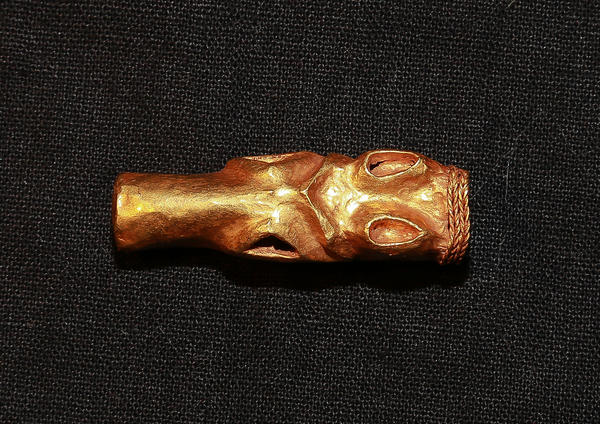
The zoomorphic head made of a gold plate is a styled horse head and a tip of an unknown object. Most likely, it was fixed on a wooden or bone base.
There are four holes punched along the object edges for nails. There is a round hole in the place of the mouth; the eye sockets are marked with triangular depressions with holes in the middle; the ears are drop-shaped holders. Holders are special recesses to fix stones or coloured glass.
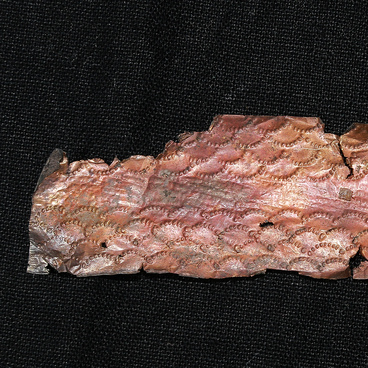
The zoomorphic head was found in the course of archaeological activities at the ‘royal burial mound’ in 1984 near the KOsika village of the YenotAyevsky District of the Astrakhan Region. Here, during the excavation activities, a burial mound of a Sarmatian leader was discovered. The bones of the skeleton were attributed to a man about 35 years old. The leader’s clothes were made of leather and decorated with gold sewn-on appliqués shaped as a styled ram’s head, a ram’s skin with a knot in the middle, and with square-shaped appliqués.
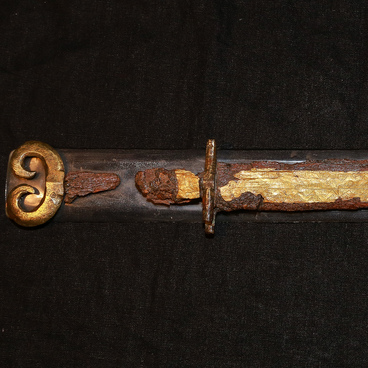
Besides the appliqués and a tip, a rich set of things was found in the burial mound. It correlates with an important milestone in the history of the Sarmatians: the aristocracy began to isolate itself from the rest of the society, and some Sarmatian tribal associations experienced the beginnings of statehood. A heavy gold pectoral was also found in the burial mound. Similar values were kept in the treasuries of the Sarmatian leaders. The pectoral was decorated with repoussé scenes of torments. They depict fantastic griffins and lions sinking their teeth into a deer, ram and bull. A large gold double-sided bracelet with enamels, like the pectoral, was most likely made for the Sarmatian by Greek craftsmen. Also, several gold buckles, a richly decorated belt that was a symbol of nobility and wealth in ancient times, two spears, iron arrows, a bow, a dagger, a sword with a golden cross and a bone handle, and other valuable items were found in the grave.
In 2005, the zoomorphic head and other archelogical finds were exhibited at the Astrakhan Steppe Treasures show at the National Museum of the Palazzo Venezia in Rome.
There are four holes punched along the object edges for nails. There is a round hole in the place of the mouth; the eye sockets are marked with triangular depressions with holes in the middle; the ears are drop-shaped holders. Holders are special recesses to fix stones or coloured glass.
The zoomorphic head was found in the course of archaeological activities at the ‘royal burial mound’ in 1984 near the KOsika village of the YenotAyevsky District of the Astrakhan Region. Here, during the excavation activities, a burial mound of a Sarmatian leader was discovered. The bones of the skeleton were attributed to a man about 35 years old. The leader’s clothes were made of leather and decorated with gold sewn-on appliqués shaped as a styled ram’s head, a ram’s skin with a knot in the middle, and with square-shaped appliqués.
Besides the appliqués and a tip, a rich set of things was found in the burial mound. It correlates with an important milestone in the history of the Sarmatians: the aristocracy began to isolate itself from the rest of the society, and some Sarmatian tribal associations experienced the beginnings of statehood. A heavy gold pectoral was also found in the burial mound. Similar values were kept in the treasuries of the Sarmatian leaders. The pectoral was decorated with repoussé scenes of torments. They depict fantastic griffins and lions sinking their teeth into a deer, ram and bull. A large gold double-sided bracelet with enamels, like the pectoral, was most likely made for the Sarmatian by Greek craftsmen. Also, several gold buckles, a richly decorated belt that was a symbol of nobility and wealth in ancient times, two spears, iron arrows, a bow, a dagger, a sword with a golden cross and a bone handle, and other valuable items were found in the grave.
In 2005, the zoomorphic head and other archelogical finds were exhibited at the Astrakhan Steppe Treasures show at the National Museum of the Palazzo Venezia in Rome.