In the 19th century, confectioners began to attach particular importance to the packaging of their products. The wrappers became increasingly bright and attractive, containing more and more information. This largely determined the success of sweets in the market.
Konstantin Somov, Ivan Bilibin, Evgeny Lansere, brothers Victor and Apollinary Vasnetsov designed on packaging brands. Many small art forms they created in industrial graphics have survived only thanks to the so-called “fantiki” (the popular name for candy wrappers). Images were carefully chosen: they had to be not only beautiful, but also interesting to the buyer. Culture, life, politics, history — everything was reflected in the design of wrappers.
Portraits of crowned persons were printed on candy wrappers. 1911 was the 50th anniversary of the abolition of serfdom — confectioners celebrated it with exclusive series of sweets: “The Liberation of the Peasants” (A.I. Abrikosov’s Sons), “Reform” (Lohengrin), “February 19” (Einem) and others.
A series of wrappers formed into a kind of folk encyclopedia. The illustrations were often supplemented with brief historical references: about the feat of Ivan Susanin, the militia of Minin and Pozharsky, or Mikhail Feodorovich becoming the tsar. Using wrappers, one could study geography and ethnography, flora and fauna, military branches and types of weapons, sports and insects, architectural monuments and the multiplication table. For younger children, candy wrappers contained riddles, puzzle pictures, and letters of the alphabet. Adult connoisseurs of sweets could have fun reading horoscopes, fortune-telling advice, as well as ditties and sayings.
A special niche was occupied by the wrappers depicting the literary genre. Anniversary series of sweets with portraits of writers and poets and series dedicated to the work of individual authors were created. They had illustrations and quotes. It could be either the name of the depicted character, or a small excerpt from the authentic text.
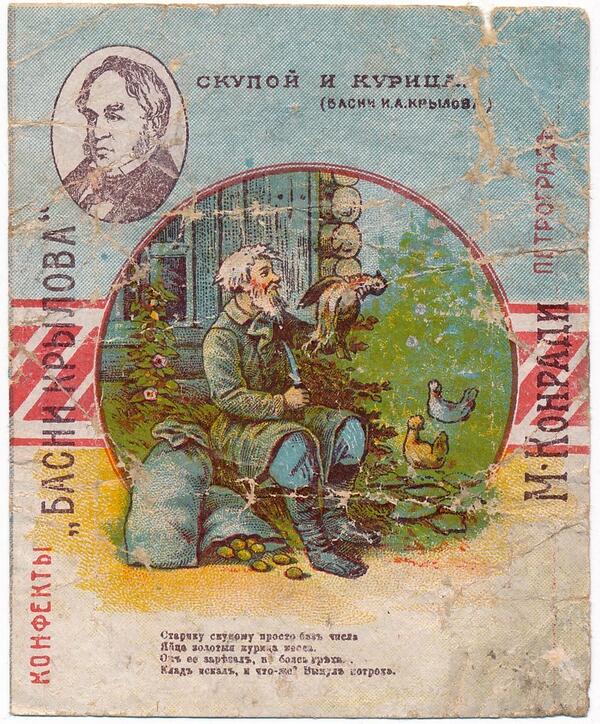
An example of such a “literary” design is a candy wrapper from the series “Krylov’s Fables” of the confectionery factory “M. Conradi”, one of the largest in Saint Petersburg. The artist depicted the climax of the fable “The Miser and the Chicken”: a miserly old man is about to slaughter a gold-bearing chicken in order to extract treasure from it. The original long text would have been impossible to fit on a candy wrapper. Therefore, they printed a quatrain with a brief retelling of the fable:
Konstantin Somov, Ivan Bilibin, Evgeny Lansere, brothers Victor and Apollinary Vasnetsov designed on packaging brands. Many small art forms they created in industrial graphics have survived only thanks to the so-called “fantiki” (the popular name for candy wrappers). Images were carefully chosen: they had to be not only beautiful, but also interesting to the buyer. Culture, life, politics, history — everything was reflected in the design of wrappers.
Portraits of crowned persons were printed on candy wrappers. 1911 was the 50th anniversary of the abolition of serfdom — confectioners celebrated it with exclusive series of sweets: “The Liberation of the Peasants” (A.I. Abrikosov’s Sons), “Reform” (Lohengrin), “February 19” (Einem) and others.
A series of wrappers formed into a kind of folk encyclopedia. The illustrations were often supplemented with brief historical references: about the feat of Ivan Susanin, the militia of Minin and Pozharsky, or Mikhail Feodorovich becoming the tsar. Using wrappers, one could study geography and ethnography, flora and fauna, military branches and types of weapons, sports and insects, architectural monuments and the multiplication table. For younger children, candy wrappers contained riddles, puzzle pictures, and letters of the alphabet. Adult connoisseurs of sweets could have fun reading horoscopes, fortune-telling advice, as well as ditties and sayings.
A special niche was occupied by the wrappers depicting the literary genre. Anniversary series of sweets with portraits of writers and poets and series dedicated to the work of individual authors were created. They had illustrations and quotes. It could be either the name of the depicted character, or a small excerpt from the authentic text.
An example of such a “literary” design is a candy wrapper from the series “Krylov’s Fables” of the confectionery factory “M. Conradi”, one of the largest in Saint Petersburg. The artist depicted the climax of the fable “The Miser and the Chicken”: a miserly old man is about to slaughter a gold-bearing chicken in order to extract treasure from it. The original long text would have been impossible to fit on a candy wrapper. Therefore, they printed a quatrain with a brief retelling of the fable: