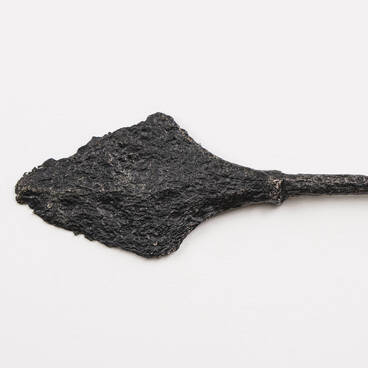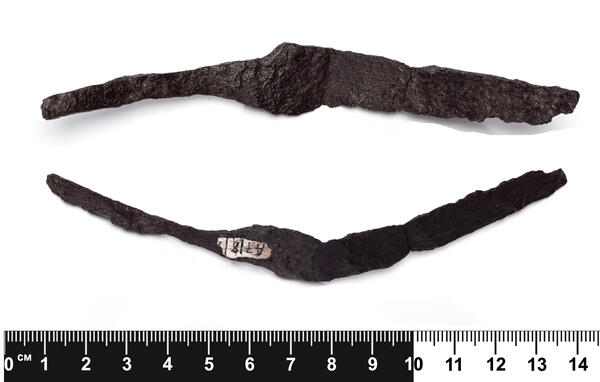
The permanent exhibition “Relics from the Battle of Kulikovo” features an iron knife — a common household tool used from the 12th to the 17th century. The knife has a tang, a narrow blade which is triangular in cross section and a straight, wide spine. There is a one-sided flange for the handle. The long curved tang is wedge-shaped and is rectangular in cross section. The total length of the knife is 12.8 cm, the length of the blade is 7.3 cm, the width of the blade is 1.8 cm, and the width of the tang is 0.5 cm.
This knife was discovered in 2002 during excavations conducted by the State Historical Museum and the State Museum-Reserve “Kulikovo Field” in the Green Oak Grove area, to the south of the Monastyrshchino village, Kimovsky District, Tula Oblast, on site No. 22. The knife is currently housed by the State Museum-Reserve “Kulikovo Field”.
In the Middle Ages, a knife was an indispensable accessory of a warrior — a common household and camping tool. In most cases, military knives did not differ from ordinary household ones.
According to some of its features (the ratio of the length of the blade to the handle 1:1.3, the straight spine, and the narrow wedge-shaped tang), this knife can be attributed to the Old Russian knives of the 11th–14 th centuries.
In general, the period from the 13th to the 15th century was the time when the Old Russian principalities began to restore the economy that had been destroyed by the Tatar-Mongol invasion and feudal strife. Meanwhile, crafts continued to develop. During that time, the market capacity increased, as evidenced by the increase in the number of goods produced by artisans, the rationalization of production technologies, and the further division and specialization of the blacksmith’s craft. Welding was the most characteristic technique of making knives, and the welded steel blade was prevalent. The knives were of high quality, as evidenced by clean and thin weld elements. Although not all objects underwent the heat treatment and quenching, apparently the technique was widespread and popular.
This knife was discovered in 2002 during excavations conducted by the State Historical Museum and the State Museum-Reserve “Kulikovo Field” in the Green Oak Grove area, to the south of the Monastyrshchino village, Kimovsky District, Tula Oblast, on site No. 22. The knife is currently housed by the State Museum-Reserve “Kulikovo Field”.
In the Middle Ages, a knife was an indispensable accessory of a warrior — a common household and camping tool. In most cases, military knives did not differ from ordinary household ones.
According to some of its features (the ratio of the length of the blade to the handle 1:1.3, the straight spine, and the narrow wedge-shaped tang), this knife can be attributed to the Old Russian knives of the 11th–14 th centuries.
In general, the period from the 13th to the 15th century was the time when the Old Russian principalities began to restore the economy that had been destroyed by the Tatar-Mongol invasion and feudal strife. Meanwhile, crafts continued to develop. During that time, the market capacity increased, as evidenced by the increase in the number of goods produced by artisans, the rationalization of production technologies, and the further division and specialization of the blacksmith’s craft. Welding was the most characteristic technique of making knives, and the welded steel blade was prevalent. The knives were of high quality, as evidenced by clean and thin weld elements. Although not all objects underwent the heat treatment and quenching, apparently the technique was widespread and popular.