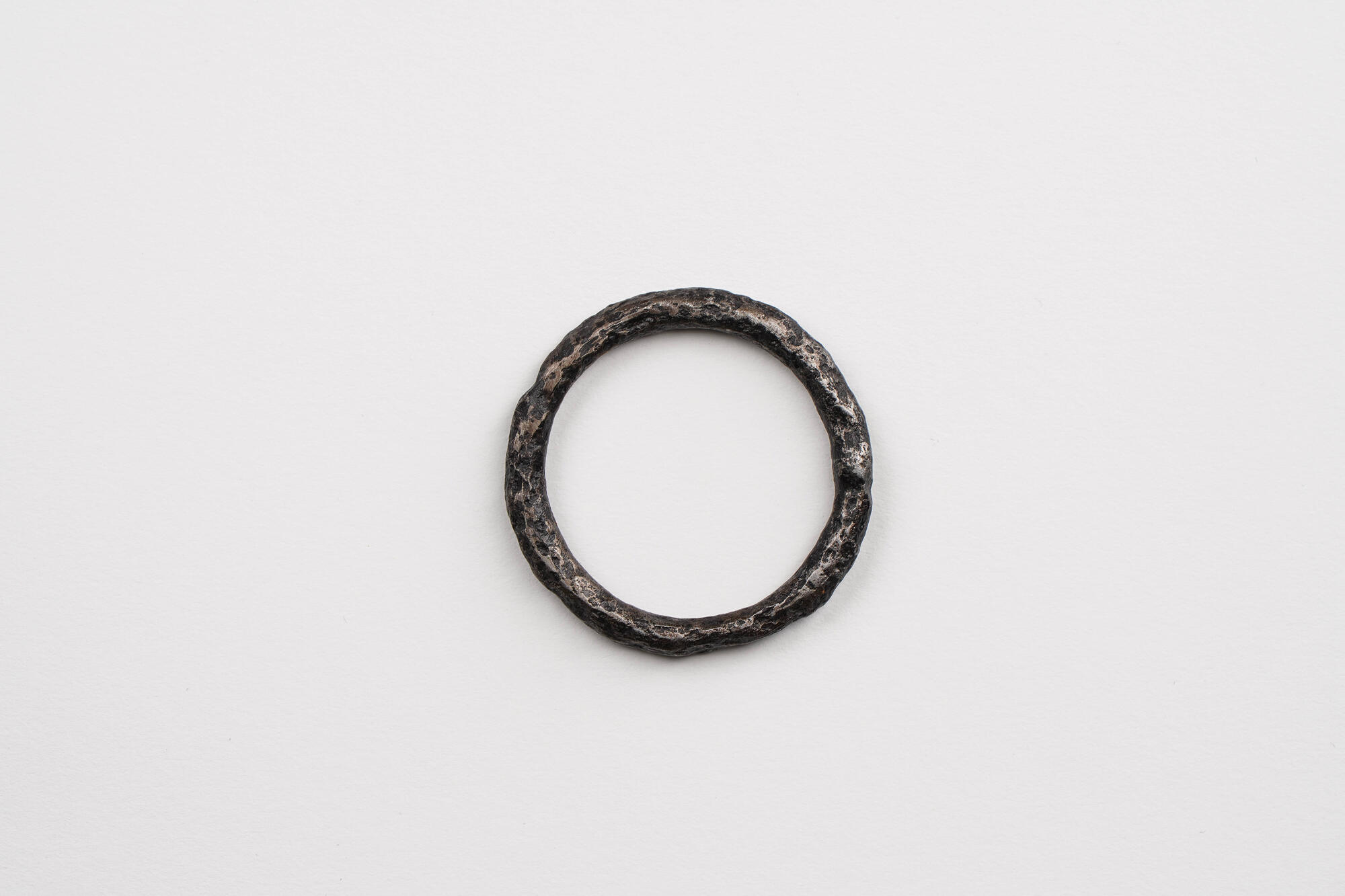


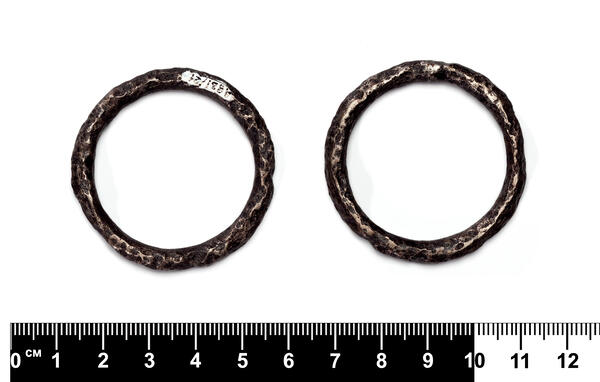
The permanent exhibition “Relics from the Battle of Kulikovo” features a forged iron piece of horse tack of the 14th century. It is a round ring with a diameter of 4.4 cm, made of a iron cane which is round in cross section with a diameter of 0.6 cm.
In 2002, this ring was discovered in excavations conducted by the military-historical unit of the Upper-Don archaeological expedition of the State Historical Museum and the State Museum-Reserve “Kulikovo Field”. The archaeological dig was conducted on the watershed of the Verkhodub and Orzhevik ravines, to the south of the Monastyrshchino village, Kimovsky District, Tula Oblast, site No. 22, grid 1.
Judging by the size, the find belongs to a group of horse harness rings. The head straps of the horse bridle were fastened using the metal parts of the harness: rings, plaques and buckles. Most of the metal parts of the bridle were attached to the belt base with 5-milimeter thick pins. Separators, more precisely— belt fasteners, were most often round, square or cruciform. All of the mentioned fasteners were used to fix together several (usually four) belts so that the resulting structure would not move. If it had to be movable, then rings with three clips were used. The presence of these rings implied that there were no browband and noseband straps.
Studies of Old Russian belt fasteners showed that both types of bridles — the heavier ones and the lighter and looser ones — appeared no later than the 10th century and existed at the same time. Round belt fasteners often had pads called “belt ends”. The bit is an important part of the bridle used for communication and control. A bit consists of a bit mouthpiece (in one, two or three parts) and cheek pads — lateral movable restraints. No matter how different the configuration of metal bits, they were always used to apply direct pressure on the tongue and corners of the horse’s mouth. The most mobile and changeable parts of the whole mechanism were rings, loops and staples, with the help of which the bit was fastened to the headband and reins.
In 2002, this ring was discovered in excavations conducted by the military-historical unit of the Upper-Don archaeological expedition of the State Historical Museum and the State Museum-Reserve “Kulikovo Field”. The archaeological dig was conducted on the watershed of the Verkhodub and Orzhevik ravines, to the south of the Monastyrshchino village, Kimovsky District, Tula Oblast, site No. 22, grid 1.
Judging by the size, the find belongs to a group of horse harness rings. The head straps of the horse bridle were fastened using the metal parts of the harness: rings, plaques and buckles. Most of the metal parts of the bridle were attached to the belt base with 5-milimeter thick pins. Separators, more precisely— belt fasteners, were most often round, square or cruciform. All of the mentioned fasteners were used to fix together several (usually four) belts so that the resulting structure would not move. If it had to be movable, then rings with three clips were used. The presence of these rings implied that there were no browband and noseband straps.
Studies of Old Russian belt fasteners showed that both types of bridles — the heavier ones and the lighter and looser ones — appeared no later than the 10th century and existed at the same time. Round belt fasteners often had pads called “belt ends”. The bit is an important part of the bridle used for communication and control. A bit consists of a bit mouthpiece (in one, two or three parts) and cheek pads — lateral movable restraints. No matter how different the configuration of metal bits, they were always used to apply direct pressure on the tongue and corners of the horse’s mouth. The most mobile and changeable parts of the whole mechanism were rings, loops and staples, with the help of which the bit was fastened to the headband and reins.