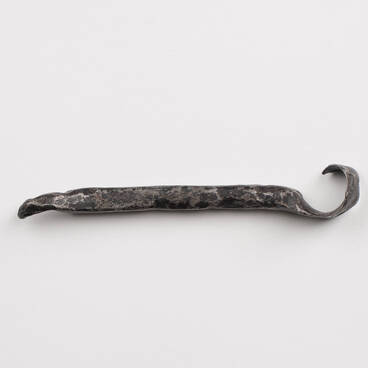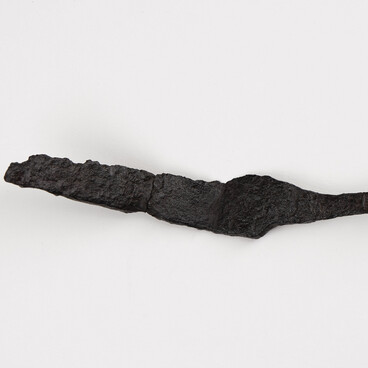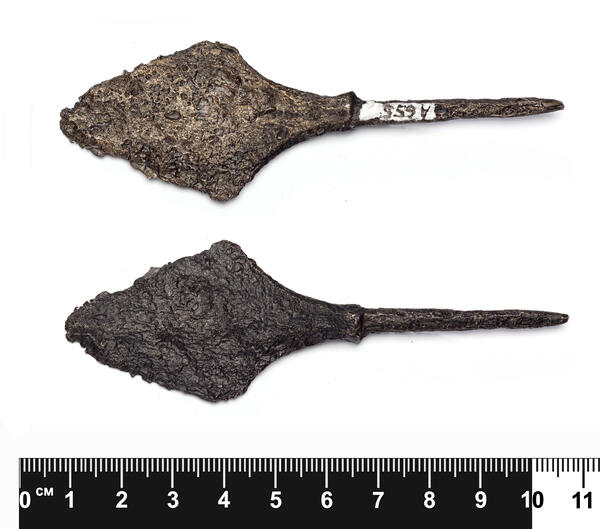
This flat arrowhead from the permanent exhibition “Relics from the Battle of Kulikovo” has a tang, a rhombus-shaped body, and a flange. The arrowhead that has been preserved is 10.1 cm long, the body is 6.2 cm long and 3.2 cm wide, and the tang is 4.3 cm long. The tang has a round cross section and it is pointed at the end. Similar Old Russian arrowheads were common from the 12th throughout the 14th centuries.
This arrowhead was discovered in 1995 in excavations conducted by the military-historical unit of the Upper-Don archaeological expedition of the State Historical Museum led by Mikhail Ivanovich Gonyany, on site No. 7, in the area of the Green Oak Grove, to the south of the Monastyrshchino village, Kimovsky district, Tula Oblast. It is currently housed by the State Museum-Reserve “Kulikovo Field”.
In Eastern Europe, archery could be done in any weather. The bowstring played an important role. Depending on the weather, a certain type of bowstrings was used in battle. For example, a bowstring made from silk and tendons was used in a cold humid climate, while a bowstring made from sinew (animal tendon that was processed in a special way) was good in dry weather. Warriors had to pay close attention to changes in humidity and air temperature, and changing the bowstring required a lot of effort. According to a 15th-century Arabic manual, there were 12 different ways of “tying” a bow.
The Slavs and the population of the East used a special bag to carry the bow — in Russian, it is called “naluchye”. The flat pouch had a wooden frame and was made from leather or thick fabric. The naluchye was not as strong as another type of the bag called “tul” — the latter also protected the shafts and fletching. Bow bags were made not only for the convenience of carrying the bows — they also protected bows and bowstrings from moisture, heat and frost.
Slavic warriors — on foot and on horseback — carried the bow in the naluchye upside down, on the left side, also on their belt or slung over the shoulder. The tul was carried on the right. The top of the tul with the arrows sticking out of it had to be in front so that the warrior could pick an arrow as quickly as possible. The tool of the Old Russian warrior contained about 20 arrows.
This arrowhead was discovered in 1995 in excavations conducted by the military-historical unit of the Upper-Don archaeological expedition of the State Historical Museum led by Mikhail Ivanovich Gonyany, on site No. 7, in the area of the Green Oak Grove, to the south of the Monastyrshchino village, Kimovsky district, Tula Oblast. It is currently housed by the State Museum-Reserve “Kulikovo Field”.
In Eastern Europe, archery could be done in any weather. The bowstring played an important role. Depending on the weather, a certain type of bowstrings was used in battle. For example, a bowstring made from silk and tendons was used in a cold humid climate, while a bowstring made from sinew (animal tendon that was processed in a special way) was good in dry weather. Warriors had to pay close attention to changes in humidity and air temperature, and changing the bowstring required a lot of effort. According to a 15th-century Arabic manual, there were 12 different ways of “tying” a bow.
The Slavs and the population of the East used a special bag to carry the bow — in Russian, it is called “naluchye”. The flat pouch had a wooden frame and was made from leather or thick fabric. The naluchye was not as strong as another type of the bag called “tul” — the latter also protected the shafts and fletching. Bow bags were made not only for the convenience of carrying the bows — they also protected bows and bowstrings from moisture, heat and frost.
Slavic warriors — on foot and on horseback — carried the bow in the naluchye upside down, on the left side, also on their belt or slung over the shoulder. The tul was carried on the right. The top of the tul with the arrows sticking out of it had to be in front so that the warrior could pick an arrow as quickly as possible. The tool of the Old Russian warrior contained about 20 arrows.