A dessert knife is an important part of everyday culture, indicating high family income.
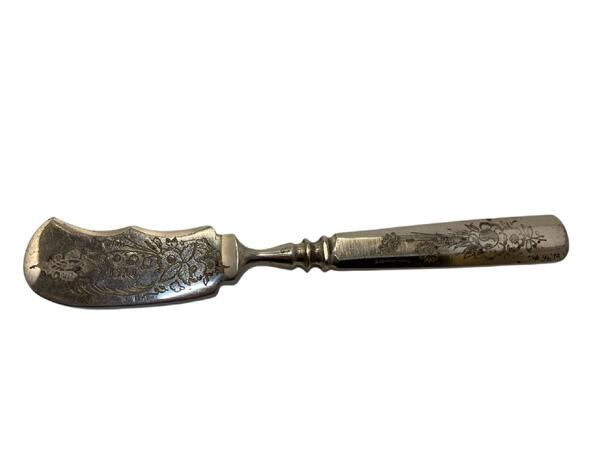
This knife is richly decorated: the handle features an engraved floral pattern and the inscription “Zlatoust” in capital letters. An image of a Russian village is included in the pattern on one side of the blade, with the inscription “Maslo” (Butter) on the other side. The metal faceted handle flares towards its end. The wide blade is given an elaborate design. Anna Stepanovna Zarina, a resident of Tyumen, donated the knife to the museum. It dates from the Soviet times, 1930–1955, and was produced at the Zlatoust Arms Factory.
The Zlatoust Arms Factory was established on December 16, 1815. The construction lasted for about two years, and some workshops opened as early as the end of the same year. In the following years, new workshops and arsenals were completed and put into operation. The history of the factory is closely connected with the name of Pavel Petrovich Anosov (1797–1851). From 1817 to 1847 he worked in the Zlatoust Mining District — from 1824 as a factory manager, and from 1831 to 1847 as a mining chief and at the same time the factory’s director. Pavel Anosov became famous for inventing a method of producing Bulat steel that duplicated the qualities of its Syrian and Indian counterparts. Unlike the blades of European origin, a Bulat steel sword was able to easily cut thin fabric.
From 1819 to 1821, Anosov was the inspector of the factory’s weapon decoration department and supported the art of engraving. He was instrumental in increasing the variety of products: the skilled factory engravers started to receive commissions not only for weapons, but for household goods as well.
The factory started producing richly engraved table knives, forks, spoons, trays, chests, trinket boxes, candlesticks and other objects. Cutlery, fish knives and spoons, bread knives, sets of dessert knives and forks, snack bar sets, and fruit knives were sold throughout the Russian Empire and offered a considerable variety of forms. There were 19 types of bread knives alone.
The First World War, the revolution of 1917 and the Russian Civil War affected factory operations. Until 1921, the Zlatoust Arms Factory produced only military goods. During the Soviet era, the factory produced surgical supplies, carpentry tools, spoons, forks, and knives.
This knife is richly decorated: the handle features an engraved floral pattern and the inscription “Zlatoust” in capital letters. An image of a Russian village is included in the pattern on one side of the blade, with the inscription “Maslo” (Butter) on the other side. The metal faceted handle flares towards its end. The wide blade is given an elaborate design. Anna Stepanovna Zarina, a resident of Tyumen, donated the knife to the museum. It dates from the Soviet times, 1930–1955, and was produced at the Zlatoust Arms Factory.
The Zlatoust Arms Factory was established on December 16, 1815. The construction lasted for about two years, and some workshops opened as early as the end of the same year. In the following years, new workshops and arsenals were completed and put into operation. The history of the factory is closely connected with the name of Pavel Petrovich Anosov (1797–1851). From 1817 to 1847 he worked in the Zlatoust Mining District — from 1824 as a factory manager, and from 1831 to 1847 as a mining chief and at the same time the factory’s director. Pavel Anosov became famous for inventing a method of producing Bulat steel that duplicated the qualities of its Syrian and Indian counterparts. Unlike the blades of European origin, a Bulat steel sword was able to easily cut thin fabric.
From 1819 to 1821, Anosov was the inspector of the factory’s weapon decoration department and supported the art of engraving. He was instrumental in increasing the variety of products: the skilled factory engravers started to receive commissions not only for weapons, but for household goods as well.
The factory started producing richly engraved table knives, forks, spoons, trays, chests, trinket boxes, candlesticks and other objects. Cutlery, fish knives and spoons, bread knives, sets of dessert knives and forks, snack bar sets, and fruit knives were sold throughout the Russian Empire and offered a considerable variety of forms. There were 19 types of bread knives alone.
The First World War, the revolution of 1917 and the Russian Civil War affected factory operations. Until 1921, the Zlatoust Arms Factory produced only military goods. During the Soviet era, the factory produced surgical supplies, carpentry tools, spoons, forks, and knives.