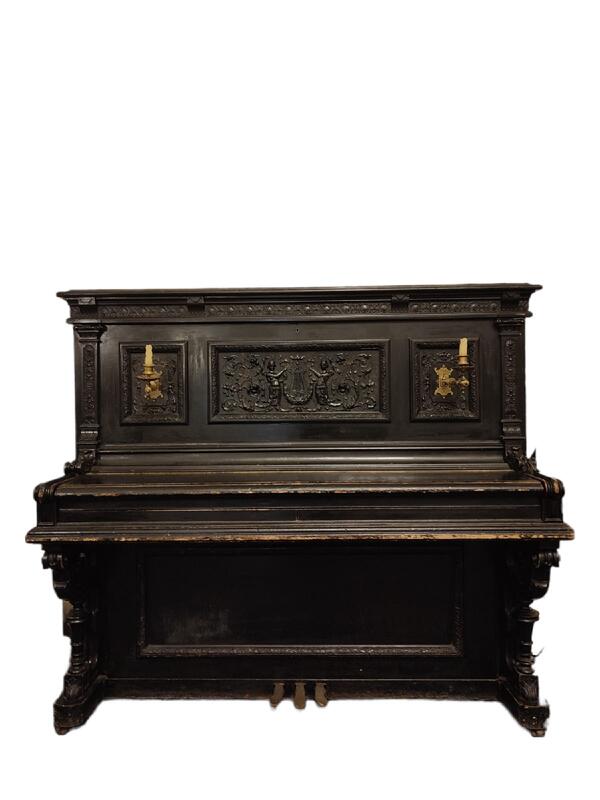
The piano displayed in the museum’s permanent exhibition was bought at the Irbit Fair and presented to Anna, the granddaughter of the merchant of the first guild Ivan Reshetnikov, for her 12th birthday around 1900. The instrument was manufactured between 1890 and 1895 in St. Petersburg by Carl Goetze. It is likely that initially the piano was finished in a natural wood style, only to be painted black later.
The Carl Goetze piano factory had a curious organizational history full of events. The company was founded in St. Petersburg, in 1866, by Carl Goetze, a German music teacher, who moved to the capital of the Russian Empire in 1862. This factory was not the only of its kind in the city. At that time, there were more than 20 factories and workshops for the production of pianos and grand pianos in St. Petersburg. Despite the high quality and reliable design of his musical instruments, Goetze was unable to withstand competition from more famous manufacturers, such as, for example, Schroeder’s piano factory. Yet Goetze had a special niche: his factory produced pianos and baby grand pianos, lavishly decorated with stucco and carving and coming in different colors — black, white, and the golden hues of Karelian birch. Goetze’s musical instruments received awards at industrial exhibitions in Moscow (1882), Riga (1883), Antwerp (1885) and Kazan (1890).
In 1895, Carl Goetze decided to move his business to Berlin, and in 1905, he made it a joint-stock company. Carl Goetze died 11 years later, on December 30, 1916, and in 1921, the company ceased operations under its brand name. However, the company’s troubles were still to follow. The hyperinflation crisis of 1923, the stock market crash on Black Friday in 1929 and the following Great Depression had a devastating effect on the company. To add to its problems, the piano industry now had to compete with the radio and the gramophone.
In 1929, the company had to merge with the Niendorf and Schimmel firms and join the Deutsche Pianowerke AG concern to establish standardized work processes and maintain production in a tough economic situation.
The Carl Goetze piano factory had a curious organizational history full of events. The company was founded in St. Petersburg, in 1866, by Carl Goetze, a German music teacher, who moved to the capital of the Russian Empire in 1862. This factory was not the only of its kind in the city. At that time, there were more than 20 factories and workshops for the production of pianos and grand pianos in St. Petersburg. Despite the high quality and reliable design of his musical instruments, Goetze was unable to withstand competition from more famous manufacturers, such as, for example, Schroeder’s piano factory. Yet Goetze had a special niche: his factory produced pianos and baby grand pianos, lavishly decorated with stucco and carving and coming in different colors — black, white, and the golden hues of Karelian birch. Goetze’s musical instruments received awards at industrial exhibitions in Moscow (1882), Riga (1883), Antwerp (1885) and Kazan (1890).
In 1895, Carl Goetze decided to move his business to Berlin, and in 1905, he made it a joint-stock company. Carl Goetze died 11 years later, on December 30, 1916, and in 1921, the company ceased operations under its brand name. However, the company’s troubles were still to follow. The hyperinflation crisis of 1923, the stock market crash on Black Friday in 1929 and the following Great Depression had a devastating effect on the company. To add to its problems, the piano industry now had to compete with the radio and the gramophone.
In 1929, the company had to merge with the Niendorf and Schimmel firms and join the Deutsche Pianowerke AG concern to establish standardized work processes and maintain production in a tough economic situation.