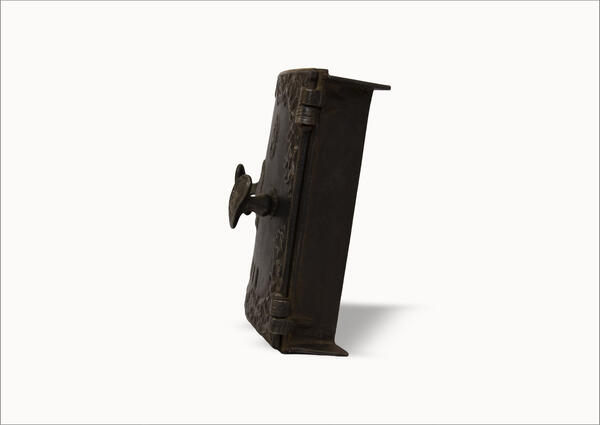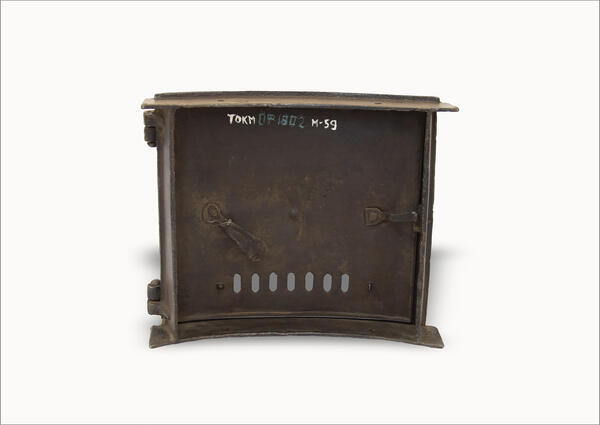
The rectangular stove door from the museum’s collection was produced at the Masharov iron foundry. It consists of a frame installed in the opening of the furnace and a door leaf fixed to the frame with hinges. The slightly convex door is designed for a round stove, which was called “Dutch” in European Russia and Siberia. This type of Dutch oven was invented by the Russian-born German architect Johann Utermark in the early 19th century.
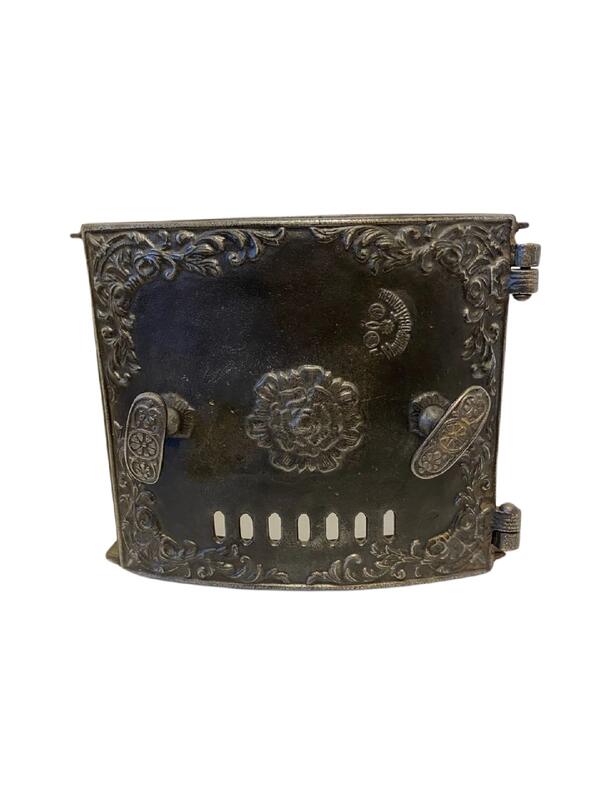
Such furnaces feature a solid hearth, without a grate or an undergrate blower door. The doors had holes in them to provide ventilation and keep the fire burning. Along the entire perimeter of the door is a floral ornament in the form of shoots winding from the corners. In the center is a bas-relief of a large rose flower. The door has two oval-shaped knobs, decorated with floral patterns; they are connected to the latch through a hinge. When the handle is turned, the latches go behind the ledges located on the door frame and make the leaf fit tightly. In the lower part of the door leaf, there are seven identical oval elongated holes instead of an undergrate blower. Above the rose bas-relief to its right is a stamp — an encircled profile image, an order on a ribbon, and an encircled image of a blacksmith with a hammer. Next to it, in the form of a semicircle is an inscription, which translates as “Masharov Tyumen”.
The casting of stoves was an important part of the production of all Russian steelworks in the 19th century and the first half of the 20th century. Since wood- and coal-burning stoves were the main source of heat for the people, all stove parts were in high demand. Apart from furnace doors, the steelworks also produced ash-box doors, cleanout doors, stoves with burners, valves, grates, and ovens. Foundry workers, smelters, cupola operators, blast-furnace keepers, boxmen, pattern makers, and molders of the Masharov plant produced boilers, frying pans, pots, cauldrons, irons, braziers, mortars, kumgans, washstands, nails, sheaves, spare parts for threshing machines and butter churns. The plant also had an enamel shop.
The door on display was purchased on June 26, 1949, from a peasant by the name of Anfilofiyev from the village of Rafailovo, Isetsky district.
Such furnaces feature a solid hearth, without a grate or an undergrate blower door. The doors had holes in them to provide ventilation and keep the fire burning. Along the entire perimeter of the door is a floral ornament in the form of shoots winding from the corners. In the center is a bas-relief of a large rose flower. The door has two oval-shaped knobs, decorated with floral patterns; they are connected to the latch through a hinge. When the handle is turned, the latches go behind the ledges located on the door frame and make the leaf fit tightly. In the lower part of the door leaf, there are seven identical oval elongated holes instead of an undergrate blower. Above the rose bas-relief to its right is a stamp — an encircled profile image, an order on a ribbon, and an encircled image of a blacksmith with a hammer. Next to it, in the form of a semicircle is an inscription, which translates as “Masharov Tyumen”.
The casting of stoves was an important part of the production of all Russian steelworks in the 19th century and the first half of the 20th century. Since wood- and coal-burning stoves were the main source of heat for the people, all stove parts were in high demand. Apart from furnace doors, the steelworks also produced ash-box doors, cleanout doors, stoves with burners, valves, grates, and ovens. Foundry workers, smelters, cupola operators, blast-furnace keepers, boxmen, pattern makers, and molders of the Masharov plant produced boilers, frying pans, pots, cauldrons, irons, braziers, mortars, kumgans, washstands, nails, sheaves, spare parts for threshing machines and butter churns. The plant also had an enamel shop.
The door on display was purchased on June 26, 1949, from a peasant by the name of Anfilofiyev from the village of Rafailovo, Isetsky district.