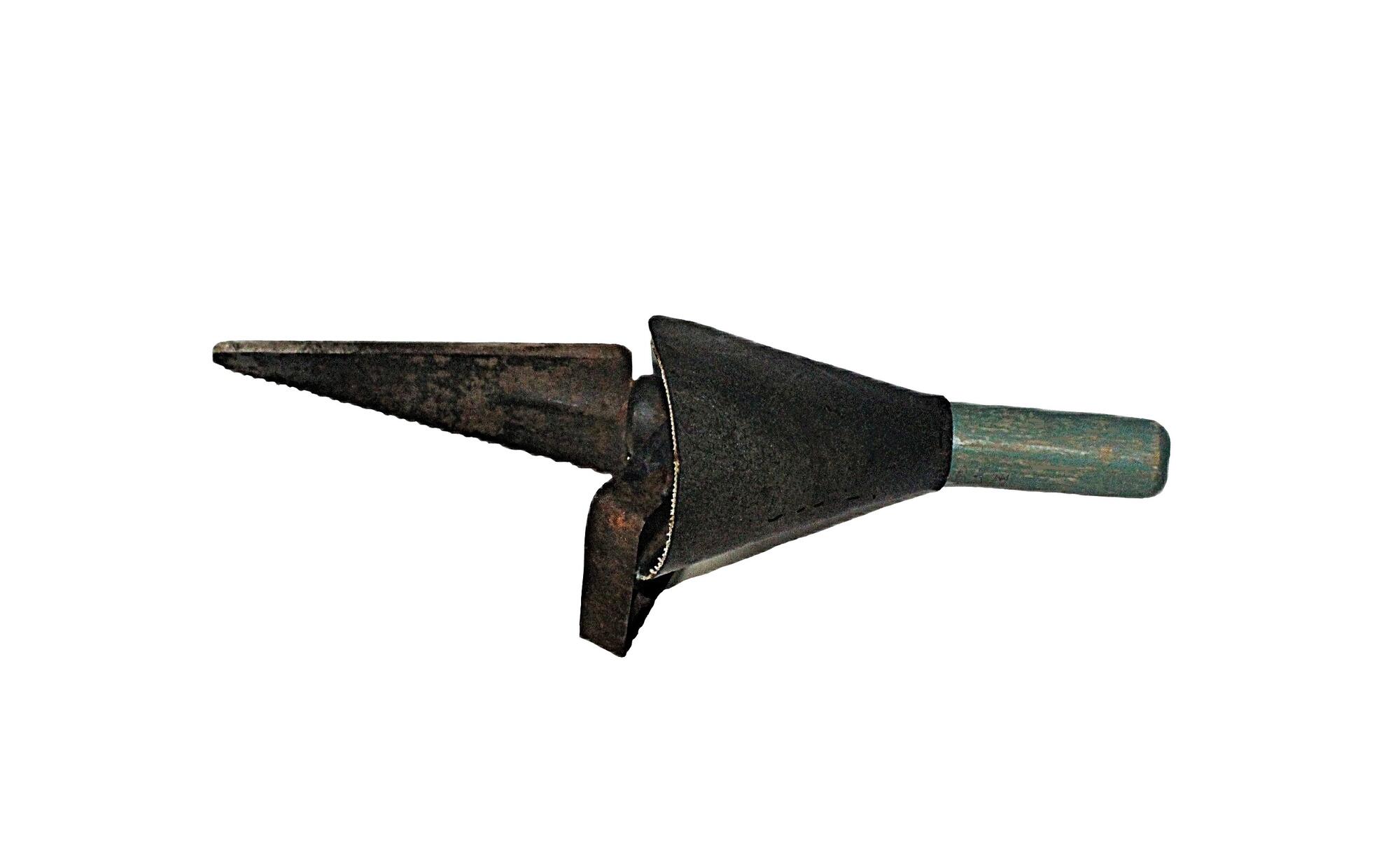


A knife for collecting barax (frozen oleoresin) was used when cutting wood — a piece of equipment for the timber chemical industry. It is intended for sampling of oleoresin from cone-shaped receivers for oleoresin and cleaning of bark pads and grooves from barracks.
The blade of the knife is conical, the end is rounded. On the other end of the knife is a wooden handle with a round cross section, painted with green paint. The handle is also fitted with a rubberized funnel and a three-angle bracket, fixed with a nut and bolt.
A podsochka is understood as the application of systematic incisions on the surface of the trunk of a growing tree in order to cause the juice to flow out — sugar in maple and birch, milky in rubber-bearing trees, resinous in conifers.
The most practical value is the cutting of coniferous species, mainly pine. The property of coniferous trees to secrete a resinous substance when wounded was known to mankind in ancient times.
The historical date of the emergence of the fishing industry has not been established. In any case, until the XIX century, the world production of turpentine was weak. In Russia, the collection of sulfur — the influx of resin on coniferous trees from accidental wounds — has been practiced for a long time, but the podsochka for the purpose of extracting oleoresin arose at the end of the XVIII century. It became widespread in the north, where single artisans were engaged in it.
After the Great October Socialist Revolution, among other problems of the national economy, the question of organizing fishing on a scientific basis was also raised. In Siberia, experimental sites were organized everywhere, where production and technical issues related to the cutting were developed.
A solid product rosin and liquid turpentine are obtained from oleoresin by distillation.
Since 1928, live turpentine has already been exported from the USSR abroad. By 1930, the production of oleoresin was 82 times higher than the production of 1926, and our country was able to export other products of turpentine production, which had previously been imported from abroad. Currently, the fishing industry has finally disappeared due to the emergence of new synthetic more advanced technologies.
The blade of the knife is conical, the end is rounded. On the other end of the knife is a wooden handle with a round cross section, painted with green paint. The handle is also fitted with a rubberized funnel and a three-angle bracket, fixed with a nut and bolt.
A podsochka is understood as the application of systematic incisions on the surface of the trunk of a growing tree in order to cause the juice to flow out — sugar in maple and birch, milky in rubber-bearing trees, resinous in conifers.
The most practical value is the cutting of coniferous species, mainly pine. The property of coniferous trees to secrete a resinous substance when wounded was known to mankind in ancient times.
The historical date of the emergence of the fishing industry has not been established. In any case, until the XIX century, the world production of turpentine was weak. In Russia, the collection of sulfur — the influx of resin on coniferous trees from accidental wounds — has been practiced for a long time, but the podsochka for the purpose of extracting oleoresin arose at the end of the XVIII century. It became widespread in the north, where single artisans were engaged in it.
After the Great October Socialist Revolution, among other problems of the national economy, the question of organizing fishing on a scientific basis was also raised. In Siberia, experimental sites were organized everywhere, where production and technical issues related to the cutting were developed.
A solid product rosin and liquid turpentine are obtained from oleoresin by distillation.
Since 1928, live turpentine has already been exported from the USSR abroad. By 1930, the production of oleoresin was 82 times higher than the production of 1926, and our country was able to export other products of turpentine production, which had previously been imported from abroad. Currently, the fishing industry has finally disappeared due to the emergence of new synthetic more advanced technologies.