

The painter Vladimir Yakunin was born in 1952 in the city of Gorky (nowadays Nizhny Novgorod). During his professional painting studies, he managed to take part in many collective and personal exhibitions, which were held both in the USSR and in Russia, and, in particular, in his native Nizhny Novgorod, and abroad, which indicates the highest level of his artistic skill.
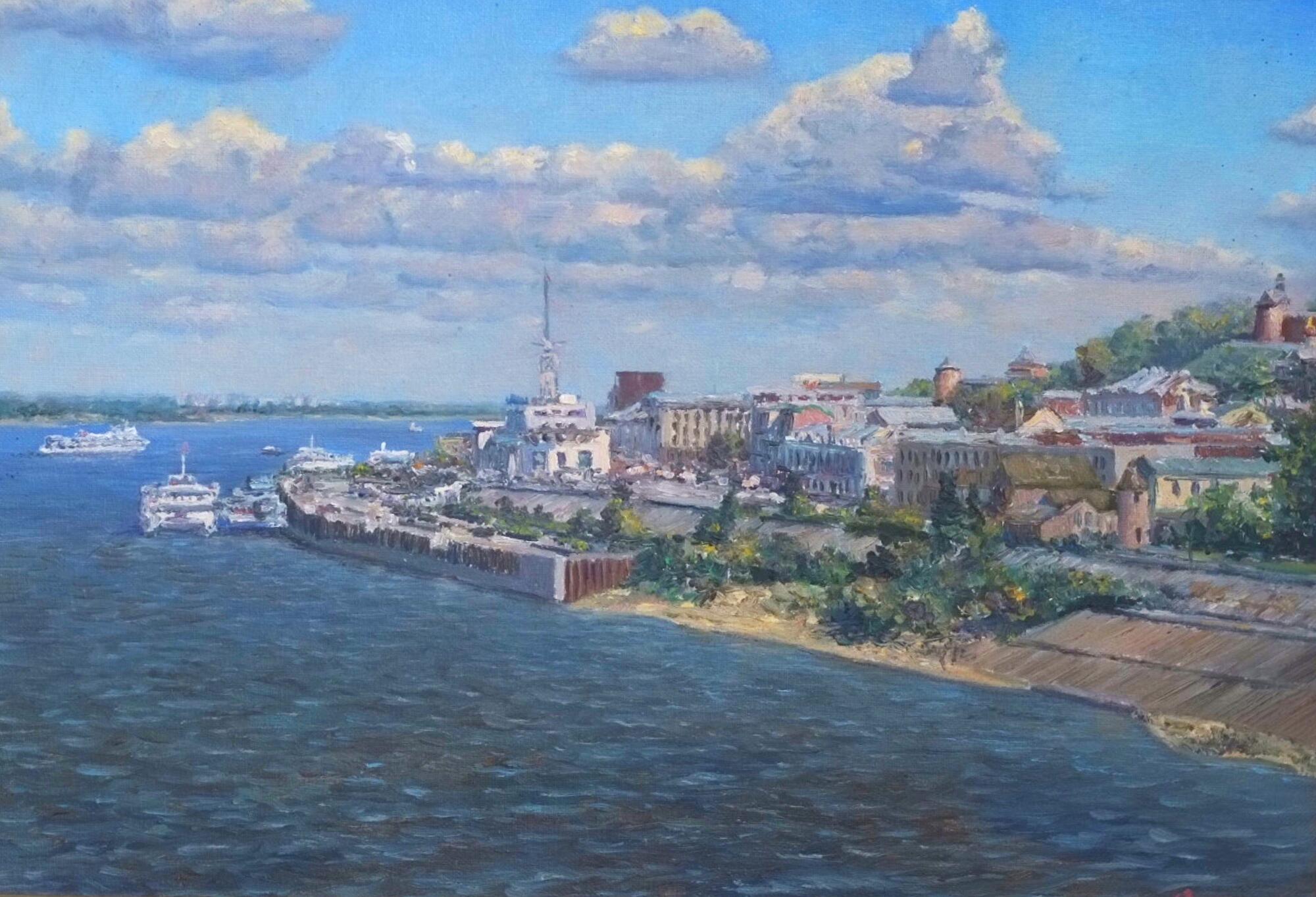
Yakunin himself once said that not a single interior would be finished until it hasn’t got a right picture. And at the same time, as if in opposition to his own thoughts, he added: contemplating forests, reservoirs, fields and meadows settles nerves, restores mental balance, puts you in a productive mood. It is interesting that such contrast to the urban and natural landscape defines the landscape “Nizhny Novgorod. River Station”.
On the one hand, it depicts the confluence of Oka and Volga, two great Russian rivers, on the other hand, the place where urban environment and nature meet. Since ancient times, rivers have served as transport arteries and ensured the successful development of settlements and cities, near which they flow. It is no coincidence that Nizhny Novgorod appeared here, at the confluence of the mighty rivers, already in the 13th century: in 1221 a small detachment of Russians settled here. Earlier, these strategically important lands belonged to the Tatars and Mordvins.
The title “Nizhny Novgorod” was given to the settlement by its founder, Grand Duke Yuri Vsevolodovich Dolgoruky. The word “Novgorod” itself means “new city”, but there are several interpretations of how the word “lower” appeared. Some researchers believe that it indicates that Nizhny Novgorod is located south of Veliky Novgorod: if you look on the map, it is lower indeed. It is also possible the prefix specified that Nizhny Novgorod is located significantly lower than the source of the Volga (the river originates in the Tver region).
For his landscape, Yakunin chose a very spectacular place: the embankment, with the modernist building of the River Station with its steeple, the architectural ensemble of the historic Rozhdestvenskaya Street, and the brick towers of the Nizhny Novgorod Kremlin can be seen in the background. The main sights of the city, combined into a complex artistic ensemble, are there for the viewer to see.
Yakunin himself once said that not a single interior would be finished until it hasn’t got a right picture. And at the same time, as if in opposition to his own thoughts, he added: contemplating forests, reservoirs, fields and meadows settles nerves, restores mental balance, puts you in a productive mood. It is interesting that such contrast to the urban and natural landscape defines the landscape “Nizhny Novgorod. River Station”.
On the one hand, it depicts the confluence of Oka and Volga, two great Russian rivers, on the other hand, the place where urban environment and nature meet. Since ancient times, rivers have served as transport arteries and ensured the successful development of settlements and cities, near which they flow. It is no coincidence that Nizhny Novgorod appeared here, at the confluence of the mighty rivers, already in the 13th century: in 1221 a small detachment of Russians settled here. Earlier, these strategically important lands belonged to the Tatars and Mordvins.
The title “Nizhny Novgorod” was given to the settlement by its founder, Grand Duke Yuri Vsevolodovich Dolgoruky. The word “Novgorod” itself means “new city”, but there are several interpretations of how the word “lower” appeared. Some researchers believe that it indicates that Nizhny Novgorod is located south of Veliky Novgorod: if you look on the map, it is lower indeed. It is also possible the prefix specified that Nizhny Novgorod is located significantly lower than the source of the Volga (the river originates in the Tver region).
For his landscape, Yakunin chose a very spectacular place: the embankment, with the modernist building of the River Station with its steeple, the architectural ensemble of the historic Rozhdestvenskaya Street, and the brick towers of the Nizhny Novgorod Kremlin can be seen in the background. The main sights of the city, combined into a complex artistic ensemble, are there for the viewer to see.