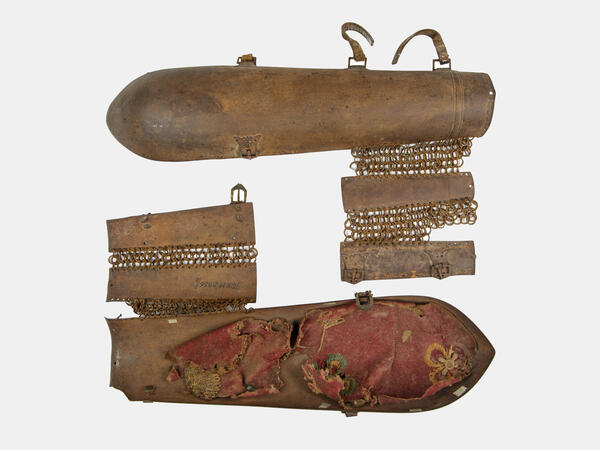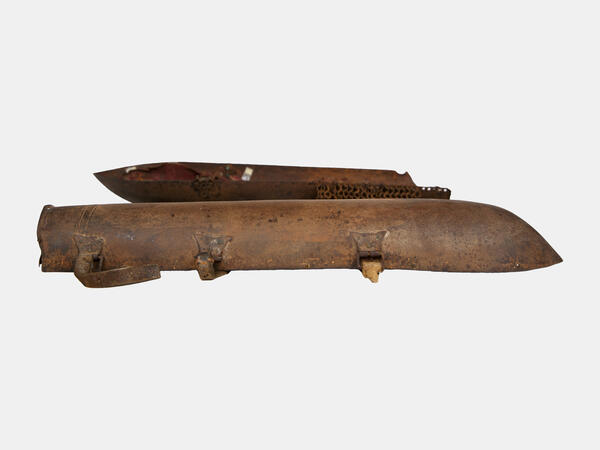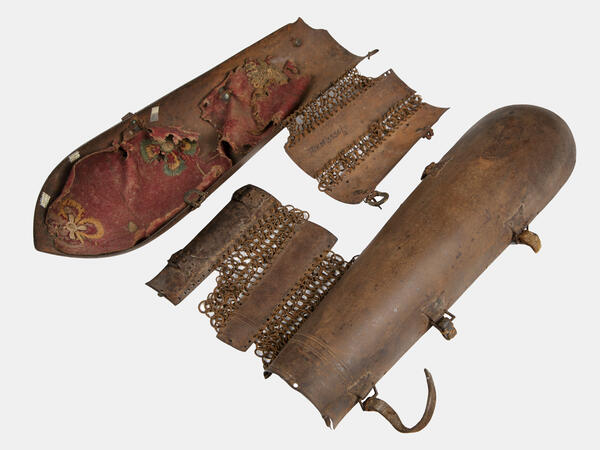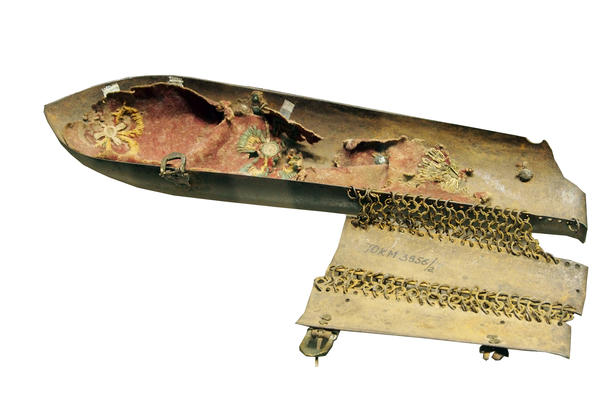
Vambraces are a piece of armor designed to protect the arm from the elbow to the wrist. They have been known since the times of ancient Greece and Rome. Initially, vambraces were made from leather and had metal plates sewn onto them.
In the Middle Ages, bracers had a tubular design: two strongly curved metal plates were connected on the arm with leather straps, chainmail mesh or strong loops. In Rus, tubular bracers appeared in the 13th century and were in use until the end of the 17th century: with the development of firearms, the need for them disappeared. They looked like the eastern prototypes and could be connected to gauntlets to protect hands.
In Rus, the use and production of articulated tubular bracers began around 1200; Slavic artisans learnt the craft from the Turks. There are archaeological finds associated with the Mongol campaigns against Rus, the most famous ones being the bracers from Sakhnovka in the Middle Dnieper region and the vambraces from the Gomiy workshop. In design they are almost no different from later items. They were made of red damask steel, steel, or iron, and they could be smooth or faceted, and decorated with gold and precious stones.
In Europe, hand protection as part of a suit of plate armor appeared around 1230, soon it was supplemented by tubular vambraces, and a century later hinged vambraces were invented. The earliest find of this type is a 14th-century bracer from Bornholm. The improvement of bracers and greaves in medieval Europe led to the appearance of plate protection for knights. Vambraces became part of the armor between the elbow and the gauntlet.
Hinged tubular vambraces were padded with leather and felt to make them more comfortable. The vambraces of noble people were decorated with engraving, inlay, silver, gold, and could be forged from Damascus steel. As a rule, they were worn together with a mirror — a breast- and backplate piece of armor. Sometimes the upper part of the vambraces was made longer than normal and extended above the elbow.
In Pre-Petrine Russia, vambraces were often used in cavalry. In Poland, cavalrymen wore bracers as part of the cuirass. In the 17th century, under Polish influence, this set appeared in other European countries.