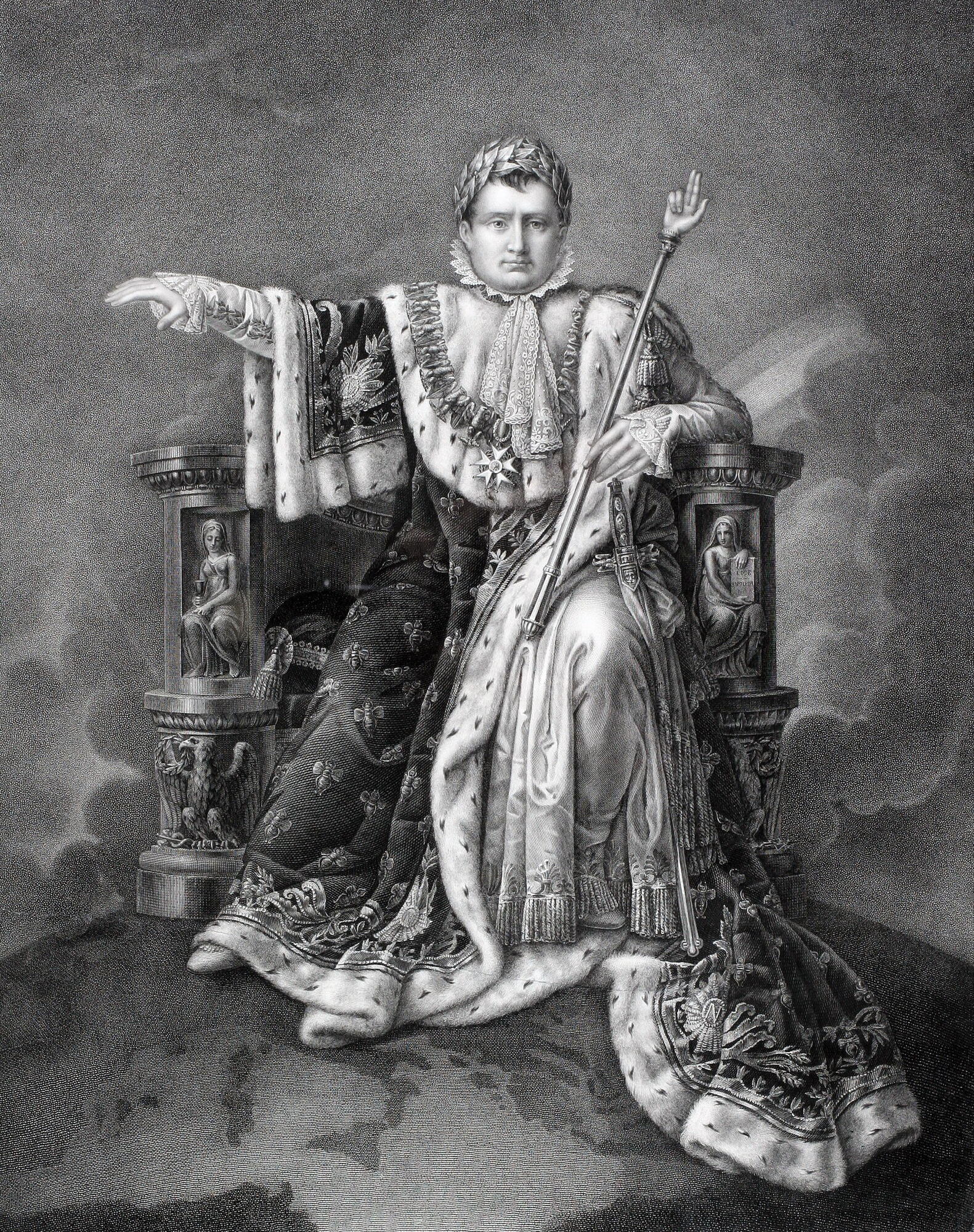


The engraving, titled “Napoleon — Ruler of the World”, depicts Napoleon I Bonaparte (1769–1821) — the brilliant military commander and French Emperor. Though the artist remains unknown, the work is a compelling interpretation of Jean-Auguste-Dominique Ingres’s celebrated 1806 ceremonial portrait, “Napoleon I on His Imperial Throne”. That original painting became the definitive visual embodiment of imperial majesty during the zenith of the First French Empire.
In the engraving, a monumental throne rises against a backdrop of brooding, dark clouds. Its massive armrests are adorned with sculptural reliefs: eagles — symbols of imperial power — and contemplative female figures personifying wisdom and strength.
At the heart of the composition sits Emperor Napoleon. His dark hair is crowned with a laurel wreath, evoking ancient Roman triumph and eternal glory. His face, rendered with meticulous precision, reveals classical features: a broad, open forehead; straight, dark eyebrows; light, almond-shaped eyes; a straight nose; and lips pressed in quiet resolve — conveying an aura of calm authority. So finely detailed is the engraving that even the distinctive dimple on Napoleon’s chin is visible.
He is robed in sumptuous ermine-trimmed imperial regalia. Across his chest glitters a chain of honors, its medallions bearing the imperial eagle. To his right, the ornate hilt of a ceremonial saber peeks from beneath his sash.
Napoleon’s posture radiates sovereign dignity: his right hand extends in a commanding gesture, while his left grasps a scepter crowned with a stylized hand — its index and middle fingers bent — an enigmatic symbol that deepens the portrait’s mystique. A delicate lace collar softens the severity of his military bearing, harmonizing regal elegance with martial discipline. More than a mere likeness, this engraving captures the very essence of imperial power — its grandeur, its unyielding authority, and its dazzling brilliance.
Born into a Corsican noble family, Napoleon Bonaparte had a meteoric rise: by 24, he was a brigadier general, his reputation forged in the siege of Toulon (1793). Later, his Grande Armée achieved legendary victories at Austerlitz (1805), Jena (1806), and Wagram (1809), bringing nearly all of continental Europe under his sway. Yet the Russian campaign of 1812 — met with heroic resistance from Russian troops and civilians alike — marked the turning point of his fortunes. Defeated decisively at Waterloo in 1815, he was exiled to the remote island of Saint Helena, where he died six years later, in 1821.