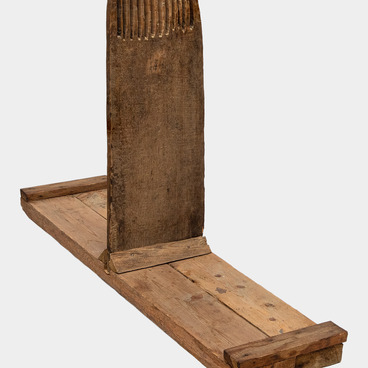
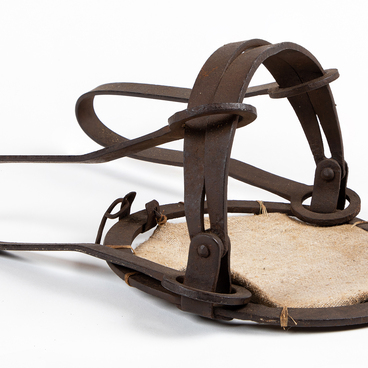
The collection of the Sheltozero Veps Ethnographic Museum includes an anvil donated to the museum by Egor Andreevich Gusev, a resident of the village of Sheltozero, a neighbor and relative of the founder of the museum, Rurik Petrovich Lonin. The anvil was the first exhibit of the Veps Folk Museum, Rurik Petrovich found it in the basement of their shared house, bought in 1961.
The anvil is quite unusual: its lower part has a square shape, like a stand, and the upper part has a flattened wide cap. The lower part was installed in a niche, hollowed out beforehand in a block of wood, and the upper part was a working place.
Blacksmithing is one of the oldest crafts on the planet. The blacksmith, unlike other craftsmen, did not engage in subsistence farming; plowing was not part of his duties. This was primarily due to the complexity of the technological process, which required maximum concentration and physical effort. Often, blacksmith shops, due to the risk of fire, were located on the outskirts of a village or city, which, in turn, emphasized the isolation and specificity of this type of activity. For centuries, the blacksmith profession was an honorable one, blacksmiths earned good money and had a high status in society.
The Veps were known in the northern region as
skilled artisans: metallurgists and blacksmiths, stonemasons, carpenters and
stove makers. Various trades and crafts were of great importance in the life of
the Veps. The income from them was used to pay state taxes, common fees, as
well as to purchase bread and other provisions. In the past, the Veps had
established areas of traditional crafts. However, most Veps villages, until the
middle of the 20th century, had forges (kuzlenic), which were used to produce
things necessary for the economy: openers, plowshares, metal parts of a sokha
plows, scythes, pike poles, holders for luchinas (wooden chips used as a
miniature torch), door hinges and locks, nails, grabbers for iron pots, tool
parts. The ironworks of the Veps were quite well developed, and the products of
blacksmiths were not only used in everyday life, but also exported for sale.