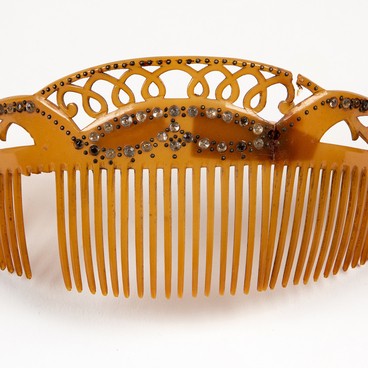
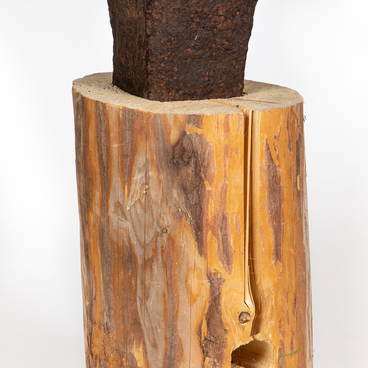
The collection of the Sheltozero Veps Ethnographic Museum named after Rurik Petrovich Lonin features a brosnuha — a tool for separating flax seed pods from stems. The tool consists of a thick board with 13 teeth cut out at the end, which is perpendicularly attached to a massive block that serves as the base of the tool.
A bundle of flax was pulled through the teeth, while the pods wider than the stem fell off. After the flax was harvested, it was necessary to separate the flax seed pods from the stems. To do this, holding a handful of flax by the butt end and loosening the upper part, the worker dragged it several times through the teeth of the comb until all the seed pods were removed. Then the bundle was turned over and once or twice the butt ends were dragged through the comb to clean the root part. The processing of flax and hemp fiber was mostly carried out in peasant farms with wooden tools made by the peasants themselves. The processing of flax and hemp fiber included several consecutive stages: breaking, scutching, hackling, carding, spinning, winding, weaving, bleaching.
To get flax, it was necessary to plant seeds, then weed the sprouts, wait for the harvest and gather it. Then spread it out on the field, where the flax stalks were soaked by dew and rains and dried by the sun and wind. After the flax was dried, it was time to process it. First, the seeds were rippled with a wooden toothed comb, after which the flax was beaten on a large breaking machine and processed with a smaller scratching machine. Then a flax bundle was heckled, and carefully carded on wooden combs with a base of pig bristles. After the material was ready, the women sat down at the spinning wheel and spun at any free moment, twisting the tow fibers into the thinnest thread. The housewives started spinning in October and finished by the end of winter. By Lent, peasant women plied all the spun threads and filled the weaving mill, sat and, using a beater and a loom, produced several meters of fabric per day. Then shirts and sundresses were sewn from this fabric.