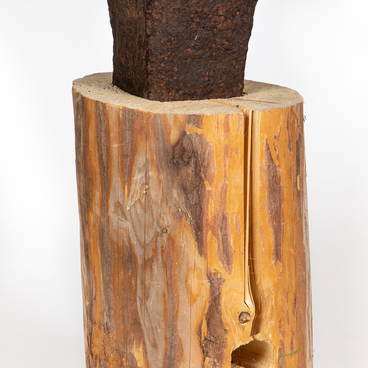
The collection of the Sheltozero Veps Ethnographic Museum named after Rurik Petrovich Lonin features a bear trap that belonged to the family of an experienced hunter Ivan Ivanovich Kemlyakov, a resident of the village of Sheltozero. The trap was donated to the museum by his son Pyotr Ivanovich Kemlyakov.
The Veps have long been engaged in hunting forest animals and game. Almost every family had its own territory for hunting, covering tens of kilometers and creating a full circle in plan. Hunters often set up a hut for storing game. Hunting tools were not very diverse. Snares were set for game and small fur-bearing animals. In autumn, each hunter set 300–400 snares and left them in place until the first snow. Bear, fox, ermine, marten, squirrel, wild deer, and elk were hunted with a dog. Traps were set on a large animal. To hunt a bear, a slingshot was also used. A bear is a large animal, so a correspondingly heavy and durable trap was required for it. The principle of operation is simple: the jaws of the trap are moved apart, one of them is fastened under a bar with a hook, to which a piece of rotten meat is tied on a rope. The bear grabs the bait, the hook is thrown back, the jaw is released and slams on the animal’s paw. To prevent the bear from leaving with the trap, it was tied to a tree with a chain.
The bear, according to the beliefs of the Veps, is the king of all animals. Bear worship was based on archaic totemic beliefs and a hunting cult. Traces of totemic ideas were manifested primarily in the recognition of the bear as a human-like creature. During the excavations of ancient Veps mounds, a large number of kresals (tinderboxes) with the image of bears standing on their hind legs were found. According to experts in the field of ancient fine arts, the vertical posture of the bear represents its connection with man and the supernatural properties of this beast. The range of such ideas also includes stories that were widespread among the Veps about sorcerers turning newlyweds into bears, and fairy tales about the marriage of a bear and a hunter or a woman and a bear. The ban on eating bear meat, preserved in some Veps villages, is another evidence that the bear in ancient times was the totem of some Veps clans.