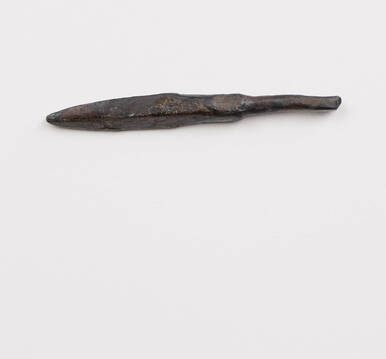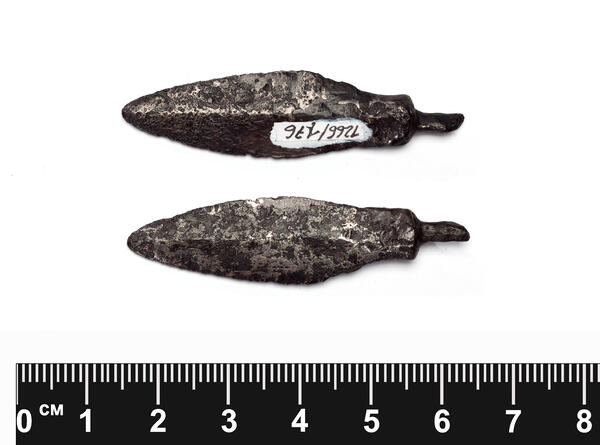
The arrowhead from the permanent exhibition “Relics from the Battle of Kulikovo” was discovered in 2005 during excavations conducted by the State Historical Museum and the State Museum-Reserve “Kulikovo Field” to the south of the Monastyrshchino village, Kimovsky District, Tula Oblast, at the watershed of Verkhodub and Orzhevik ravines, on site No. 22, grid 6, square 46. The arrowhead is currently housed by the State Museum-Reserve “Kulikovo Field”.
The arrowhead belongs to the type of points with tangs. The tang with the round cross section (its diameter at the point where it is connected to the stem is 0.2 cm) is mostly missing. The shape and cross section of the arrowhead is a narrow rhombus with the flaring lower third of the body.
The bow and arrows were used for many centuries running. As a result, a whole science emerged that described how to select the components and what proportions to use when making the bow and arrows. An arrow consisted of a shaft, a tip, a nook and fletching. The shaft had to be perfectly straight, strong and light. Straight types of wood like birch, spruce or pine were used to make arrows. After processing, the wooden surface had to be perfectly smooth. Old wood was preferred because it was denser, harder and stronger. Old Russian arrows were usually 75–90 cm long and weighed about 50 grams. The tip was fixed at that end of the shaft, which had been closer to the root of the tree, since the wood near the root was stronger. And the fletching was attached to the end of the shaft that used to be closer to the top of the tree.
The shape of the arrowhead depended on its intended purpose. Different kinds of arrowheads were needed to penetrate two main types of armor. Arrowheads with a tip that was slightly flaring at the base were used for penetrating chain mail, while only long narrow arrowheads were used against plate armor.
Fletching ensured the stability and accuracy of the arrow flight. Arrows could have between two and six feathers. Smooth, elastic, and straight feathers that were not too hard were used to make arrows.
The nock that served as the attachment point to place an arrow on a bowstring also had a certain size and shape.
The arrowhead belongs to the type of points with tangs. The tang with the round cross section (its diameter at the point where it is connected to the stem is 0.2 cm) is mostly missing. The shape and cross section of the arrowhead is a narrow rhombus with the flaring lower third of the body.
The bow and arrows were used for many centuries running. As a result, a whole science emerged that described how to select the components and what proportions to use when making the bow and arrows. An arrow consisted of a shaft, a tip, a nook and fletching. The shaft had to be perfectly straight, strong and light. Straight types of wood like birch, spruce or pine were used to make arrows. After processing, the wooden surface had to be perfectly smooth. Old wood was preferred because it was denser, harder and stronger. Old Russian arrows were usually 75–90 cm long and weighed about 50 grams. The tip was fixed at that end of the shaft, which had been closer to the root of the tree, since the wood near the root was stronger. And the fletching was attached to the end of the shaft that used to be closer to the top of the tree.
The shape of the arrowhead depended on its intended purpose. Different kinds of arrowheads were needed to penetrate two main types of armor. Arrowheads with a tip that was slightly flaring at the base were used for penetrating chain mail, while only long narrow arrowheads were used against plate armor.
Fletching ensured the stability and accuracy of the arrow flight. Arrows could have between two and six feathers. Smooth, elastic, and straight feathers that were not too hard were used to make arrows.
The nock that served as the attachment point to place an arrow on a bowstring also had a certain size and shape.