

The encolpion cross “Assunta” (the Assumption of the Mother of God) was found in the 1880s and then purchased by Nikolay Ivanovich Troitsky, a local historian and archaeologist, for the collection of the Tula provincial museum called “Chamber of Antiquities”. The State Museum-Reserve “Kulikovo Field” houses a replica of this encolpion cross made by Oleg Zaidov in 2013.
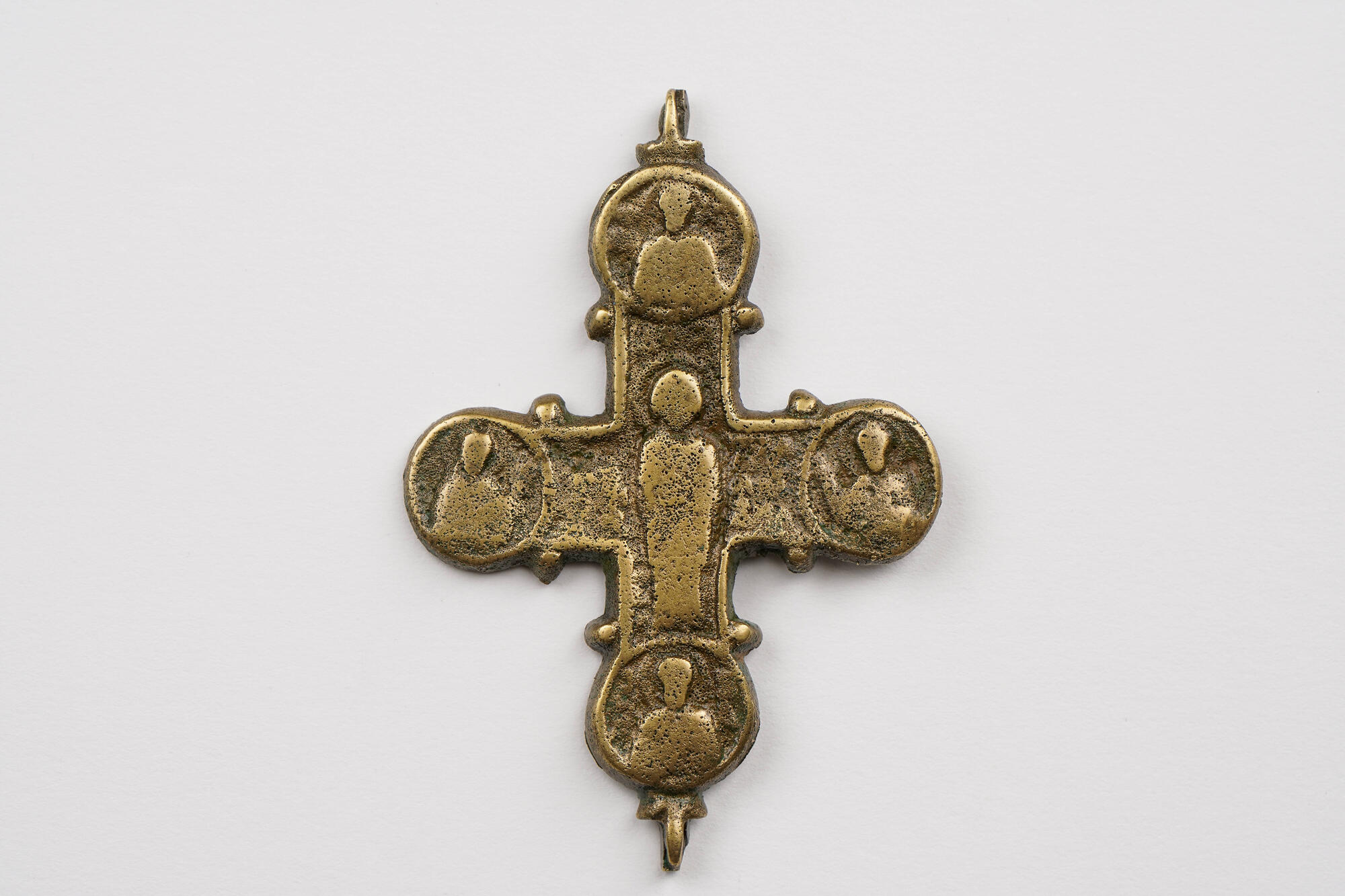
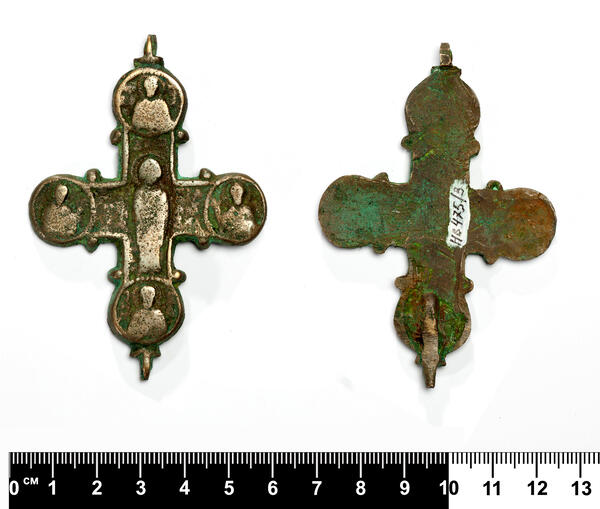
The cross has rounded terminals, side decorations, and a slightly raised rim along the edge. There is a suspension loop at the top and bottom attached to a rectangular base. In the center of the cross is the figure of the Mother of God; in the medallions are the bust images of the saints: Cosmas and Damian, Peter and Basil. In the middle of the cross and in the upper and lower medallions there are fragments of heavily worn inscriptions. The relief is hard to make out.
Judging by the typological features, this is the lower part of an encolpion cross with a full-length relief image of Assunta and half-length figures of saints in medallions with accompanying inscriptions turned “upside down”. It can be assumed that this encolpion cross was made in the early 13th century. However, not all known copies were made at that time: later copies are prevalent, including the crosses made by captured Russian craftsmen in the Golden Horde. Therefore, it is impossible to deny the existence of such crosses in Muscovite Russia throughout the 14th century and even at a later time, when the model was largely adapted.
In Orthodox churches, the images of the Mother of God are among the most revered ones. Icon painters depicted the Mother of God alone, with the Holy Child, surrounded by saints, seated on a throne and in full length, with different hand gestures and head positions. The first Christian icons came to Russia from Byzantium in the 11th and 12th centuries. Russian icon painters adopted Byzantine traditions and created “spiski” — copies of icons. Numerous icons were named after the place where they were especially venerated. In Russia, some icons owed their names to the epithets of the Virgin. This encolpion cross features the Virgin holding her palms open. A similar gesture is rendered in the icon of the Annunciation — in that scene, the Virgin holds only one hand in front of her. Starting from the 11th and 12th centuries, the image of the Virgin with open palms in front of her becomes completely independent.
The cross has rounded terminals, side decorations, and a slightly raised rim along the edge. There is a suspension loop at the top and bottom attached to a rectangular base. In the center of the cross is the figure of the Mother of God; in the medallions are the bust images of the saints: Cosmas and Damian, Peter and Basil. In the middle of the cross and in the upper and lower medallions there are fragments of heavily worn inscriptions. The relief is hard to make out.
Judging by the typological features, this is the lower part of an encolpion cross with a full-length relief image of Assunta and half-length figures of saints in medallions with accompanying inscriptions turned “upside down”. It can be assumed that this encolpion cross was made in the early 13th century. However, not all known copies were made at that time: later copies are prevalent, including the crosses made by captured Russian craftsmen in the Golden Horde. Therefore, it is impossible to deny the existence of such crosses in Muscovite Russia throughout the 14th century and even at a later time, when the model was largely adapted.
In Orthodox churches, the images of the Mother of God are among the most revered ones. Icon painters depicted the Mother of God alone, with the Holy Child, surrounded by saints, seated on a throne and in full length, with different hand gestures and head positions. The first Christian icons came to Russia from Byzantium in the 11th and 12th centuries. Russian icon painters adopted Byzantine traditions and created “spiski” — copies of icons. Numerous icons were named after the place where they were especially venerated. In Russia, some icons owed their names to the epithets of the Virgin. This encolpion cross features the Virgin holding her palms open. A similar gesture is rendered in the icon of the Annunciation — in that scene, the Virgin holds only one hand in front of her. Starting from the 11th and 12th centuries, the image of the Virgin with open palms in front of her becomes completely independent.