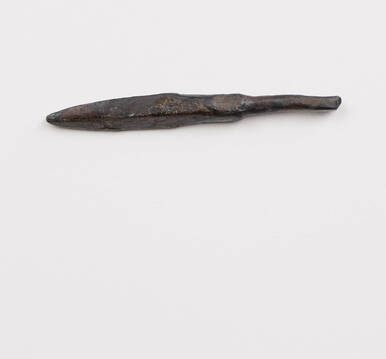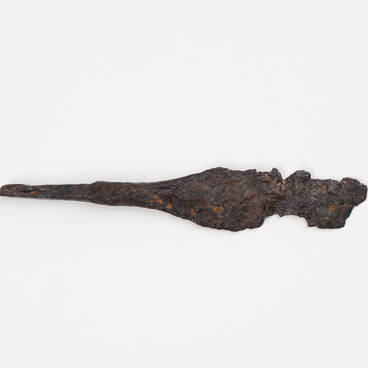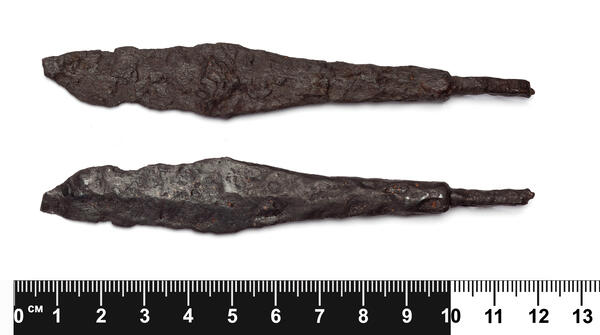
The permanent exhibition “Relics from the Battle of Kulikovo” features an iron arrowhead with a tang. It has been only partially preserved: part of the tang and the tip of the head are missing. The body has an oblong triangular shape (9.9 cm long) with a flange and a long neck with a sub-rectangular cross section (0.8×0.8). The tang has a round cross section (its diameter is 0.4 cm at the base), the body of the arrowhead — an oval rhombus one. Similar lanceolate arrowheads with a distinctive flange were used from the late 12th to the late 14th centuries.
This artifact was discovered in 2014 in excavations conducted by the military-historical unit of the Upper-Don archaeological expedition of the State Historical Museum and the State Museum-Reserve “Kulikovo Field”. The archaeological dig took place in the upper reaches of the Smolka River to the north of the Khvorostyanka village, Kurkinsky District, Tula Oblast, on site No. 22, grid 11, square 17. The arrowhead is currently housed by the State Museum-Reserve “Kulikovo Field”.
An arrow consisted of several parts: a shaft, a head, fletching, and a nock. Arrowheads with tangs were prevalent in Old Rus. The tang was inserted into the split in order to attach the arrowhead to the shaft.
The wood for the shaft was harvested in autumn: the level of moisture in wood was at its lowest at this time of the year. It was preferable to use the wood of old trees to make arrows — this type of wood was stronger and more durable. The length of the arrows usually ranged from 75 to 90 cm, and the weight was about 50 g.
The fletching ensured the stability and accuracy of the arrow flight. Feathers had to be even, elastic, and not too hard. All fletches had to have the same length, width, and weight. The longer the arrow was, the longer and wider the fletching had to be. Feathers were glued to the shaft with fish glue and wrapped around with horsehair or threads.
The bowstring was put into the nock. It also had a certain shape and size. If the nock was too big, it could slow down the flight of the arrow. If the nock was too small, the arrow would not sit firmly on the bowstring. Sometimes the nock was made directly in the shaft of the arrow, but most often, the nock was a separate part that was attached to the shaft.
This artifact was discovered in 2014 in excavations conducted by the military-historical unit of the Upper-Don archaeological expedition of the State Historical Museum and the State Museum-Reserve “Kulikovo Field”. The archaeological dig took place in the upper reaches of the Smolka River to the north of the Khvorostyanka village, Kurkinsky District, Tula Oblast, on site No. 22, grid 11, square 17. The arrowhead is currently housed by the State Museum-Reserve “Kulikovo Field”.
An arrow consisted of several parts: a shaft, a head, fletching, and a nock. Arrowheads with tangs were prevalent in Old Rus. The tang was inserted into the split in order to attach the arrowhead to the shaft.
The wood for the shaft was harvested in autumn: the level of moisture in wood was at its lowest at this time of the year. It was preferable to use the wood of old trees to make arrows — this type of wood was stronger and more durable. The length of the arrows usually ranged from 75 to 90 cm, and the weight was about 50 g.
The fletching ensured the stability and accuracy of the arrow flight. Feathers had to be even, elastic, and not too hard. All fletches had to have the same length, width, and weight. The longer the arrow was, the longer and wider the fletching had to be. Feathers were glued to the shaft with fish glue and wrapped around with horsehair or threads.
The bowstring was put into the nock. It also had a certain shape and size. If the nock was too big, it could slow down the flight of the arrow. If the nock was too small, the arrow would not sit firmly on the bowstring. Sometimes the nock was made directly in the shaft of the arrow, but most often, the nock was a separate part that was attached to the shaft.