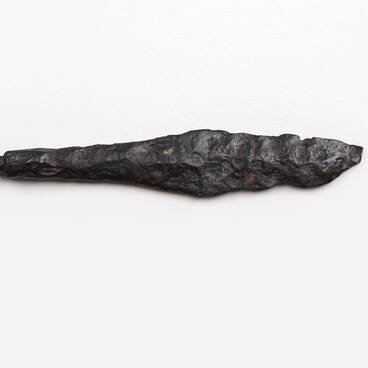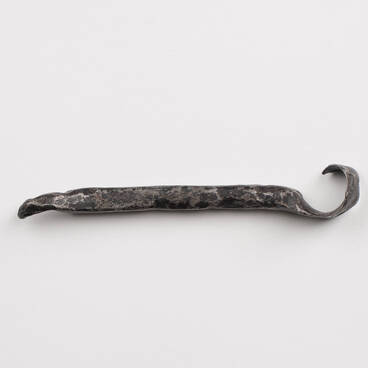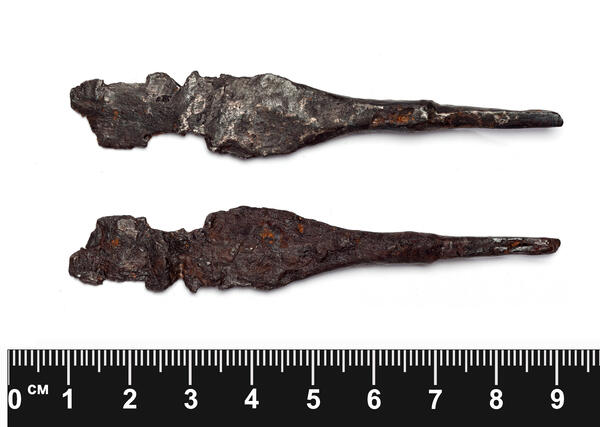
This iron lanceolate arrowhead with a tang from the permanent exhibition “Relics from the Battle of Kulikovo” has been only partially preserved, yet its appearance can be easily inferred. Such lanceolate arrowheads with a distinctive flange were used from the late 12th to the late 14th centuries.
This artifact was discovered in 2014 in excavations conducted by the military-historical unit of the Upper-Don archaeological expedition of the State Historical Museum and the State Museum-Reserve “Kulikovo Field”. The archaeological dig was located in the upper reaches of the Smolka River to the north of the Khvorostyanka village, Kurkinsky District, Tula Oblast.
An arrowhead is the tip of an arrow, which is responsible for impacting and penetrating a target. Arrowheads were made of solid materials — stone, animal bone, horn, shells, and metal. Usually, they were smaller and lighter than spearheads. Arrowheads came in a variety of configurations depending on the intended purpose. For example, there were “srezny” — from the Russian word meaning “to cut”. They had different (mainly splayed) shapes, but they all shared one common feature — a broad flat blade with its longer edge on the front. Srezny were used for firing at the exposed parts of the enemy or his horse or for hunting big game. Srezny could inflict enormous damage: as the result of being hit, the enemy or the animal lost a lot of blood and this would cause significant weakness.
In the 8th and 9th centuries, when protective armor, like chain mail and coat-of-plates, came into use, faceted armor-piercing arrowheads were introduced. The choice of the arrowhead depended on what type of protection the warriors used. Only pointed arrowheads could penetrate mail armor, while splayed flat arrowheads were still used to pierce chain mail. Barbed arrowheads were quite rare. They were mainly attached to incendiary arrows to keep them from sliding off rooftops. Thimble-shaped arrowheads (the term is an exhaustive definition of their shape) were used to shoot birds and fur-bearing animals. In Old Rus, they were called “tomary strelnye”.
This artifact was discovered in 2014 in excavations conducted by the military-historical unit of the Upper-Don archaeological expedition of the State Historical Museum and the State Museum-Reserve “Kulikovo Field”. The archaeological dig was located in the upper reaches of the Smolka River to the north of the Khvorostyanka village, Kurkinsky District, Tula Oblast.
An arrowhead is the tip of an arrow, which is responsible for impacting and penetrating a target. Arrowheads were made of solid materials — stone, animal bone, horn, shells, and metal. Usually, they were smaller and lighter than spearheads. Arrowheads came in a variety of configurations depending on the intended purpose. For example, there were “srezny” — from the Russian word meaning “to cut”. They had different (mainly splayed) shapes, but they all shared one common feature — a broad flat blade with its longer edge on the front. Srezny were used for firing at the exposed parts of the enemy or his horse or for hunting big game. Srezny could inflict enormous damage: as the result of being hit, the enemy or the animal lost a lot of blood and this would cause significant weakness.
In the 8th and 9th centuries, when protective armor, like chain mail and coat-of-plates, came into use, faceted armor-piercing arrowheads were introduced. The choice of the arrowhead depended on what type of protection the warriors used. Only pointed arrowheads could penetrate mail armor, while splayed flat arrowheads were still used to pierce chain mail. Barbed arrowheads were quite rare. They were mainly attached to incendiary arrows to keep them from sliding off rooftops. Thimble-shaped arrowheads (the term is an exhaustive definition of their shape) were used to shoot birds and fur-bearing animals. In Old Rus, they were called “tomary strelnye”.