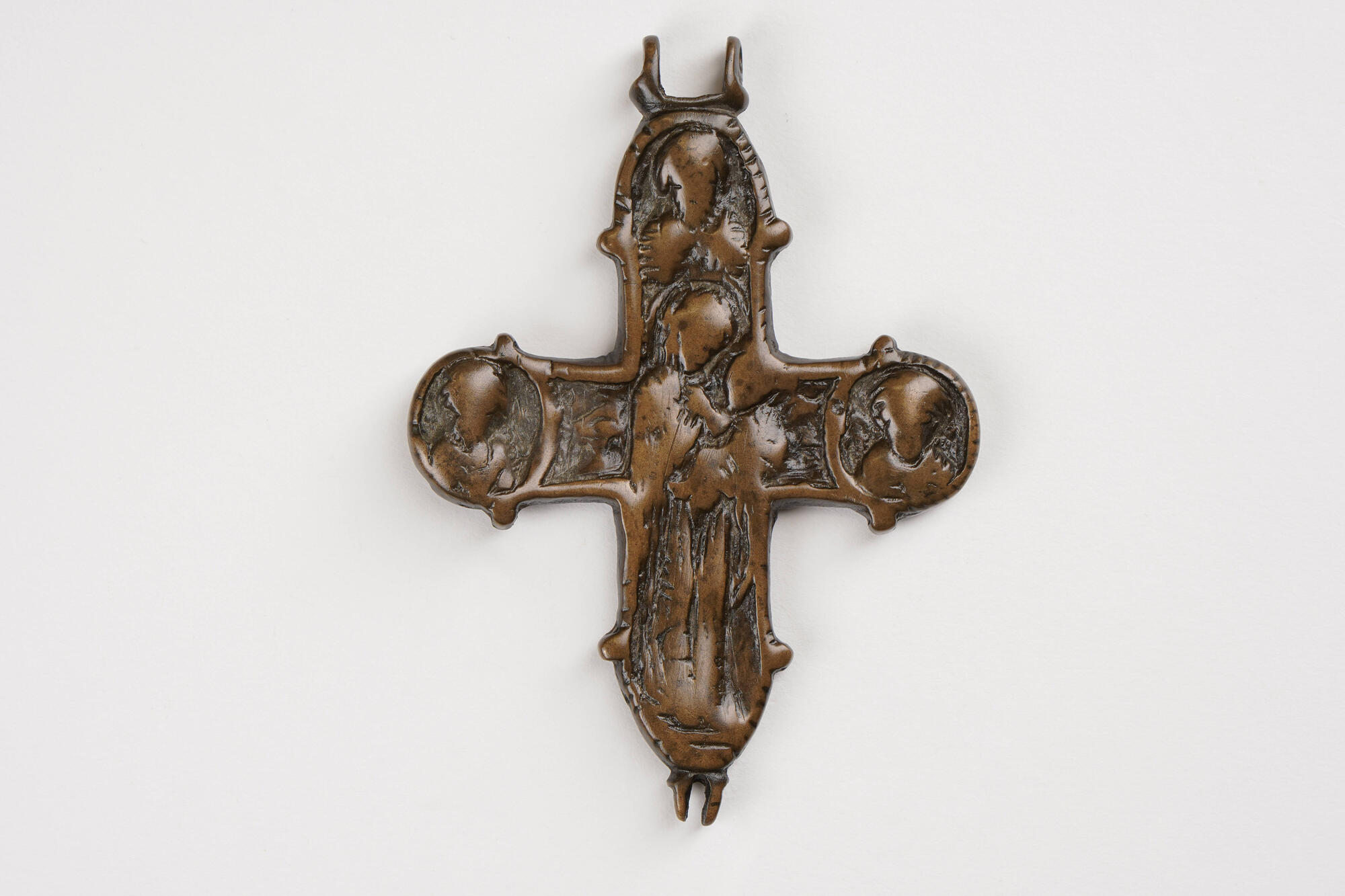


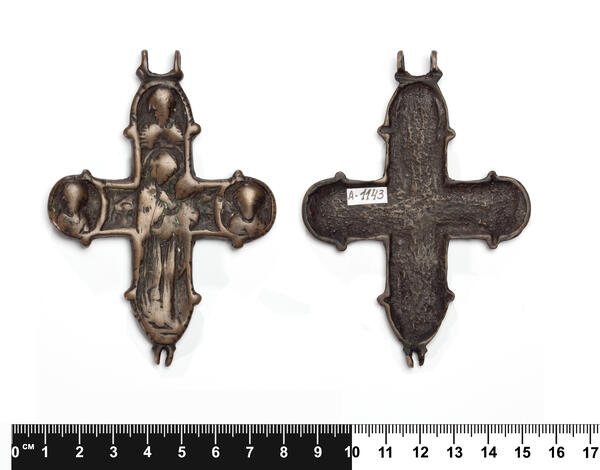
The collection of the State Museum-Reserve “Kulikovo Field” includes the lower part of an encolpion cross “The Kupyatitskaya Icon of the Mother of God with Saints” from the 12th–13th centuries. It was found in 1976 near the Krasny Hill (on the territory of the Kulikovo Field) during the preparation for the celebration of the 600th anniversary of the Battle of Kulikovo and donated to the museum by N.I. Pestrikova, a resident of Tula, in 2009.
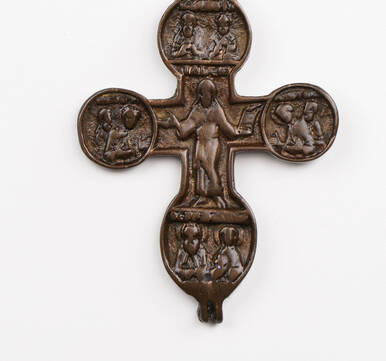
The encolpion cross has four points, with rounded ends and drop-shaped side decorations. The raised rim with oblique notches frames the top side of the encolpion. There are suspension loops at the terminal of the top and bottom arms. The medallions contain the bust images of the saints. Unfortunately, there are no inscriptions so the names of the saints can only be surmised. According to some versions, these may be the apostles Peter and Paul. Some researchers claim that these are two archangels — Michael and Gabriel. In the center is a full-length image of the Virgin holding the Holy Child with her left hand. The Kupyatitskaya icon of the Mother of God belongs to the Hodegetria iconographic image. The reverse side of the lower part with a high rim was not processed. There is no information as to what was depicted on the upper side. However, there are similar pendants that enable us to suggest several hypotheses. Most likely, the upper side featured the Savior, since encolpions with similar images were quite common. At the same time, there were other examples, when an unknown saint in a long robe was depicted on the second side with a martyr’s cross in one hand and the Gospel in the other.
The encolpion crosses found on the Kulikovo field are believed to have belonged to the warriors who were killed in battle.
Legend has it that this image of the Mother of God was revealed in the form of a cross in 1182. Then a wooden church was built at the place where the icon had been found. At the end of the 12th century, castings with the Kupyatitskaya image of the Mother of God became widespread in the Rus southern lands as well as beyond. In 1240, when the Tatars raided the village and set fire to the church, the icon could have been destroyed but instead it was preserved in the ashes.
The encolpion cross has four points, with rounded ends and drop-shaped side decorations. The raised rim with oblique notches frames the top side of the encolpion. There are suspension loops at the terminal of the top and bottom arms. The medallions contain the bust images of the saints. Unfortunately, there are no inscriptions so the names of the saints can only be surmised. According to some versions, these may be the apostles Peter and Paul. Some researchers claim that these are two archangels — Michael and Gabriel. In the center is a full-length image of the Virgin holding the Holy Child with her left hand. The Kupyatitskaya icon of the Mother of God belongs to the Hodegetria iconographic image. The reverse side of the lower part with a high rim was not processed. There is no information as to what was depicted on the upper side. However, there are similar pendants that enable us to suggest several hypotheses. Most likely, the upper side featured the Savior, since encolpions with similar images were quite common. At the same time, there were other examples, when an unknown saint in a long robe was depicted on the second side with a martyr’s cross in one hand and the Gospel in the other.
The encolpion crosses found on the Kulikovo field are believed to have belonged to the warriors who were killed in battle.
Legend has it that this image of the Mother of God was revealed in the form of a cross in 1182. Then a wooden church was built at the place where the icon had been found. At the end of the 12th century, castings with the Kupyatitskaya image of the Mother of God became widespread in the Rus southern lands as well as beyond. In 1240, when the Tatars raided the village and set fire to the church, the icon could have been destroyed but instead it was preserved in the ashes.
The second time the icon was found at the end of the 15th century on the site of a burned-out church by Joachim, a pilgrim returning to his homeland from Jerusalem via Polesye. In the 17th century, the icon was transferred to the Saint Sophia Cathedral in Kyiv, where it remained until the 1920s. The further fate of the miraculous icon remains unknown. Its 17th-century exact replica is currently housed by the St. Nicholas Church in the village of Kupyatichi, Pinsk District, Brest Region.