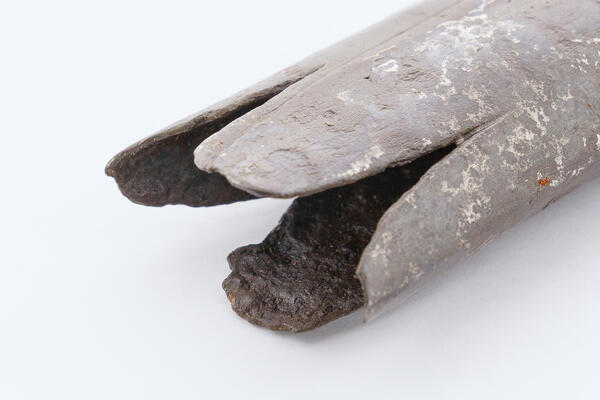
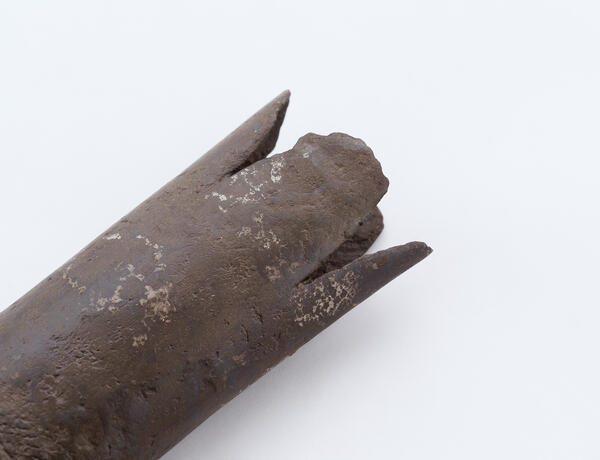
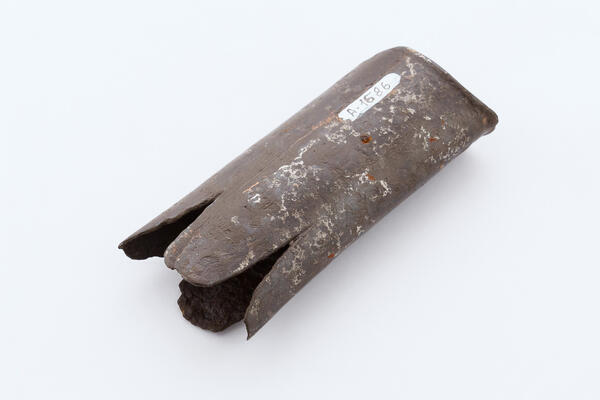
The chape (tip) of scabbard on display in the museum-reserve exhibition is part of a saber, a long-bladed offensive weapon from the 12th to 14th centuries. It has an elongated shape with an oval cross-section. The bottom of the chape is joined with copper solder. At the base, the chape is adorned with two engraved bands, with a ribbon placed on top of these. The upper portion of the chape is shaped as a small decorative crown.
A saber is a long-bladed weapon sharpened on one side, with a curved blade, and a handle tilted towards the blade. Originally, the saber was a horseman’s weapon and was used exclusively by mounted warriors until the 15th century. In the 11th century, the saber became an integral part of the ancient Russian arms. During the 13th–14th centuries, both the saber and sword were equally valued in Russia, but by the middle of the 15th century, swords had completely fallen out of use among Russian warriors. For the warriors of the Golden Horde, the saber dominated among their arms.
Researchers have found information that during this period, there were several centers of manufacture where sabers were made, which were exported to the markets of Eastern Europe. It should be noted, however, that this is true in regards to the supply of so-called “saber” stripes, which are non-dressed blades. In most cases, weapons with blades, including swords, came to the market from craft centers in the form of semi-finished products — non-dressed blades. Then, on the spot, these semi-finished products were dressed, that is, equipped with handles, and scabbards were made for them. One can judge the origin of a saber by its dressing and decoration.
The chape of the long-bladed offensive weapon on display at the State Museum-Reserve “Kulikovo Field” has a specific design detail: a crown-shaped tip. This design technique is also found on chapes of saber scabbards in the North Caucasus region, as evidenced by archaeological finds.