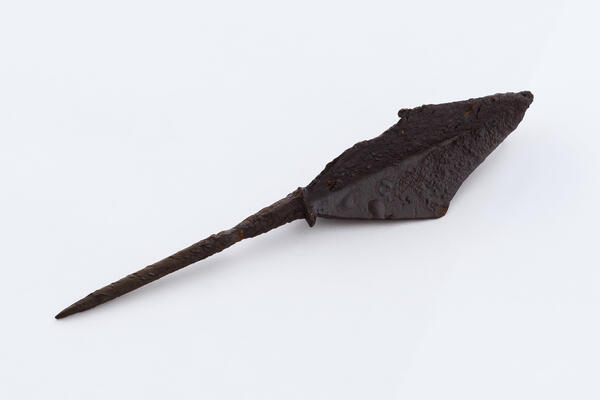
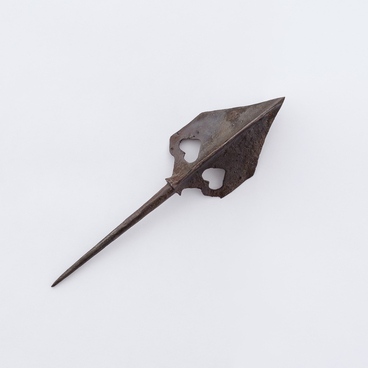
The collection of the State Museum-Reserve “Kulikovo Field” includes a three-bladed, tanged arrowhead. This is part of an arrow for a 14th-century composite bow. It was made of iron and shaped using swaging. The arrowhead features a three-bladed head and an elongated tang. Each blade has a complex trapezoidal shape.
An arrow consists of several parts: an arrowhead, fletching, a shaft, and a nock. The purpose of the arrowhead is to effectively hit the target. Arrowheads are among the most common archaeological finds unearthed during excavations at ancient settlements.
Flat three-bladed arrowheads were considered the most effective against unarmored enemy soldiers and horses. However, these arrowheads were ineffective against armored warriors. As a result, they were replaced with arrowheads designed to penetrate chain mail.
The displayed arrowhead was crafted by a skilled blacksmith using a die. It combines two functions, that of a standard arrowhead and a forked arrowhead. In addition to hitting an enemy, it was designed to expand the wound and cause significant blood loss which could result in death.
This complicated design indicates highly developed archery and its active use by nomads. The discovery of these arrowheads in forested areas suggests traces of nomadic incursions. Most likely, the local population did not use such arrowheads, possibly due to inferior archery skills or weaker bows.
Such arrowheads are rarely found among archaeological materials. This rarity indicates that the complex design made them difficult to manufacture and therefore expensive. Additionally, it suggests that using these arrowheads required a certain level of skill, which resulted in their limited application.