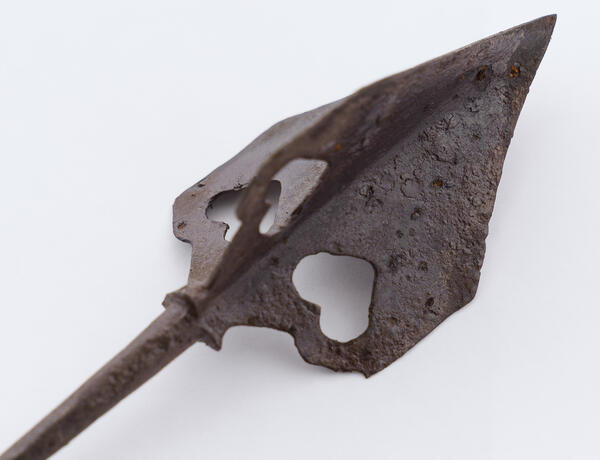
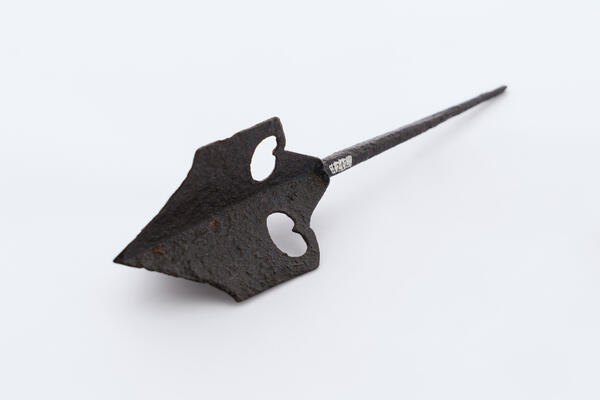
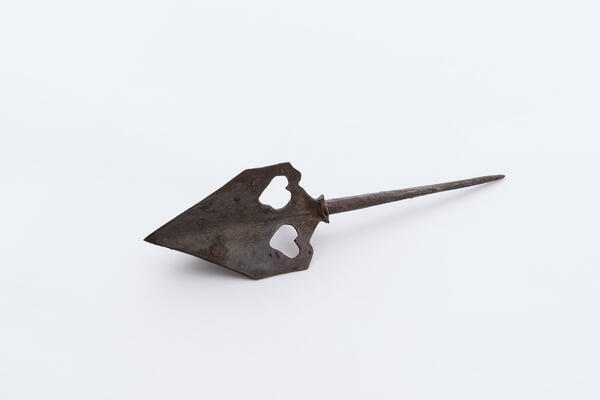
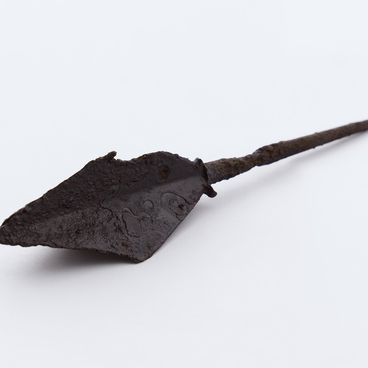
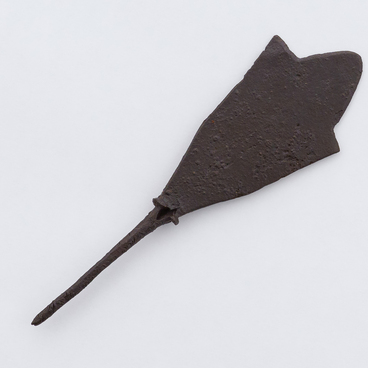
The exhibition at the State Museum-Reserve “Kulikovo Field” features a three-bladed arrowhead with a long tang displayed in its main hall “Rus and Horde: 14th Century Warfare”. It is part of the arrow for a composite bow used in the 11th–14th centuries. It was made of iron and shaped using swaging. It features a three-bladed head and an elongated tang. Each blade of the arrowhead has a complex trapezoidal shape. At the bottom of each blade, there is a hole with a shape that resembles a heraldic heart.
The displayed arrowhead was highly advanced, as evidenced by its intricate design. It is a heavy arrowhead intended for close-range combat. The range of shooting with a composite bow, used by the nomads, did not exceed 150 meters, while the efficient range was even shorter at 50 to 90 meters. Arrows with this type of head were typically shot at distances of merely 15 to 20 meters. In other words, these heavy arrowheads were used for almost point-blank shooting.
Heavy arrows differed from ordinary ones not only in weight and shape but also in the shaft design. Their shafts were exclusively made from poplar wood and were more robust and heavier than those of ordinary arrows, which could even be made from reeds. Some reports suggest that the Tatar-Mongols painted the shafts of their arrows red.
Arrows with heads of this type were always carried in cylindrical quivers made of birch bark, resembling tubes. A quiver could hold no more than 20 arrows at a time, and typically only two or three arrows were equipped with this type of arrowhead. The arrowheads used by the Horde warriors were diverse in shape, ranging from wide leaf-shaped ones to chisel-shaped and narrow armor-piercing arrowheads. In the steppe, archers usually carried their arrows with the arrowheads facing up so that they could easily select the desired arrow by touch. This arrangement prevented the fletching from crumpling in the quiver, which was wider at the bottom than at the top.