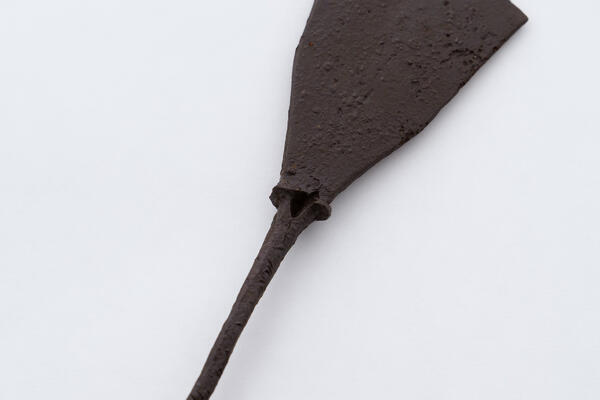
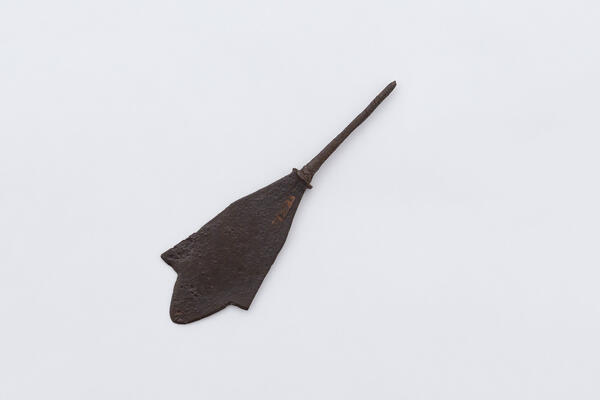
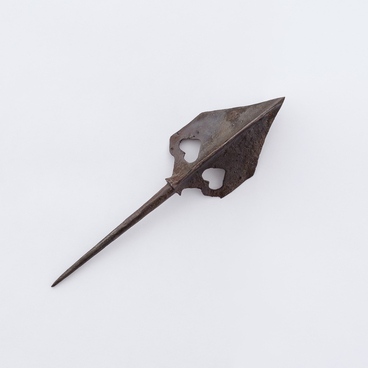
The exhibition at the State Museum-Reserve “Kulikovo Field” features a tanged arrowhead displayed in its main hall “Rus and Horde: 14th Century Warfare”. This is part of a Horde warrior’s arrow for a composite bow used in the 13th to 14th centuries. The arrowhead features a flat, spatula-shaped head with an ornately decorated upper edge and an elongated tang. The transition from the arrowhead to the tang was swaged.
There were two methods for attaching an arrowhead to its shaft: by using a sleeve or a tang. Tanged arrowheads were affixed to the arrow shaft using a metal rod driven into its center, whereas the sleeved ones had a hollow base that fit over the end of the shaft. Both types were reinforced with glue for added strength. After attaching the arrowhead, tanged arrowheads were secured with adhesive winding to prevent splitting of the shaft. Furthermore, a thin strip of birch bark was glued to the end of the shaft on top of the winding to make sure that the roughness did not reduce flight speed or cause deviations in trajectory. Tanged arrowheads make up the majority of archaeological finds.
The displayed arrowhead belongs to a forked type. These arrowheads feature a flat, spatula-shaped blade and are typically adorned with a trapezoidal feather. They were designed for use against unarmored or poorly armored opponents, as well as against horses. The purpose of these arrowheads was to inflict wide, cutting wounds that could result in death from blood loss.
According to archaeological evidence, these types of arrowheads were common in the quivers of Golden Horde warriors but were not typically used in Ancient Rus.
Based on the fact that this arrowhead is well-preserved, it appears that it is made from high-grade materials. However, it exhibits somewhat rough craftsmanship. This likely suggests that it was produced through mass production methods. The use of mass weapon production techniques in the 14th century is corroborated by archaeological findings and contemporary records. However, there is currently no evidence of such methods in Ancient Rus.