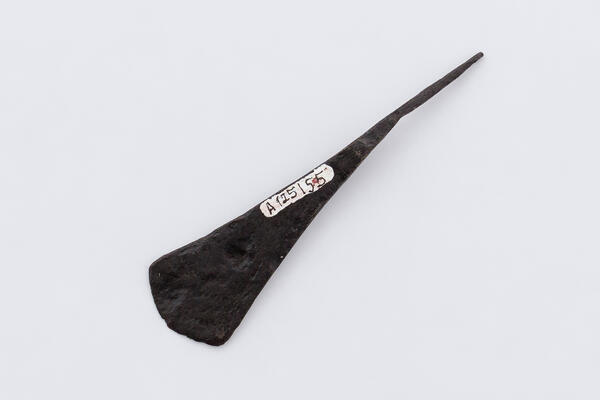
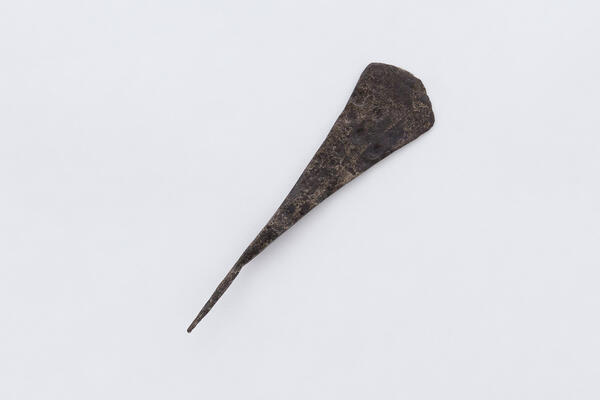
The museum exhibition features a tanged arrowhead, which is part of an arrow for a composite bow used in the 13th–15th centuries. The arrowhead has a flat, spatula-shaped head and an elongated tang. Such arrowheads were not designed to penetrate armor. However, their wide cutting edge was highly effective against unarmored enemies and horses, causing deep incised wounds and significant bleeding.
This artifact was discovered during an exploration near the Torkhovo settlement, Tula Oblast, conducted by the expedition of the State Museum-Reserve “Kulikovo Field”, led by Kirill Nikolayevich Fomin.
Long-distance archery was a key tactic used by nomadic warriors. It was shooting arrows that enabled the Mongols and Tatars to achieve victories and conquer new territories. The distinctive features of their style included powerful bows and a variety of arrowheads, many of which were designed to target horses rather than riders. None of their opponents could counteract this method. The strategy allowed the Mongol-Tatars to strike from a distance and protect their own warriors.
Chinese, Armenian, Georgian, Middle Eastern, and European chroniclers who lived during the time of the Tatar-Mongol invasion reported that whenever the invaders faced resistance, they simply bombarded their enemy with arrows, striking both people and horses. Russian chronicles describe how the Tatar-Mongols used their arrows to sweep defenders from the fortress walls of cities like Kiev, Vladimir, Chernigov, Rostov, and Yaroslavl. The same tactic was employed in late summer 1382 when Tokhtamysh, the khan of the Golden Horde, captured and burned Moscow.
The displayed arrowhead was used by the Tatar-Mongols to shoot at unarmored or poorly protected enemies and their horses. If they could not defeat the enemy in head-on confrontation, they would shift their focus to targeting horses to limit the enemy’s mobility.