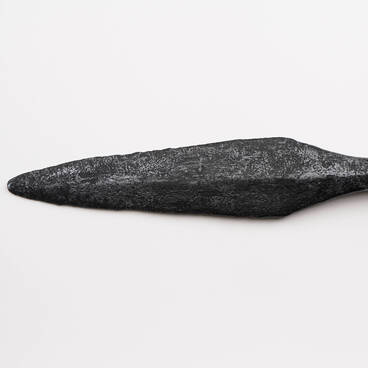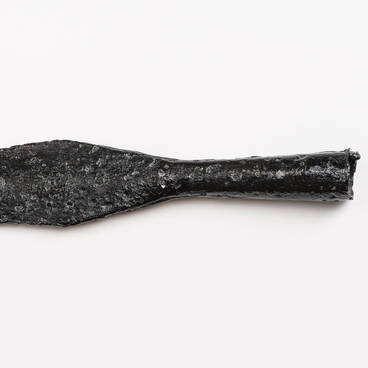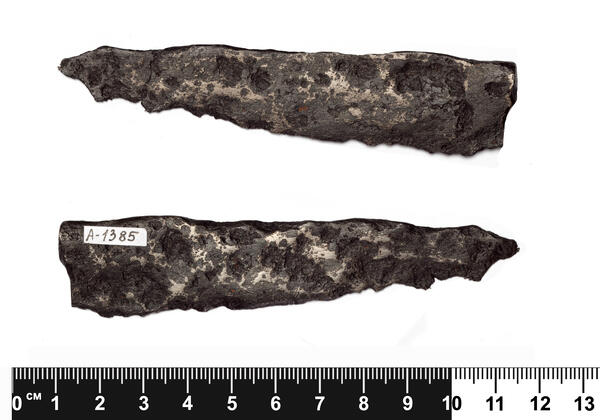
The permanent exhibition “Relics from the Battle of Kulikovo” features a forged iron knife. The total preserved length of the blade is 10.5 cm, the width is 2.2 cm. The item has a narrow triangular blade and a straight spine.
In 2003, the knife was discovered during joint excavations conducted by the State Historical Museum and the State Museum-Reserve “Kulikovo Field” on the watershed of the Verkhodub and Orzhevik ravines, to the south of the Monastyrshchino village, Kimovskiy District, Tula Oblast.
In Old Rus, knives were the most common tools. They were widely used in everyday life and households, in crafts and trades. Special knives were made for warriors.
It is common knowledge that a knife consists of a blade, a tang and a handle. When it came to the length of blades and handles, the ratio depended on the intended purpose of the tool. The wedge-shaped tang is still the most popular one. Bone or wooden handles were mounted on the tang of the knife blade. Later, some knives had a flat tang, which was inserted between bone, less often wooden, riveted plates.
Several basic methods of manufacturing knives have been known. The most ancient technique (used in the 10th and 11th centuries) involved making multilayer knife blades, the so-called package: a steel strip was the basis of the blade, and iron strips were added on the sides. The package technology ensured that the blade was strong and sharp, and the side strips made it flexible and resilient. In the early 12th century, welding (a combination of a hard steel blade and a soft iron base) became the leading technique. It had two versions — edge joint and corner joint. From the middle of the 12th century until the beginning of the 14th century, edge joint welding was prevalent, and later, corner joint welding became popular. At the same time, the simplest technological methods were used: blades were made entirely from iron, entirely from steel, or in the form of welded strips of iron and steel. The proportion of such knives gradually increased from the 14th to the 15th century. However, the use of simple techniques by artisans of South Russia (Kyiv, Staraya Ryazan, and Serensk) was a tradition since pre-Mongolian times.
In 2003, the knife was discovered during joint excavations conducted by the State Historical Museum and the State Museum-Reserve “Kulikovo Field” on the watershed of the Verkhodub and Orzhevik ravines, to the south of the Monastyrshchino village, Kimovskiy District, Tula Oblast.
In Old Rus, knives were the most common tools. They were widely used in everyday life and households, in crafts and trades. Special knives were made for warriors.
It is common knowledge that a knife consists of a blade, a tang and a handle. When it came to the length of blades and handles, the ratio depended on the intended purpose of the tool. The wedge-shaped tang is still the most popular one. Bone or wooden handles were mounted on the tang of the knife blade. Later, some knives had a flat tang, which was inserted between bone, less often wooden, riveted plates.
Several basic methods of manufacturing knives have been known. The most ancient technique (used in the 10th and 11th centuries) involved making multilayer knife blades, the so-called package: a steel strip was the basis of the blade, and iron strips were added on the sides. The package technology ensured that the blade was strong and sharp, and the side strips made it flexible and resilient. In the early 12th century, welding (a combination of a hard steel blade and a soft iron base) became the leading technique. It had two versions — edge joint and corner joint. From the middle of the 12th century until the beginning of the 14th century, edge joint welding was prevalent, and later, corner joint welding became popular. At the same time, the simplest technological methods were used: blades were made entirely from iron, entirely from steel, or in the form of welded strips of iron and steel. The proportion of such knives gradually increased from the 14th to the 15th century. However, the use of simple techniques by artisans of South Russia (Kyiv, Staraya Ryazan, and Serensk) was a tradition since pre-Mongolian times.