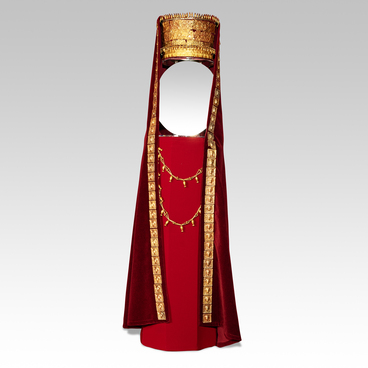
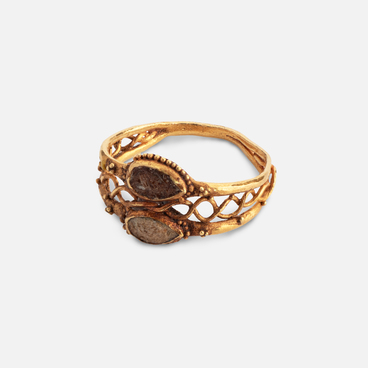
The collection of the Rostov Regional Museum of Local Lore includes items from the kurgan complex “Five Brothers”, specifically kurgan No. 8. It was excavated in 1959 near the village (stanitsa) of Yelizavetovskaya.
Over a thousand objects made of gold and silver, including jewelry, parts of horse harnesses, weapons, and ceremonial vessels, were found in this burial. The nature of the grave goods, which are very well preserved, indicated the high status of the deceased individual. In popular scientific literature, this burial has been referred to as the “tomb of a Scythian King”.
Scythian garments were characterized by their sophistication and were ideally suited to the conditions of nomadic lifestyle and mild climate conditions. The clothing, shoes, and headwear of the Scythianss were made from leather, hides, felt, and wool. Men wore short and loose leather caftans, which were tightly belted, as well as either long, tight-fitting leather trousers or loose, wide wool trousers. The caftans had fur linings. The edges of the front parts were decorated with patterns, and there was a decorative stripe on the back.
Trousers could be worn over the shoes or tucked into low, soft boots (called “skifiki” in Russian), which were tied with a strap at the ankle. Leather belts were used to carry a quiver on the left side of the body and a sword or dagger on the right. Similar garments are depicted on a gold overlay decoration for a sword scabbard, which was also found at this burial site. In particular, one image shows a nomadic warrior fighting a Greek military leader, a strategos.
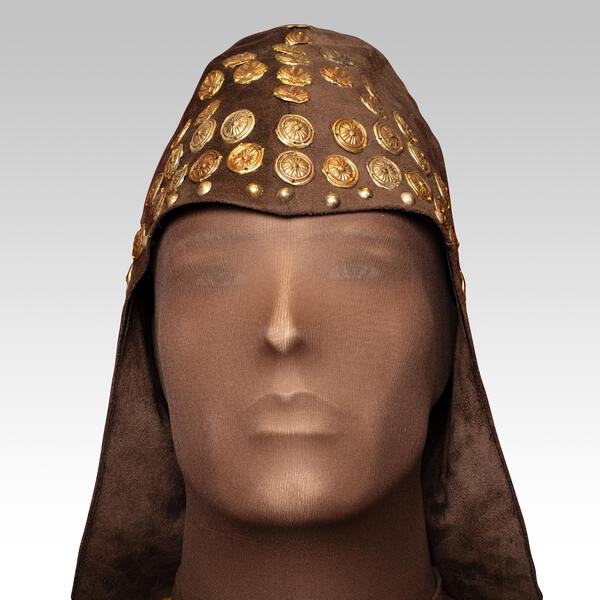
The headdress of male Scythians from the 5th–3rd centuries BCE most commonly consisted of a pointed cap with lappets reaching the shoulders and a pointed top. This type of headdress can be seen in many depictions of Scythian nomads from this period.
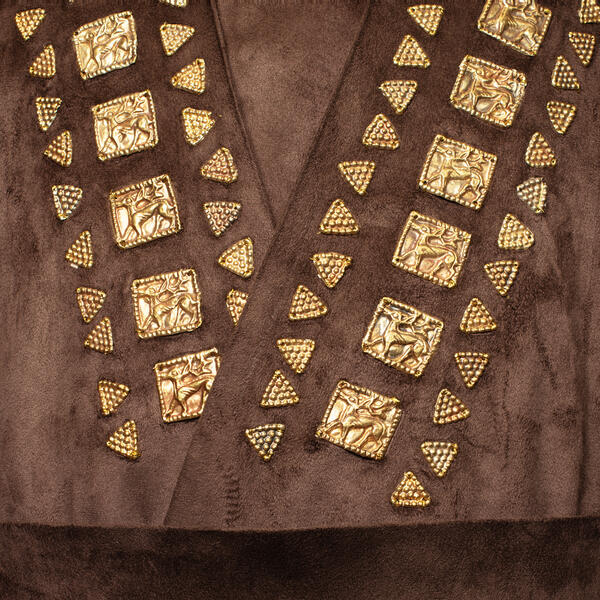
The clothing of the Scythian king from the kurgan complex “Five Brothers” was similar in style. His pointed headdress was adorned with 88 golden hemispherical plaques featuring images of palmettes and eight-petaled rosettes. The front parts of the king’s caftan were decorated with gold sewn-on plaques shaped like squares, depicting deer and fighting Scythians. Additionally, there were triangular plaques with a hammered pattern and 125 hemispherical golden plaques. The sleeves of the king’s clothing also featured 49 of these plaques.