Font
Color
Graphics
Изображение точки

To see AR mode in action:

1. Install ARTEFACT app for iOS or Android;

2. Find the exhibition «“Sakhalin Island”: An Open-Ended Story»

3. Push the «Augmented reality» button and point your phone's camera at the exhibit;

Скрыть точки интересаПоказать точки интереса
Показать в высоком качестве

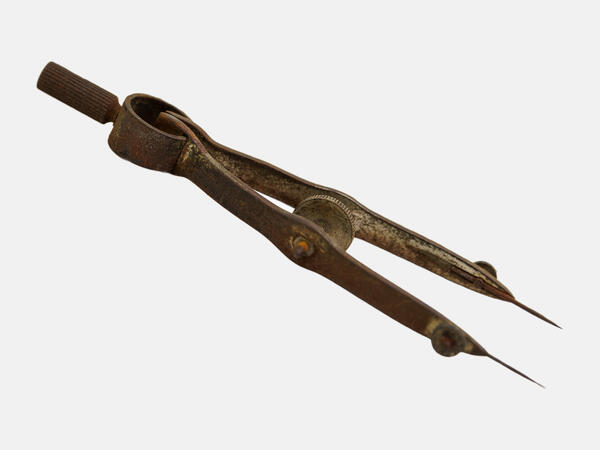
Dividing compass

Creation period
the late 19th — early 20th century
Dimensions
11x3,2 cm
Technique
metal; plant production
0
Open in app
#6

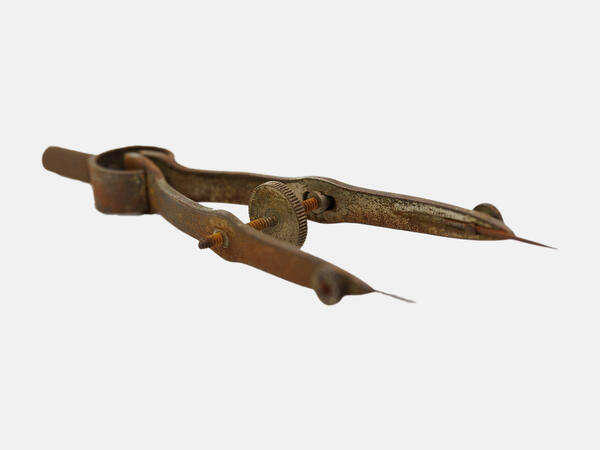
This compass is believed to have belonged to the Chekhov family. It was donated to the museum by Valentina Chekhova, the widow of the writer’s nephew, Sergey Chekhov. A dividing compass is a device for marking out locations on the surface of details and workpieces. It is distinguished by its sharpened points that act as scribers.

A compass consists of a pair of sharpened steel legs connected by a spring or rivet. The distance between them is known as the spread. It is fixed with an adjusting screw or hinge. Anton Chekhov wrote about the skill of working with compasses in his 1886 short story “Art”,
#7

‘Show you… It’s always me: me to show you, and me to do it. They have no sense of their own! Mark it out with the compasses, that’s what’s wanted! You can’t break the ice without marking it out. Mark it! Take the compass.’

Matvey takes the compasses from Seryozhka’s hands, and, shuffling heavily on the same spot and jerking with his elbows in all directions, he begins awkwardly trying to describe a circle on the ice. Seryozhka screws up his eyes contemptuously and obviously enjoys his awkwardness and incompetence.

‘Eh-eh-eh! ’ he mutters angrily. ‘Even that you can’t do! The fact is you are a stupid peasant, a wooden-head! You ought to be grazing geese and not making a Jordan! Give the compasses here! Give them here, I say! ’

Seryozhka snatches the compasses out of the hands of the perspiring Matvey, and in an instant, jauntily twirling round on one heel, he describes a circle on the ice…

#8

The first compasses were invented over 2000 years ago. Perfect circles drawn in Ancient Babylon have been well preserved. At the beginning of the Common Era, compasses were used by Roman and Gallic craftsmen and builders. Archeologists found not only drawing instruments but also compasses with curved edges — the prototypes of modern outside calipers used for measuring length and scale.

In Europe, iron and bronze compasses were used. In ancient Russia, compasses were made of wood and were used to mark patterns in woodcarving. For centuries, people used compasses for various purposes, including arms manufacturing, cartography, and construction. With the development of shipbuilding and artillery equipment in Europe, stricter requirements have been applied to compasses as it was important to eliminate any errors.

#10
Dividing compass
#9
View in the State Catalogue
read morehide
00:00
00:00
1x

Dividing compass

Creation period
the late 19th — early 20th century
Dimensions
11x3,2 cm
Technique
metal; plant production
0
Point your smartphone camera to open in the app
Share
VkontakteOdnoklassnikiTelegram
Share on my website
Copy linkCopied
Copy
Open in app
To see AR mode in action:
  1. Install ARTEFACT app for 
  2. iOS or Android;
  3. Find and download the «Paintings in Details» exhibition
  4. Push the «Augmented reality» button and point your phone's camera at the painting;
  5. Watch what happens on your phone screen whilst you flip through the pictures.
 
We use Cookies
Cookies on the Artefact Website. We use cookies to ensure that we give you the best experience on our website. If you continue without changing your settings, we'll assume that you are happy to receive all cookies on the Artefact website. However, if you would like to, you can change your cookie settings at any time.
Learn more about useHide
Content is available only in Russian

X

Нашли опечатку?...

%title%%type%