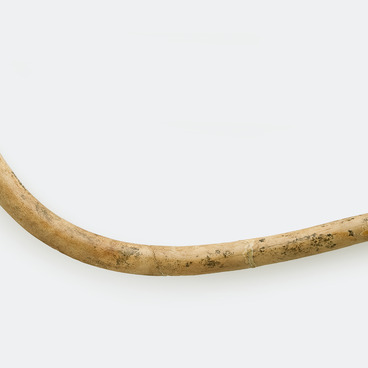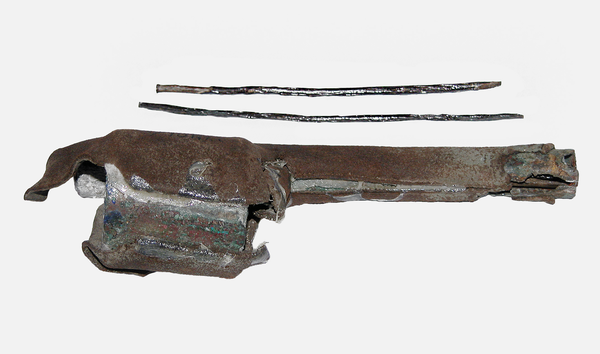
In 1967 the Archaeological expedition under the leadership of Peter Lisitsyn discovered a case with scribe’s utensils, which characterises the written culture of Ulus of Jochi, near the village of Bakhtiyarovka, Leninsky district, Volgograd region. The writing utensils, including a pencil case, qalams, and a cylindrical inkwell are accommodated in a small leather case. The shape of the writing utensils and the case were very convenient, both for use and transport.
The activity of the chancellery service is one of the most important indicators of the civilisational development of a society. In this regard, the Mongols were able to create something special, distinguishing this field from all other political cultures, most clearly manifested in the Ulus of Jochi.
An integral attribute of chancellery culture are materials and writing utensils, the use of which was determined by the level of development of record-keeping in the state of Jochid.
Paper was the most common and practically the only writing material in Jochid chancelleries. The widespread use of paper in the Ulus of Jochi is evidenced by materials of various kinds. Vasiliy Grigoriev, who conducted the first archaeological research in the Tsarevsky settlement in 1843-1847, singles out paper among many other finds. Alexander Tereshchenko mentions the same point.
The scribe or bitigchi of the khan’s chancellery always had a certain number of writing utensils with him.
The Jochid chancelleries used traditional writing utensils such as quills or qalams, which were widespread in the Central Asian and Middle Volga region long before the formation of the Yeke Mongɣol Ulus.
The quill or qalam was made of reed, bamboo, wood or bone in the shape of a stick. Materials for the production of writing utensils were mostly imported from Central Asia, Iran and Egypt; it is also possible that local reeds growing at the mouth of the Volga River were used as well.
Muhammad Nakhchivani notes that the scribe “should also have a stirrer and a bone plate (in the pencil case) so that he does not have to stir (the ink) with a penknife or a (reed) quill and does not need to trim (the tip) of a qalam on another qalam… It is also necessary to add a little musk or rose water to the inkwell, for incense. One must also have a cloth to wipe the (tip) of the qalam”.
The qalams were usually kept in special pencil cases or boxes. In the dictionary “Muqaddimat al-Adab” such a box is denoted by the word “kömürkei” in Mongolian, and by the word “sanduq” in Turkic.
Archaeological materials also testify to the use of metal scribes in the practice of writing.