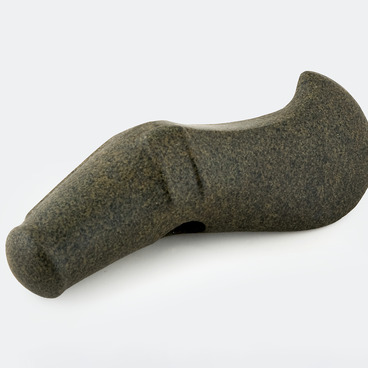
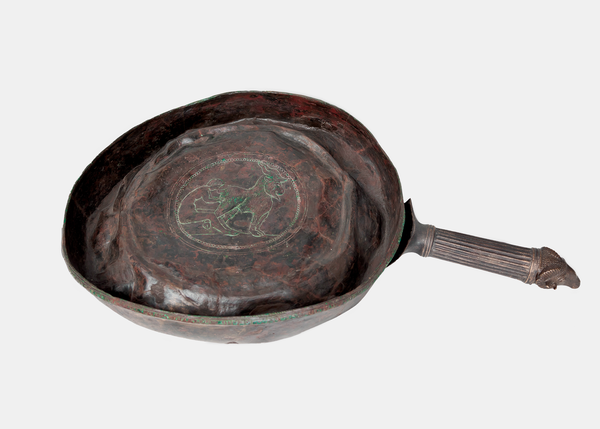
Bronze paterae are quite rare finds, but in Burial 1 of Kurgan 4 (Verbovsky II, Kalachyovsky District, Volgograd Region), a pre-deformed (the outer bottom dented inward) bronze patera was discovered lying at the feet of the deceased. Its bottom is decorated with a medallion, which due to the deformation, ended up on the outer side. It depicts a large goat with thick, grown fur. Its hind legs are slightly spread apart, while the front legs are placed straight. The eyes, hooked nose, ears, and beard are well defined by the craftsman. The head features large, horizontally growing horns. The fur is shown with wavy lines. Near the goat’s hind legs, on the ground, sits a naked girl with short hair, her head inclined. Her body is slightly curved, with the curve of the line emphasizing her abdomen and small breasts. Her right hand touches the legs of the animal, which are clasped by the girl’s legs. Also found in this burial was a bronze handle in the shape of a ram’s head from this patera. The craftsman accurately depicted the hooked nose of the domestic animal. The steep horns, highlighted with short notches, are pressed to the head and surround the ears. The fur is imitated by frequently repeated embossed circles. The animal’s eyes are bulging.


Patera
Creation period
1st century – first half of the 2nd century
Dimensions
height - 7.2 cm, diameter - 26.8 cm
Technique
bronze, casting
Collection
0
Open in app#1
Patera
#2
#3
Volgograd Regional Museum of Local Lore
read morehide
Patera
Creation period
1st century – first half of the 2nd century
Dimensions
height - 7.2 cm, diameter - 26.8 cm
Technique
bronze, casting
Collection
0
 Point your smartphone camera to open in the app
Open in app
Share