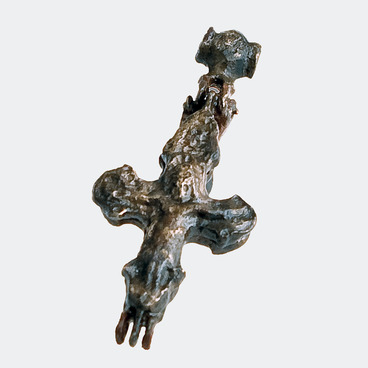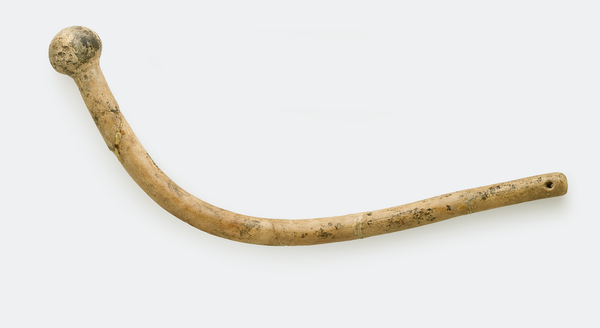
Already in the Bronze Age, burials of the dead, who had a high social status, began to spread. As a rule, these were the main burials, which were associated with the construction of large burial mounds. The inventory of these graves is quite diverse and, in addition to the usual vessels and bone rings it includes: large bronze tools, sets of excavated flint arrowheads, bronze awls and temple pendants in 1.5 turns, stone pestles and mortars. Unique items are less common. So, in the elite burial a bone wand (an attribute of the sacred authority of the leader-priest) was discovered in the elite burial near to khutor Pervomaysky in the Kalachevsky district.
Quite close analogies to the scepter from Pervomaisky, we can see on the seal of the Hittite period of the XVI century BC. It depicts two deities sitting near the “tree of life”, their hands raised in mutual greeting and holding curved short scepters with “knobs”.
It should be noted that the tradition of using wands as symbols of power has not only deep roots dating back to the stone age, but also wide territorial areas of its existence.
For example, the image of the god Sharrum and King Tudhaliya in the Hittite sanctuary of Yazylykai is very remarkable. We see a certain similarity in shape. The researchers also suggest that such insignia were originally used as a weapon, but later had only a symbolic character.