In the early 19th century, there were many porcelain decoration workshops in Paris. Most of them worked with white unpainted porcelain, which they purchased from famous French porcelain manufactories, including the renowned Sèvres manufactory. In this highly competitive market, workshops sought to constantly improve the quality of painting and gilding.
This cognac set was painted at the Brangeon workshop, as evidenced by the marks on the items. Not much is known about this workshop. It was located on rue Vivienne in Paris and existed for a fairly short period. There was a store at the workshop, which sold not only porcelain but also crystal and faience products, as well as vases and statues made of biscuit — unglazed white porcelain.
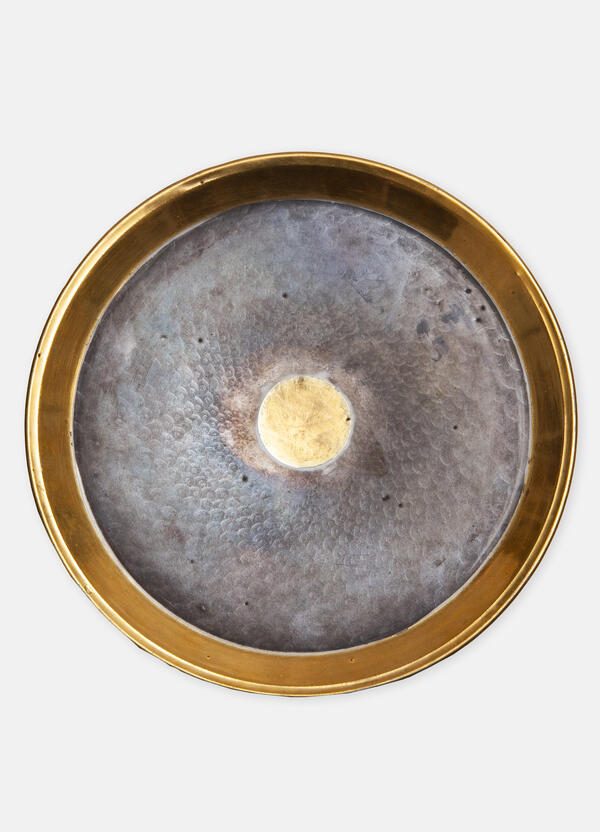
The set consists of a round tray on a leg, a decanter with a narrow neck, and four small octagonal glasses. The color palette is based on a combination of a muted gray-brown background and contrasting gilded elements. The decanter’s neck and base, as well as the inside of the glasses and the edge of the tray, are all decorated with gold.
This contrast of the primary background color and the gilding was popular in the Empire style that dominated the art scene in the early 19th century. The style was characterized by symmetry, order, and strictness, while gilding was intended to emphasize its magnificence and splendor.
The dominant dark color resembles a matte surface of stone or patinated bronze, which was fashionable during the Empire period. Painting porcelain to imitate another material is a technique that was used quite often in this style.
The fine scaly pattern, barely noticeable against the dark background, was also created in this manner. It was painted manually using silver across the entire surface. The pattern consists of rows of semicircles and scales. Each element has shading along the edge and a small circle in the center.
This cognac set was painted at the Brangeon workshop, as evidenced by the marks on the items. Not much is known about this workshop. It was located on rue Vivienne in Paris and existed for a fairly short period. There was a store at the workshop, which sold not only porcelain but also crystal and faience products, as well as vases and statues made of biscuit — unglazed white porcelain.
The set consists of a round tray on a leg, a decanter with a narrow neck, and four small octagonal glasses. The color palette is based on a combination of a muted gray-brown background and contrasting gilded elements. The decanter’s neck and base, as well as the inside of the glasses and the edge of the tray, are all decorated with gold.
This contrast of the primary background color and the gilding was popular in the Empire style that dominated the art scene in the early 19th century. The style was characterized by symmetry, order, and strictness, while gilding was intended to emphasize its magnificence and splendor.
The dominant dark color resembles a matte surface of stone or patinated bronze, which was fashionable during the Empire period. Painting porcelain to imitate another material is a technique that was used quite often in this style.
The fine scaly pattern, barely noticeable against the dark background, was also created in this manner. It was painted manually using silver across the entire surface. The pattern consists of rows of semicircles and scales. Each element has shading along the edge and a small circle in the center.